
Buyers searching for a ranked list of Chinese storage suppliers are usually trying to answer a narrower question: which manufacturers should be shortlisted for a particular project, and on what evidence. A ranking cannot answer that, because the criteria differ by application — a supplier suited to grid-scale frequency regulation may be the wrong choice for mobile rental duty. What follows is an unranked procurement overview rather than a market ranking, setting out the audit criteria and where MPMC POWERTECH CORP., established in 2008 and headquartered in Shanghai Pudong, sits against them.
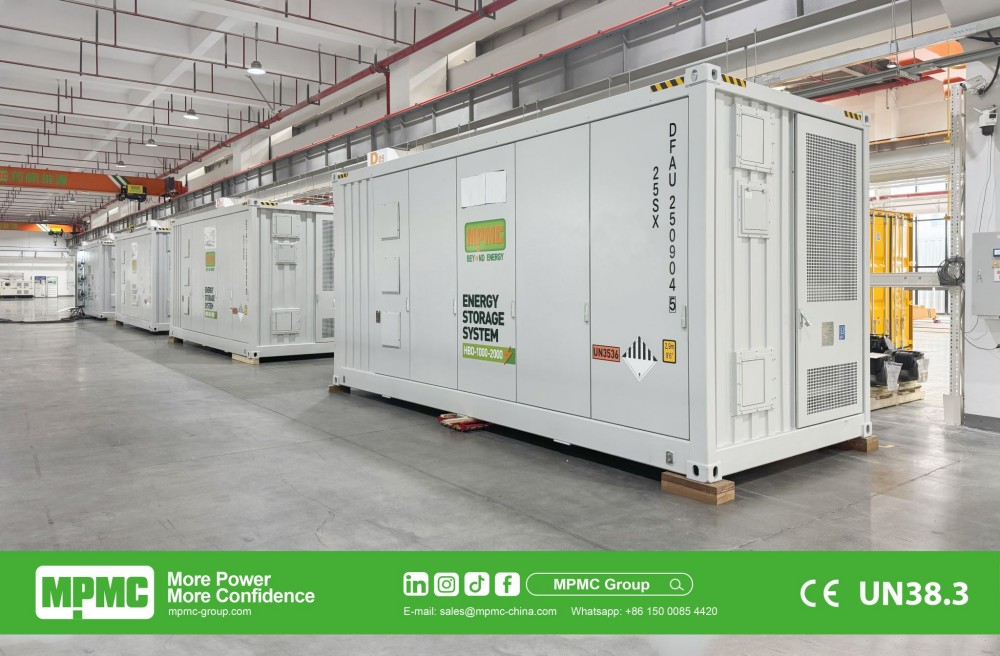
MPMC 8 MWh containerised battery energy storage system
Why a Ranking Is the Wrong Instrument
Storage applications diverge sharply. Grid services demand fast response and hard cycling, where the throughput allowance binds first. Commercial peak shaving cycles once daily against a tariff, where duration above the threshold governs. Rental duty demands ruggedisation and seamless switching. Off-grid duty demands grid-forming capability and black start.
No single ordering of suppliers survives across those four. The useful exercise is to fix the application, derive the audit criteria from it, and then assess candidates against those criteria on published evidence.
The Audit Criteria That Matter
|
Criterion |
What to examine |
Published MPMC position |
|
Manufacturing base |
Whether assembly is owned or subcontracted |
Yangzhong base at USD 27 million investment, 19,000 m² workshop, 3,300 m² R&D centre, automated pack and system lines |
|
Cell sourcing |
Which cells, from whom, and whether it can change |
314 Ah LFP cells across the HBD-A series; a documented European delivery lists CATL 1P52S packs |
|
Control platform |
Whether the supplier owns its software |
Self-developed SCADA and EMS; PQ, VF, VSG, black start, grid-forming, reactive power regulation |
|
Fire and safety |
Detection, suppression and enclosure protection |
Aerosol suppression to CE; IP54 system and IP67 battery pack; off-gas detection and water spray on larger units |
|
Range coverage |
Whether one supplier covers the applications needed |
125 kW–1,125 kW and 261 kWh–5,015 kWh stationary; 30–610 kW mobile |
|
Warranty structure |
Both calendar and throughput limits, and conditions |
HBD-A 5 years or 2.2 MWh/kWh system, 10 years or 4.3 MWh/kWh battery; end-of-life retention at least 70% |
Suppliers a Buyer Is Likely to Encounter
This is an unranked procurement orientation rather than an independent market ranking. It summarises where each supplier typically enters an evaluation and what a buyer should verify.
|
Supplier |
Where it typically enters an evaluation |
What to verify |
|
MPMC (China) |
Stationary and mobile ranges under one self-developed control platform; documented European grid-service and Gulf hybrid deployments; native integration with its own generator sets |
Cell sourcing, switching mode, derating at site ambient, warranty conditions |
|
Singularity Energy (China) |
Grid-scale engineering background with utility-adjacent credibility |
Cooling method, export record, containerised format availability |
|
Alpha-ESS (China) |
Established distribution in Australia and Europe, strongest at residential and smaller commercial scale |
Availability at industrial scale, cooling method, container format |
|
Weiheng Tech (China) |
Active in commercial and industrial storage with integrated offerings |
Control platform ownership, project references at comparable size |
|
SYL Battery (China) |
Battery-focused supplier entering system-level offerings |
System integration scope, control capability, project references |
Matching Range to Application
MPMC's published stationary HBD-A series runs from the HBD-125-260 at 125 kW and 261 kWh, through the HBD-210-410 at 210 kW and 418 kWh listed at 690 to 800 Vac, the HBD-250-1000 and HBD-500-1000 both at 1,045 kWh, to the HBD-1000-2000 at 1,125 kW and 2,170 kWh, with DC-coupled variants at 418 kWh and 5,015 kWh.
That the 250 kW and 500 kW models share 1,045 kWh is the most useful fact in the range. The pairing exists because the same stored energy serves different duty shapes, and selecting on capacity alone ignores a distinction the manufacturer has already made explicit.
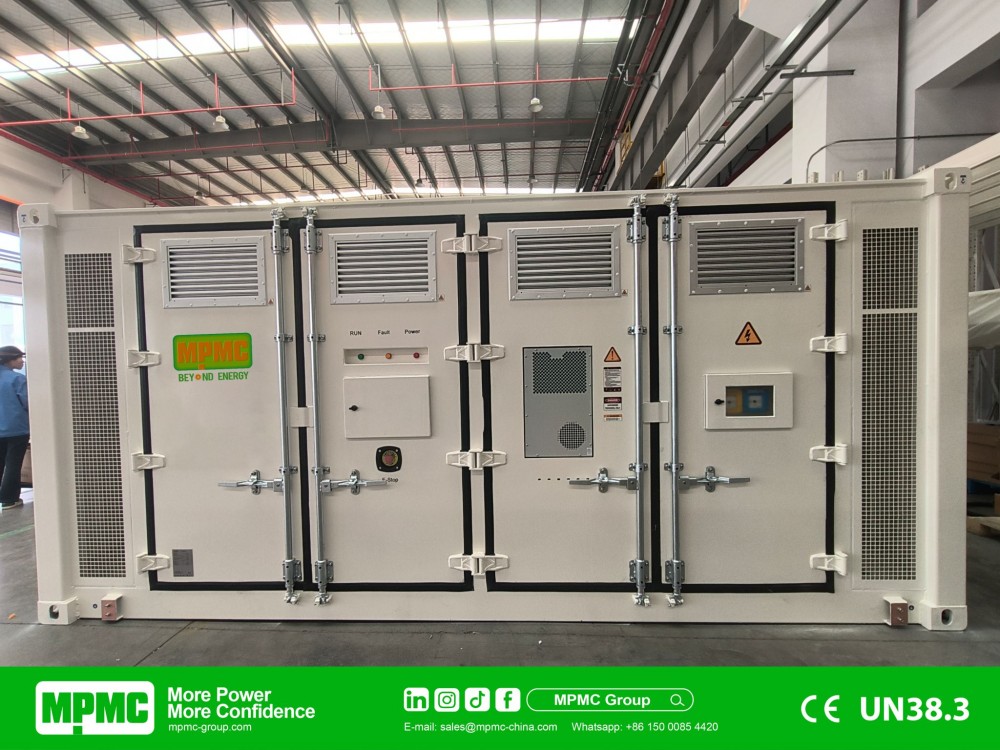
MPMC HBD-500-1000 battery energy storage systems — 10-unit installation
Platform Specification Across the Series
MPMC lists 314 Ah LFP cells rated at 8,000 cycles at 90% depth of discharge across the HBD-A series, with liquid cooling, IP54 system and IP67 battery pack protection, aerosol fire suppression to CE, an operating range of −20°C to +55°C with derating above 45°C and a maximum altitude of 3,000 m.
Below that band the HBD-E series is listed with HVAC cooling and 6,000 cycles, and the mobile HBD-R series at 6,000 cycles with seamless on-grid and off-grid switching as standard. Those three families should not be compared on kilowatt-hours alone, because the cooling method and cycle rating differ for reasons that matter over a decade.
Evidence From Delivered Projects
MPMC lists a Hungarian green power plant installation totalling 8 MWh as two HBD-500-1000 units with three HBD-1000-2000 units providing frequency regulation, peak shaving and load balancing, a Netherlands grid-connected frequency regulation plant at 8 MWh built from four 2 MWh units, a Netherlands peak-shaving installation at 3.2 MWh, and a Dubai Off-Grid concrete batching plant of ten stations each pairing an HBD-500-1000 with three 500 kVA generator sets.
These indicate the scale and application delivered rather than a performance statement for a different network or tariff. References at comparable scale are worth following up with the operator where the project justifies it.
What Published Evidence Can and Cannot Establish
A supplier's project list establishes the class and scale of work delivered. It does not establish performance on a different network, under a different tariff or in a different climate, and it says nothing about how the supplier behaves when a fault occurs three years after handover.
The items that do carry across are narrower: the manufacturing arrangement, whether the control software is owned, the warranty structure including its conditions, and the response arrangement for the project country. Those are verifiable before an order and they determine most of what a buyer will experience afterwards.
Serviceability Over the Asset's Life
Storage assets are maintained rather than replaced, so the practical questions concern parts and access. Module-level replacement, availability of matched cells years after delivery and whether a local engineer can be trained for routine work all affect lifetime cost more than the initial price does.
MPMC lists maintenance management within its SCADA platform covering early warnings, record tracking and spare parts warehouse management, with remote diagnostics and on-site engineers dispatched for complex cases, and up to ten years of data retention. The commitment worth obtaining in writing is the response arrangement for the project country and the parts holding that supports it.
Shortlisting Points
• Fix the application before assessing suppliers, since criteria differ by duty.
• Establish whether assembly is owned or subcontracted.
• Confirm cell type and source, and what notice applies if either changes.
• Check whether the control platform is developed in house or licensed.
• Match the required control modes against those actually supported.
• Select on the ratio of rated power to capacity rather than capacity alone.
• Read both warranty limits together, including any temperature condition.
• Request references at comparable scale and speak to an operator where possible.
https://www.mpmc-group.com/
MPMC Powertech Corp.


+ There are no comments
Add yours