


In today's hyper-connected industrial landscape, network downtime isn't just inconvenient—it's catastrophic. For enterprises managing distributed IoT deployments across manufacturing plants, transportation networks, and remote monitoring stations, a single connectivity failure can cascade into operational paralysis, revenue loss, and compromised safety protocols. This reality has driven demand for dual SIM 4G routers, a critical infrastructure component designed to eliminate single points of failure in industrial wireless communications.
The Industrial Connectivity Challenge
Industrial IoT projects face a sobering statistic: 68% experience failures due to network instability, hardware malfunctions in extreme environments, and prohibitive maintenance costs for geographically dispersed installations. Unlike consumer applications where brief disconnections represent minor annoyances, industrial scenarios—such as power grid monitoring, intelligent transportation systems, and financial payment terminals—require always-on connectivity with uptime rates exceeding 99.5%.
Traditional single-carrier solutions create vulnerability. When network congestion, signal degradation, or carrier outages occur, connected equipment becomes isolated. For applications like ATM networks processing financial transactions or traffic signal systems managing urban mobility, even minutes of downtime translate to measurable economic and safety impacts.
How Dual SIM Architecture Delivers Resilience
Dual SIM 4G routers employ redundant cellular connections to ensure continuous operation. These devices house two independent SIM cards from different carriers or network types, enabling automatic failover when the primary connection degrades or fails. The switching mechanism operates transparently within seconds, maintaining active sessions without requiring manual intervention or equipment resets.
This architecture addresses three critical failure modes:
Carrier-Specific Outages: When one mobile network experiences service disruptions—whether from infrastructure failures, capacity overload, or regional coverage gaps—the router seamlessly transitions to the backup SIM on an alternative carrier.
Signal Quality Degradation: In environments with variable RF conditions, such as mobile applications or sites with physical obstructions, the device continuously monitors signal strength and switches to whichever SIM provides superior connectivity.
Load Balancing: Advanced implementations distribute traffic across both connections based on real-time performance metrics, optimizing bandwidth utilization while maintaining failover readiness.
Industrial-Grade Hardware: Beyond Consumer Specifications
Not all dual SIM routers meet industrial requirements. Consumer-grade devices repurposed for commercial use typically fail when subjected to the thermal extremes, electrical interference, and mechanical stress inherent to industrial environments. Genuine industrial-grade hardware incorporates several critical design elements:
Wide Temperature Tolerance: Operating ranges from -35°C to +75°C, enabling deployment in outdoor installations, vehicle-mounted applications, and non-climate-controlled enclosures. This capability proves essential for sectors like transportation (Nordic bus fleets in sub-zero winters) and energy (Middle Eastern solar farms with ambient temperatures exceeding 48°C).
Enhanced Electrostatic Protection: Industrial sites generate significant electromagnetic interference from heavy machinery, high-voltage equipment, and radio frequency systems. Routers with 15KV ESD protection and 1.5KV electromagnetic isolation prevent hardware damage and communication disruptions that plague standard devices.
Robust Mechanical Design: DIN-rail mounting, metal enclosures, and industrial-grade connectors withstand vibration, dust, and moisture exposure common in factory floors, vehicle installations, and outdoor deployments.
Real-World Validation: Case Studies in Mission-Critical Deployments
The theoretical advantages of dual SIM technology translate into measurable operational improvements across diverse industrial sectors:
Telecom Infrastructure Monitoring: A leading Indian telecom operator serving over 230 million subscribers deployed 100,000 dual SIM 4G routers for remote base station monitoring. Operating in areas with unstable power grids (5V-55V fluctuations) and extreme heat (48°C ambient temperatures), the solution achieved a 99.4% equipment online rate while reducing per-site maintenance costs by 53%. Centralized batch management capabilities improved operational efficiency by 82%.
Airport Ground Support Equipment: A European aviation GSE manufacturer serving airports in 100+ countries required real-time connectivity for aircraft ground power and air conditioning units operating on electromagnetic-interference-heavy airport aprons. The dual SIM implementation achieved equipment online rates exceeding 99.9%, reduced on-site maintenance costs by 68%, and enabled 85% remote fault resolution through secure 4G/VPN connectivity.
Public Transit Systems: Smart transportation providers in Sweden, Norway, and Denmark faced unique challenges with in-vehicle networking and electronic passenger information displays operating in sub-zero winters (down to -32°C). Dual SIM routers reduced network interruption rates to 0.3%, decreased information screen blackout duration by 96%, and enabled 90% remote fault handling—saving 62% in annual maintenance costs.
Gaming Terminal Networks: A South American gaming equipment manufacturer managing 25,000 terminals across eight countries required secure transaction data transmission in high-interference casino environments. The dual SIM solution delivered 99.9% data transmission success rates with zero accounting disputes, while streamlining maintenance personnel from 25 to 7—generating approximately $1.18 million in annual savings.
Key Technical Capabilities for Industrial Applications
When evaluating dual SIM 4G router solutions, enterprises should prioritize several technical capabilities proven critical in industrial deployments:
Link Self-Healing Mechanisms: Hardware watchdog timers and automated reconnection protocols ensure the router recovers from software hangs or temporary network anomalies without requiring physical intervention.
Enterprise VPN Support: Advanced protocol compatibility (WireGuard, IPsec, OpenVPN) enables secure, encrypted tunnels protecting sensitive industrial data from interception—essential for financial transactions, operational telemetry, and proprietary control systems.
Industrial Interface Compatibility: Beyond standard Ethernet connectivity, industrial routers must support RS232/RS485 serial protocols and digital I/O for integration with legacy PLCs, SCADA systems, and industrial sensors.
Remote Management Capabilities: Support for TR-069, SNMP, and cloud-based network management platforms enables centralized configuration, firmware updates, and troubleshooting across geographically distributed installations—reducing on-site maintenance requirements by up to 40%.
The E-Lins Technology Approach
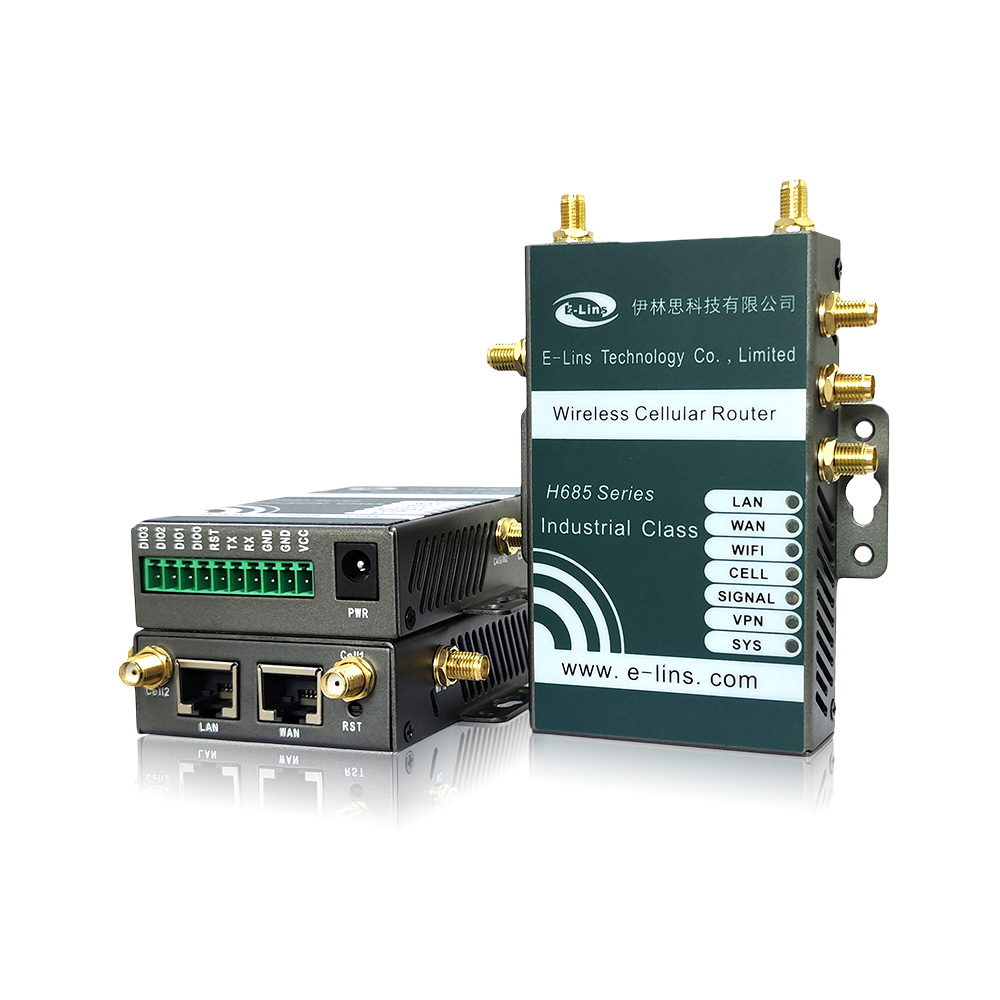
E-Lins Technology, with 20 years of expertise in industrial wireless communications since 1999, has established itself as a specialized provider of dual SIM 4G router solutions validated across 150+ countries. The company's H900 Gigabit Industrial 4G Router exemplifies this technical approach, incorporating triple-link redundancy (cellular, wired, WiFi) beyond basic dual SIM functionality.
The platform achieves differentiated value through several design choices: five Gigabit Ethernet ports enable high-speed expansion for multi-device environments; vehicle-grade protection meeting ISO 7637-2 standards with ignition sensing supports mobile applications; and 100% self-developed firmware optimized for stability addresses the disconnection and vulnerability issues common in generic Linux-based alternatives.
Manufacturing credibility derives from the company's history as an ODM/OEM partner for global brands including Huawei, ZTE, Samsung, and LG. This tiered manufacturing experience, combined with focused product lines and scaled supply chain management, enables professional-quality hardware at price points typically 20-40% below comparable industrial manufacturers—addressing the cost-to-performance imperative for large-scale IoT deployments.
Implementation Considerations for Enterprise Deployments
Successful dual SIM router deployments require strategic planning beyond hardware selection:
Carrier Selection Strategy: Optimal redundancy pairs carriers with complementary coverage footprints and independent infrastructure. Geographic analysis identifies which carrier combinations provide true failover capability rather than shared backhaul dependencies.
SIM Management Protocols: Data plan structures vary significantly between carriers. Enterprises must evaluate whether dual active (both SIMs continuously connected) or active-standby configurations align with their usage patterns and cost structures.
Testing and Validation: Pre-deployment testing under simulated failure conditions validates failover timing, session persistence, and application compatibility. This proves particularly critical for stateful applications requiring connection continuity.
Lifecycle Management: Firmware update strategies, remote configuration capabilities, and batch management tools determine operational scalability as deployments grow from pilot projects to enterprise-wide infrastructure.
Future-Proofing Industrial Connectivity
As industrial IoT evolves toward 5G and edge computing architectures, dual SIM redundancy principles remain relevant. The underlying requirement—eliminating connectivity as a single point of failure—transcends specific radio access technologies. Forward-looking implementations consider:
5G Migration Paths: Dual SIM routers supporting both 4G LTE and 5G NR enable incremental migration as 5G coverage expands, protecting infrastructure investments while accessing enhanced capabilities where available.
Edge Computing Integration: Next-generation platforms combine connectivity redundancy with onboard processing, enabling localized analytics and control that continue functioning during temporary cloud disconnections.
AI-Driven Network Optimization: Machine learning algorithms that predict network degradation and proactively switch connections before failures occur represent the next evolution in automated resilience.
Conclusion
For industrial organizations where connectivity failures translate directly into operational and financial consequences, dual SIM 4G routers represent fundamental infrastructure rather than optional redundancy. The technology's maturity, proven through millions of deployments across telecom, transportation, energy, and financial sectors, demonstrates measurable improvements in uptime, maintenance efficiency, and total cost of ownership.
Success requires moving beyond superficial specifications to evaluate genuine industrial-grade design, validated performance in relevant environmental conditions, and vendor capabilities spanning technical support, customization, and lifecycle management. Organizations that treat connectivity infrastructure with the same rigor applied to other mission-critical systems position themselves to fully capture industrial IoT value while mitigating the network instability risks that derail 68% of projects.
In an era where digital transformation initiatives depend absolutely on reliable wireless connectivity, dual SIM architecture transforms networking from a vulnerability into a competitive advantage—enabling the always-on industrial operations that modern markets demand.
https://e-lins.com/
Shenzhen E-Lins Technology Co., Ltd.


+ There are no comments
Add yours