In clear aligner manufacturing, throughput is often discussed as a simple output number: how many pieces can be produced per hour, per shift, or per day. But in real factory operations, throughput is not created by one fast machine alone. It is created by how well multiple process steps stay connected, how little time is lost between stations, and how consistently the line can run without repeated manual intervention.
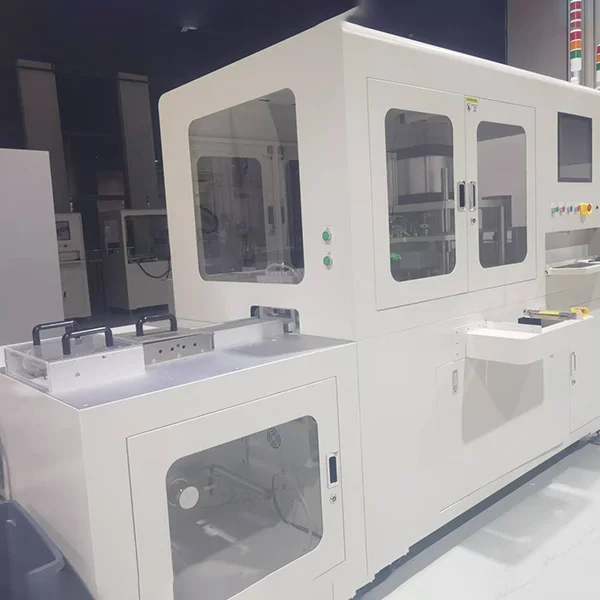
That is why an Automatic Invisible Aligner Production Line is becoming increasingly important for larger clear aligner manufacturers. On ConverSight’s product page, this production line is presented as an integrated system combining pressure thermoforming, laser marking, and robot flexible trimming, with an optional teeth feeder for a fully automatic workflow. The page also states that one load of roll film material can support about one hour of continuous running, with production capacity reaching 240 pieces per hour and daily capacity up to 5000 pieces.
Throughput problems usually come from process gaps, not just machine speed
Many factories discover that their biggest production bottleneck is not a single step such as thermoforming or trimming. Instead, the problem comes from the space between steps.
Film needs to be prepared and loaded. Models need to be fed and positioned. The aligner has to move from forming to marking, then from marking to trimming, and finally into collection or inspection. If each station works reasonably well on its own but the handoff between them is unstable, actual line throughput drops quickly.
This is why integrated production architecture matters. According to the ConverSight page, the system is designed around three core modules as a whole: pressure thermoforming, laser marking, and robot flexible trimming. The modular setup is composed of one thermoforming machine, one laser marking machine, and two automatic trimmers, and each machine can either run separately or connect with the other modules without modification. That design is important because it allows manufacturers to reduce transfer losses while keeping the system flexible enough for phased deployment or line expansion.
Integrated modules improve line balance
In a semi-automatic environment, line balance is difficult to maintain because each process depends heavily on manual timing. An operator may load film slightly later than expected. Another may delay model replacement. Downstream trimming may pause while waiting for upstream output. These delays look small in isolation, but over a full shift they reduce effective capacity.
An automatic production line improves throughput by creating a more synchronized manufacturing rhythm. In the ConverSight system, the modules are already structured to work as a coordinated flow rather than a collection of independent devices. That matters because throughput in aligner production depends on stable pacing across the full chain, not on one machine reaching a high theoretical cycle speed by itself.
This is also reflected in the individual station capacities listed on the page. The thermoforming machine is rated at 15 seconds per piece, the laser marking machine at 2 seconds per piece, and the auto trimming machine at 15 seconds. By distributing the workflow across dedicated modules and using two automatic trimmers, the line is designed to support higher system-level output instead of letting one finishing step slow the entire chain.
Continuous film feeding reduces hidden downtime
One of the less visible causes of low throughput in aligner production is repeated material interruption. If film loading requires frequent manual replacement or setup, the line cannot maintain a stable beat for long periods.
ConverSight highlights roll film feeding as a core advantage of the system. The page states that feeding with roll film material allows the production line to run continuously with a single load of material, and that automatic film cutting is also available. It also explicitly links roll film feeding to lower material cost and higher work efficiency.
From a factory operations standpoint, this matters because stable material feeding does two things at once. First, it reduces operator intervention at the front of the process. Second, it helps maintain uninterrupted machine rhythm across a longer production window. When the page says one single load of film roll material supports about one hour of continuous machine running, that is directly relevant to throughput, because sustained runtime is often more valuable than short bursts of high-speed output.
Pressure thermoforming supports more stable downstream flow
Thermoforming quality is not just a product quality issue. It is also a throughput issue.
If forming is inconsistent, the next steps inherit that instability. Marking may require adjustment. Trimming may need more correction. Finished parts may face higher rework or inspection rejection. In that case, the line may continue moving, but its effective throughput drops because a larger portion of output needs extra handling.
The ConverSight page describes the thermoforming module as using a pressure thermoforming system design, with an automatic dehumidifying mechanism in the material box to eliminate the possibility of bubbles. It also states that high-precision temperature control ensures the material is evenly heated and helps maintain consistent aligner thickness.
For buyers, this is important because stable thermoforming improves throughput in two ways. It supports a more consistent flow into downstream stations, and it lowers the likelihood that finished parts will require correction later. In other words, better forming quality helps convert nominal machine speed into usable output.
Laser marking reduces manual handling and process interruption
Marking may not seem like a major throughput driver at first glance, but in automated production it plays a larger role. Any process that requires manual positioning, repeated adjustment, or re-identification introduces micro-stoppages that add up across the shift.
ConverSight states that the marking position is computed and generated through an AI-powered deep learning algorithm, and that the repetition accuracy reaches 0.01 mm. The page also notes that clear marking is possible on multiple aligner materials.
The throughput value here is straightforward. If marking location is automatically generated and repeated with high precision, operators spend less time making corrections or handling exceptions. That keeps the line moving and reduces unnecessary pauses between forming and trimming. In a high-output environment, this kind of automation contributes more to line efficiency than many manufacturers initially expect.
Robotic flexible trimming removes one of the most common finishing bottlenecks
Trimming is one of the last major process steps, and it is often where factories lose time through polishing, rework, or repeated manual teaching. Even if upstream production is fast, a weak trimming stage can limit the overall line.
ConverSight addresses this directly. The product page says the upgraded laser trimming technology produces finished edges with no burrs and almost no need for manual polishing, with high pass rate and extremely low rework. It also states that HyperBrain Orthodontics can extract gingival lines in batch from STL data and generate the cutting trajectory before the robot performs flexible aligner trimming, removing the need for tedious manual teaching.
This is one of the clearest ways the line improves throughput. When the trimming process is more data-driven, more repeatable, and less dependent on manual finishing, the line can sustain higher output without creating a downstream correction bottleneck. Throughput improves not only because the cutting step is automated, but because the post-trim workload is reduced as well.
Labor reduction improves throughput when it protects process control
Factories often talk about reducing labor costs, but the more useful question is whether labor reduction improves or weakens production stability. In a good automation system, fewer operators should not mean less control. It should mean that operators are removed from repetitive, rhythm-sensitive work and redirected toward monitoring and exception handling.
ConverSight states that only one operator is needed for loading teeth models and replacing the film roll in the material box, reducing labor dependence by 80% compared with manual work.
That matters to throughput because fewer manual touchpoints usually mean fewer timing disruptions. Instead of depending on several people to keep the line moving, the production system itself carries more of the pace. For large-scale aligner manufacturers, that shift can make output more predictable across long runs and across multiple shifts.
Daily output is the result of sustained process stability
The headline numbers on the page, 240 pieces per hour and 5000 pieces per day, are important. But for serious buyers, those numbers only matter if the system can maintain stable quality and low interruption while running at scale. ConverSight’s page ties those capacity claims to several specific process mechanisms: continuous roll film feeding, automated film cutting, pressure thermoforming, AI-positioned laser marking, and batch-driven robotic trimming.
That combination is what makes the throughput argument credible. A production line improves output not simply by moving faster, but by reducing the common causes of lost time: material interruptions, manual handoffs, unstable positioning, post-trim polishing, and repeated setup work.
Final thoughts
An automatic aligner line improves throughput when it turns isolated automation into coordinated manufacturing. That is the main takeaway from the Automatic Invisible Aligner Production Line. ConverSight’s system is built around integrated pressure thermoforming, laser marking, and robot flexible trimming, with optional automatic teeth feeding, continuous roll film operation for about one hour per load, capacity up to 240 pieces per hour, and daily output up to 5000 pieces.
For large-scale manufacturers, the real value is not just higher speed on paper. It is the ability to run a more stable, less labor-dependent, and more repeatable production flow every day. That is what turns machine capacity into actual factory throughput.
www.conversighttech.com
ConverSight Technology Limited


+ There are no comments
Add yours