Heavy industrial equipment operates under some of the most challenging conditions in modern manufacturing. In sectors such as metallurgy, petrochemical processing, waste incineration, and heat treatment, machinery components are continuously exposed to abrasion, corrosion, thermal stress, and elevated temperatures. Conventional materials can deteriorate quickly under these conditions, resulting in frequent maintenance, unplanned downtime, and higher operating costs.
To address these challenges, High Cr castings are widely used for components that require a combination of high wear resistance, corrosion resistance, and thermal stability. By carefully controlling alloy composition, microstructure, casting methods, and heat treatment, manufacturers can produce components capable of maintaining reliable performance in demanding environments.
This article examines the material characteristics of High Cr castings, the reasons behind their excellent wear resistance, their major industrial applications, and the manufacturing expertise that helps companies such as Wuxi Dongmingguan Special Metal Manufacturing Co., Ltd. improve casting performance.
What Are High Cr Castings?
High Cr castings are alloy castings containing a relatively high proportion of chromium, commonly within the range of approximately 12% to 30%. The addition of chromium significantly improves the material's resistance to abrasion, oxidation, and corrosion while also contributing to its performance at elevated temperatures.
One of the most important advantages of High Cr alloys comes from their internal microstructure. During solidification and subsequent heat treatment, hard chromium-rich carbides, particularly M7C3 carbides, are formed within a metallic matrix. The resulting combination of hard carbide phases and a supportive matrix provides a useful balance between surface hardness and overall mechanical strength.
Typical characteristics include:
-
High hardness, often exceeding HRC 55
-
Strong resistance to abrasive wear
-
Improved oxidation resistance
-
Good resistance to corrosive environments
-
Reliable performance at elevated temperatures
Because of these properties, High Cr castings are especially suitable for components exposed to simultaneous mechanical wear, heat, and chemical attack.
Why High Cr Alloys Offer Excellent Wear Resistance
Wear resistance cannot be determined by hardness alone. Industrial components may experience sliding friction, impact, abrasive particles, thermal cycling, and corrosive atmospheres at the same time. The material must therefore have a microstructure capable of handling several types of stress.
1. Hard Carbide Phases
The chromium-rich carbides distributed throughout the alloy form a highly wear-resistant phase. When abrasive particles come into contact with the component surface, these hard carbides help resist cutting, scratching, and material removal.
This makes High Cr castings particularly effective in applications where raw materials or solid particles continuously contact the working surface.
2. Strong Metallic Matrix
Carbides provide hardness, but excessive hardness without sufficient toughness can increase the risk of cracking or impact damage. The metallic matrix surrounding the carbides helps support the hard phases and absorb mechanical loads.
Depending on the alloy composition and heat-treatment process, the matrix may be primarily martensitic, austenitic, or another controlled structure. Properly balancing the matrix and carbide phases is essential for achieving both wear resistance and service reliability.
3. Chromium-Based Oxidation Protection
Chromium also contributes to oxidation and corrosion resistance. Under suitable conditions, chromium can promote the formation of a protective oxide layer that slows further surface oxidation.
This characteristic is particularly useful in furnaces and other high-temperature equipment where ordinary carbon or low-alloy steels may suffer from rapid scaling and degradation.
Major Industrial Applications
The combination of wear resistance, corrosion resistance, and thermal stability allows High Cr castings to serve in many demanding industrial sectors.
Heat Treatment Equipment
Heat treatment equipment requires components that can withstand repeated heating and cooling cycles without excessive deformation, oxidation, or loss of mechanical strength.
Common applications include:
-
Radiant tubes
-
Furnace rollers
-
Heat treatment fixtures
-
Furnace support components
These parts often operate continuously at elevated temperatures and may also carry substantial mechanical loads.
Waste Incineration
Waste incineration systems expose components to a particularly aggressive combination of abrasion, corrosion, and heat. Grate bars and other furnace components must resist both mechanical wear and chemically aggressive combustion environments.
High Cr alloys can help extend component life and reduce the frequency of replacement.
Metallurgical Machinery
Metallurgical processing involves high temperatures, heavy loads, and continuous contact with raw materials. Rollers, liners, tubes, and other components may experience severe abrasion during steel and non-ferrous metal processing.
High Cr castings provide a practical material option for areas where conventional cast alloys may wear too quickly.
Petrochemical Equipment
Petrochemical equipment can experience high temperatures, thermal cycling, corrosion, and mechanical stress. Depending on the specific operating environment and alloy selection, High Cr cast components can be used for pipes, tubes, reactor-related components, and other applications requiring enhanced resistance to corrosion and heat.
For additional information about specifications and typical applications, see High Cr Castings.
Casting Methods Affect Final Performance
The chemical composition of an alloy is only one part of the equation. Casting technology has a major influence on density, carbide distribution, dimensional accuracy, and internal quality.
Centrifugal Casting
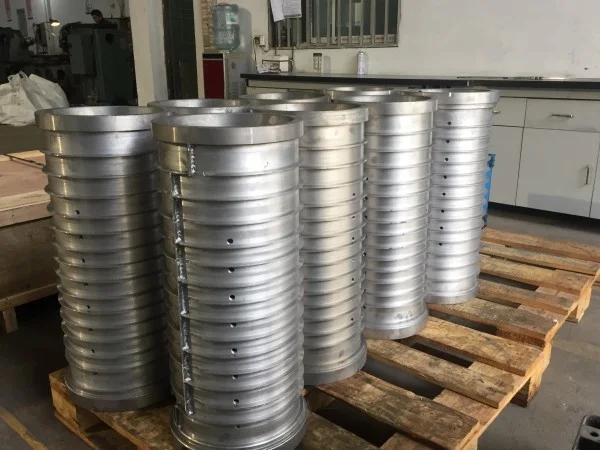
Centrifugal casting is particularly suitable for tubular and cylindrical products such as heat-resistant pipes, furnace tubes, and rollers.
The rotating mold generates centrifugal force during solidification, helping produce a dense casting with reduced internal porosity and a relatively uniform structure.
Wuxi Dongmingguan specializes in high-alloy centrifugal cast pipes with diameters from approximately 50 mm to 1000 mm and lengths of up to 4000 mm. This production capability allows the company to manufacture components for different industrial equipment requirements.
Investment Casting
Investment casting, also known as lost-wax casting, is useful when components have complex geometries or require tighter dimensional control.
Its advantages include:
-
Ability to produce intricate shapes
-
Good dimensional accuracy
-
Reduced need for extensive machining
-
Suitable surface quality for complex components
This method can be particularly valuable for specialized heat-treatment fixtures and other components with complicated configurations.
Resin Sand Casting
Resin sand casting provides greater flexibility for larger and more complicated castings. It can accommodate different component sizes and geometries while maintaining the structural requirements needed for heavy industrial applications.
Selecting the appropriate casting method according to component geometry, operating conditions, and material requirements is essential to achieving consistent performance.
Heat Treatment Is Essential
Even a well-designed High Cr alloy may not deliver its full potential without appropriate heat treatment. Thermal processing changes the microstructure and helps establish the required relationship between hardness, toughness, and wear resistance.
Key objectives include:
-
Controlling carbide and matrix structures
-
Increasing hardness
-
Improving mechanical strength
-
Balancing wear resistance and toughness
-
Reducing undesirable internal stresses
Processes such as quenching and tempering must be carefully controlled according to the alloy grade, component geometry, and intended application.
Wuxi Dongmingguan operates dedicated heat-treatment furnaces to provide controlled thermal processing for its cast products. Consistent heat treatment is particularly important for components that must maintain stable performance over repeated operating cycles.
Quality Control Determines Reliability
Industrial casting performance depends not only on the selected alloy but also on the consistency of production. Small internal defects, dimensional deviations, or variations in chemical composition can become serious problems when a component operates under high temperature and heavy mechanical loading.
A comprehensive inspection system can include:
-
Direct-reading spectrometers
-
Metallographic analysis equipment
-
3D scanning systems
-
Tensile and impact testing machines
-
Brinell hardness testers
-
Ultrasonic testing equipment
-
Magnetic particle inspection systems
These methods allow manufacturers to evaluate chemical composition, microstructure, mechanical properties, surface condition, and internal quality before components are delivered.
Digital Technology in Modern Casting Production
Modern foundries increasingly use digital engineering tools to reduce production risks and improve casting consistency.
Tools such as CAD and UG can be used during product design and modeling. Casting simulation software such as ANYCASTING can help engineers evaluate filling and solidification behavior, while ABAQUS can be applied to stress and structural analysis. GEOMAGIC can assist with three-dimensional dimensional inspection and comparison.
Using these technologies before mass production makes it possible to identify potential defects, optimize casting structures, and reduce unnecessary trial-and-error during manufacturing.
Practical Benefits in Industrial Operation
The use of High Cr castings can provide several operational advantages when the alloy and manufacturing process are properly matched to the working environment.
Longer Component Life
The hard carbide structure and corrosion-resistant characteristics can help components withstand prolonged exposure to abrasive and high-temperature conditions. Longer service intervals can reduce the frequency of component replacement.
Lower Maintenance Requirements
When critical parts experience slower wear, maintenance teams may spend less time on replacement and repair. This can also help reduce production interruptions.
More Stable Equipment Operation
Components with stable dimensions and mechanical properties can contribute to smoother equipment operation, particularly in continuous production systems where unexpected component failure can affect the entire process.
Replacement of Imported Components
Material development and manufacturing capabilities can also provide domestic alternatives to imported industrial components. Wuxi Dongmingguan has developed high-performance heat-treatment fixtures that have been used as replacements for imported products, helping customers obtain reliable alternatives for demanding applications.
Application Example: Heat Treatment Fixtures
Heat treatment fixtures are a representative application where material selection and manufacturing quality are especially important.
During operation, fixtures may be exposed to:
-
Continuous high temperatures
-
Oxidizing atmospheres
-
Repeated thermal cycling
-
Mechanical loading
-
Contact with heated workpieces
If the fixture deforms, cracks, or oxidizes excessively, production efficiency can be affected and maintenance requirements can increase.
By combining suitable High Cr alloy compositions with controlled casting, machining, and heat treatment processes, Wuxi Dongmingguan manufactures heat-treatment fixtures, radiant tubes, and furnace rollers designed for prolonged industrial service.
Production Capacity and Global Supply
Wuxi Dongmingguan has an annual casting capacity of approximately 5,000 tons and provides high-alloy cast products for multiple industrial sectors.
Its products are supplied to customers in markets including:
-
Europe
-
South America
-
Japan
The company's location also provides logistical advantages. Its proximity to major transportation infrastructure, including high-speed railways, expressways, and Sunan Shuofang International Airport, supports efficient transportation for domestic and international orders.
How to Select a High Cr Casting Manufacturer
Choosing the right supplier involves more than comparing alloy grades. Buyers should evaluate the manufacturer's complete technical and production capabilities.
Manufacturing Capability
Review the supplier's available casting methods, production range, equipment, and ability to manufacture components according to specific dimensions.
Heat Treatment Capability
A supplier should have appropriate heat-treatment equipment and process controls to ensure consistent mechanical properties and microstructure.
Quality Assurance
Check whether the manufacturer has suitable chemical analysis, mechanical testing, nondestructive testing, dimensional inspection, and traceability systems.
Custom Manufacturing
Industrial equipment often requires non-standard components. A capable manufacturer should be able to work with customer drawings, operating conditions, and technical requirements to develop customized castings.
Relevant Industry Experience
Experience in heat treatment, metallurgy, petrochemical processing, waste incineration, and other demanding industries can help a supplier better understand real operating conditions and material-selection requirements.
Wuxi Dongmingguan Special Metal Manufacturing Co., Ltd. focuses on high-alloy centrifugal castings, heat-resistant products, and corrosion-resistant components, providing customized casting solutions for demanding industrial applications.
Conclusion
High Cr castings provide an effective material solution for industrial components exposed to severe abrasion, corrosion, oxidation, and elevated temperatures. Their performance comes from the combination of chromium-rich hard carbides, a carefully controlled metallic matrix, and suitable heat-treatment processes.
However, material composition alone does not determine service life. Casting technology, heat treatment, inspection, digital engineering, and manufacturing consistency all have a direct influence on final component performance.
For industries such as heat treatment, metallurgy, waste incineration, and petrochemical processing, selecting the appropriate High Cr casting and working with an experienced manufacturer can help extend component life, reduce maintenance requirements, and improve equipment reliability. With advanced production methods and comprehensive quality control, manufacturers such as Wuxi Dongmingguan are continuing to develop more durable casting solutions for increasingly demanding industrial environments.
www.alloy-castings.com
Wuxi Dongmingguan Special Metal Manufacturing Co., Ltd.



+ There are no comments
Add yours