
Why Technical Documentation Matters in International B2B Battery Sourcing
For equipment manufacturers, product brands, and system integrators operating across global markets, sourcing a battery pack is rarely as simple as selecting a part number from a catalog. Many B2B buyers discover that generic battery packs cannot satisfy their project's specific requirements for voltage, capacity, load current, BMS functions, cell chemistry, physical dimensions, connectors, and environmental safety certifications. When these requirements are not properly documented and reviewed before production, projects risk delays, incompatibility, and certification failures. This is why a well-structured battery technical file has become a foundational requirement for any international custom battery project.
A battery technical file is not a marketing brochure—it is the engineering record that defines what the battery must do, how it will be built, and how it will be validated before mass production begins. Preparing this file correctly is one of the most important steps a B2B buyer and supplier can take together to reduce selection errors, thermal issues, and certification delays.
Core Components of a Battery Technical File
A complete technical file for a custom battery project typically needs to address several interconnected layers of information, rather than treating electrical parameters in isolation.
Requirement Definition
The first component is a clear statement of the device's real-world operating conditions: actual load profile, charging source, runtime targets, and the environment in which the battery will operate. Scenario-based conversion of these device inputs into reviewable specifications allows both the buyer and the engineering team to confirm expectations before any design work begins.
Electrical Architecture and Chemistry Selection
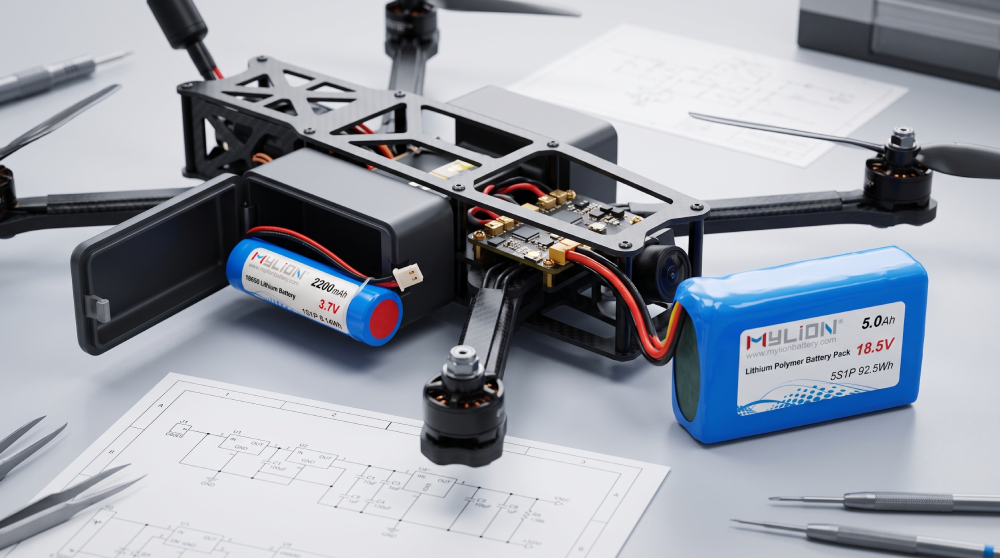
The file should specify the chosen cell chemistry—such as LiFePO4, 18650/21700 cylindrical cells, or LiPo formats—along with the series/parallel configuration determined from energy and runtime targets. Chemistry and cell format should be selected based on the specific project conditions and device geometry, not assumed from standard voltage conventions.
BMS Matching and Protection Functions
Battery Management System (BMS) requirements, including balancing, monitoring, and protection functions, along with continuous and peak current limits, must be documented and matched to the real device loads. Without this step, generic chemistry replacements can cause charger or BMS incompatibility due to a lack of system review.
Mechanical and Interface Specifications
Connector types, cable routing, enclosure design, mounting methods, and insulation requirements all belong in the technical file. For compact devices with strict shape, peak-current, or cable-routing constraints, this mechanical integration must be reviewed as part of a unified assembly task rather than an afterthought.
Safety and Transport Documentation
International shipments require supporting documentation such as UN38.3 transport documentation and MSDS/SDS (Safety Data Sheets). These documents confirm that the battery pack meets recognized transport safety requirements and provide the necessary compliance information for customs and logistics processes across international borders.
The Engineering Process Behind Technical File Preparation
Preparing a technical file is not a one-time paperwork exercise; it is tied directly to a structured engineering process. This process generally follows defined stages: requirement confirmation, feasibility review, solution definition, prototype development, testing support, specification approval, and mass-production coordination.
Specification freeze and change-control management are essential once a design is approved. Version-controlled Bills of Materials (BOMs) help ensure that any later modification is reviewed and documented, preventing uncontrolled drift between what was approved and what is eventually produced. This approach also supports repeat-order supply coordination, which matters for B2B buyers who need consistent battery specifications across multiple production runs over time.
Documentation Required for International Transport and Safety Compliance
For any battery pack crossing international borders, compliance documentation is a mandatory part of the technical file. UN38.3 transport documentation support confirms that lithium battery shipments meet established transport testing requirements, while MSDS/SDS documentation communicates safety data relevant to handling, storage, and emergency response. Buyers preparing for international B2B projects should request these documents early in the engineering process, rather than treating them as a final-step formality, since missing or incomplete documentation is a common source of shipment and customs delays.
How Mylion Supports Technical File Preparation for Global Partners
Shanghai Mylion New Energy Co., Ltd., operating under the brand MYLION, is positioned as an engineering-driven B2B lithium battery solution provider with over 13 years of experience in the lithium battery industry. Rather than functioning as a low-price retail supplier, MYLION operates as an engineering-oriented battery-pack supplier and OEM/ODM project partner, serving global B2B equipment manufacturers, product brands, and system integrators from its base in Shanghai, China.
MYLION's approach treats the battery as an integral part of the customer's entire system—considering the real load, charging source, BMS functions, mechanical interfaces, and production constraints together, rather than evaluating electrical parameters in isolation. This is reflected across its three core offerings: Custom Lithium Battery Pack Development, Custom LiFePO4 Battery Pack Solutions, and 18650/21700/LiPo Custom Battery Packs.
For each of these product lines, the technical file preparation process includes requirement engineering, system matching across battery, BMS, charger, and mechanical structure, and risk control through early identification of technical blockers before mass production. Service models include OEM, ODM, Sample Development, Private Label, and Project-based Custom Supply, supported by change-control management, version-controlled BOMs, and repeat-order supply coordination.
MYLION's experience spans multiple industries that frequently require custom technical files, including smart devices and robotics, agricultural equipment, selected medical devices, smart lighting and portable electronics, and industrial equipment. In these settings, the company has addressed challenges such as integrating batteries into limited spaces for sensors and motors, balancing runtime and weight for outdoor agricultural use, supporting strict documentation and electrical matching for compliance-reviewed devices, and providing stable output with robust connectors to prevent BMS trips and voltage drops in industrial instruments.
Practical Steps for B2B Buyers Preparing Technical Files
B2B buyers approaching an international battery project can follow a structured sequence that mirrors the engineering process described above:
- Define the actual device load, charging source, and environmental operating conditions before specifying voltage or capacity.
- Confirm BMS functions needed, including balancing, monitoring, and protection, based on real current demands rather than assumptions.
- Select cell chemistry and format—LiFePO4, 18650, 21700, or LiPo—according to device geometry and project conditions.
- Specify mechanical and connector requirements as part of the same system, not as a separate consideration.
- Request UN38.3 and MSDS/SDS documentation early to avoid international shipment delays.
- Establish specification freeze and change-control procedures before mass production begins.
Pricing for this type of project is typically determined through project-based quotation following technical requirement confirmation and feasibility review, reflecting the fact that each custom battery file is built around a specific, validated set of requirements rather than a fixed catalog price.
Conclusion
Preparing battery technical files for international B2B projects requires more than listing electrical specifications—it requires a coordinated engineering process that connects requirement definition, chemistry and BMS selection, mechanical integration, and transport safety documentation into a single, controlled record. Companies such as Shanghai Mylion New Energy Co., Ltd. demonstrate how this process can be structured around requirement engineering, system matching, and risk control, supporting B2B buyers across industries from robotics to industrial equipment as they move from initial specification to validated, mass-production-ready battery packs.
Shanghai Mylion New Energy Co.,Ltd.


+ There are no comments
Add yours