



1. Background
azd1390 (T5175), CAS: 2089288-03-7 is a small‑molecule inhibitor that targets the serine/threonine kinase ATM with exceptional potency in cells (IC50: 0.78 nM) and demonstrates >10,000‑fold selectivity over closely related phosphatidylinositol 3‑kinase–related kinases (PIKKs) within the same signaling superfamily. By selectively suppressing ATM catalytic activity, azd1390 blocks the phosphorylation of canonical ATM substrates that orchestrate the double‑strand break (DSB) arm of the DNA damage response (DDR), thereby attenuating checkpoint signaling and downstream genome‑stability programs.
In the canonical DDR, ATM is rapidly recruited to DSBs through the MRE11–RAD50–NBS1 (MRN) complex and activated to phosphorylate a broad network of substrates, including histone H2AX, CHK2 (CHEK2), and p53, which together coordinate cell‑cycle checkpoints (notably the G1/S and intra‑S/G2 brakes), chromatin remodeling, and the choice and efficiency of DSB repair pathways [1,2]. ATR, a closely related PIKK, is activated primarily by replication stress and RPA‑coated single‑stranded DNA to signal through CHK1 (CHEK1), forming a complementary axis with ATM in safeguarding genome integrity [2]. Because azd1390 is highly selective for ATM over other PIKKs, it provides a precision handle to interrogate the ATM/ATR network with minimal confounding from direct inhibition of ATR, DNA‑PKcs, mTOR, or SMG1.
Mechanistically, azd1390 prevents ATM from propagating DSB‑evoked phosphorylation cascades, thereby reducing ATM‑dependent events such as CHK2 activation, p53 stabilization, and H2AX phosphorylation near break sites. Functionally, this blunts DSB‑triggered checkpoint enforcement and constrains ATM‑driven facilitation of DNA repair processes, acutely shifting the DDR signaling balance toward alternative compensatory routes—most prominently the ATR–CHK1 pathway under conditions of replication stress [1,2]. The compound’s sub‑nanomolar cellular potency enables near‑complete and rapid suppression of ATM activity at low exposure, allowing time‑resolved studies of signaling dynamics following genotoxic stimuli such as ionizing radiation or topoisomerase poisons in cellular systems.
As a research tool, azd1390 is well suited for: (i) dissecting ATM‑specific signaling nodes by phosphoproteomics and live‑cell imaging of DDR foci; (ii) mapping checkpoint dependencies and cell‑cycle outcomes after DSB induction; (iii) probing pathway crosstalk and redundancy with ATR, including combinatorial perturbation strategies; and (iv) functionally annotating genetic dependencies (e.g., via CRISPR screens) that emerge when ATM signaling is selectively suppressed. The pronounced selectivity (>10,000‑fold over other PIKKs) is particularly valuable for attributing observed phenotypes to ATM blockade rather than off‑target inhibition within the PIKK family. Collectively, azd1390 provides a high‑precision chemical probe to modulate the ATM/ATR pathway, enabling mechanistic studies of DSB signaling, checkpoint control, and genome maintenance across diverse experimental models [1,2].
■ 2. Literature review
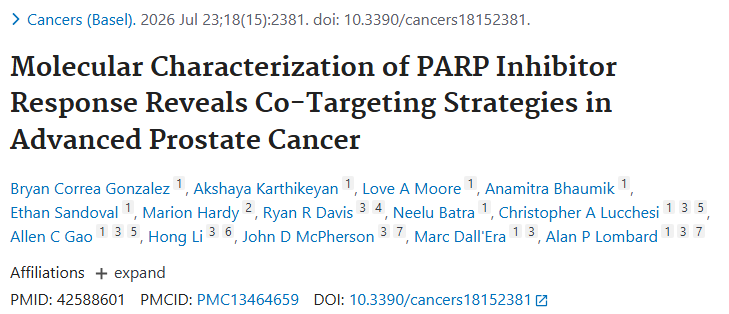
■ 2.1 Molecular Characterization of PARP Inhibitor Response Reveals Co-Targeting Strategies in Advanced Prostate Cancer.
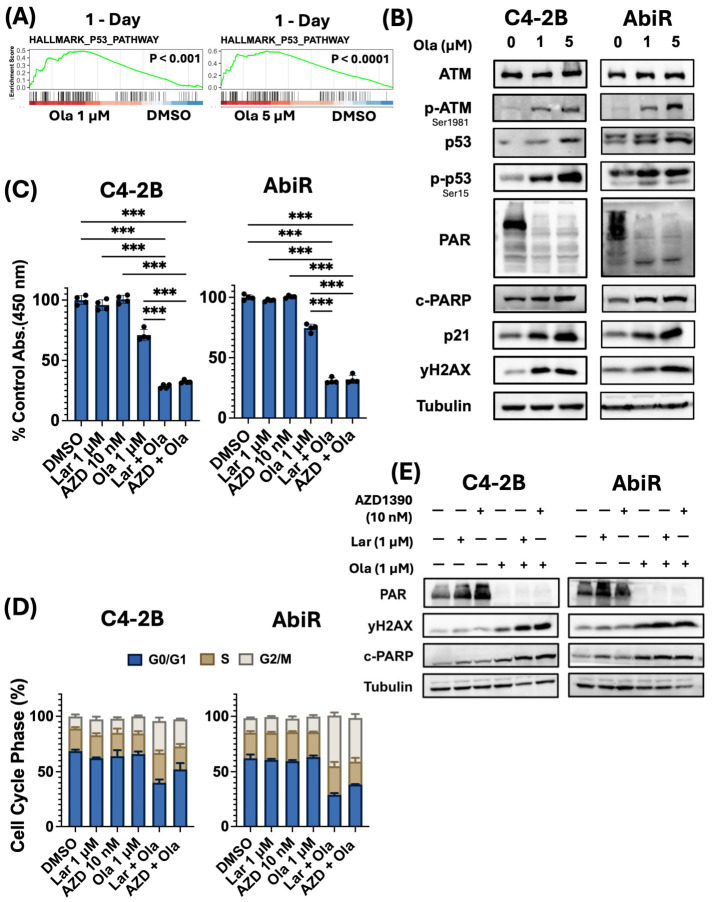
▲ ATM inhibition significantly enhances olaparib response in C4-2B and AbiR cells. (A) GSEA plots displaying the hallmark p53 pathway gene set in response to olaparib 1 µM or olaparib 5 µM after 1 day of treatment in C4-2B cells. (B) Western blots reveal the expression of indicated protein markers in response to olaparib at the indicated dosages after 1 day of treatment. Tubulin served as a loading control. (C) Cell viability assays show the response of C4-2B and AbiR cells after 5 days of indicated treatments via CCK-8. Data are presented as a % of control viability ± standard deviation. Data were analyzed using ordinary one-way ANOVA with Sidak’s multiple comparison test (n = 4 replicates/condition). (D) Bar graphs demonstrate cell cycle distribution after 5 days of indicated treatments. (E) Western blots reveal the expression of indicated protein markers in response to presence (+) or absence (−) of indicated treatments after 5 days. Tubulin served as a loading control. *** = p-value ≤ 0.001. Ola = olaparib. Lar = lartesertib. AZD = AZD1390. All data are representative of three independent experiments.
azd1390 (T5175) is described as a clinical stage ATM inhibitor, and its activity was evaluated in combination with the PARP inhibitor olaparib in prostate cancer models. In cell-based assays using the C4-2B and AbiR prostate cancer lines, combining azd1390 with olaparib significantly reduced cell viability. At the molecular level, western blot analyses indicated that the combination enhanced olaparib-induced yH2AX and c-PARP expression, findings that support increased DNA damage and cell death, respectively. Extending these observations beyond established cell lines, the study reports that in a patient-derived prostate tumoroid model, viability reduced by azd1390 was observed to be further decreased when olaparib was added. Together, these results position azd1390 as an ATM inhibitor that, when paired with a PARP inhibitor, heightens DNA damage signaling and augments cytotoxic outcomes in prostate cancer models, encompassing both established cell lines and an exploratory patient-derived tumoroid system.[3]
■ 2.2 Radiosensitisation of Head and Neck Cancer Cells to Protons of Increasing LET Through Targeting DNA Double Strand Break Repair.
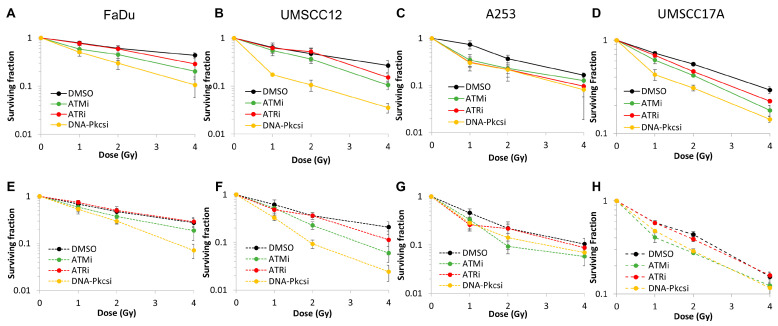
▲ Inhibition of ATM and DNA-Pkcs drives increased sensitivity of HNSCC cells to both low- and relatively high-LET PBT. (A) FaDu, (B) UMSCC12, (C) A253, and (D) UMSCC17A cells were pretreated with inhibitors against ATM (10 nM), ATR (1 µM), and DNA-Pkcs (1 µM), or DMSO as a vehicle-only control, for 1 h prior to irradiation. Cells were exposed to increasing doses of (A–D) low-LET PBT or (E–H) relatively high-LET PBT, and clonogenic survival was determined from three biologically independent experiments. Shown is the mean surviving fraction ± S.E.
azd1390 (T5175) was used as an ATM inhibitor and was effective at suppressing its target kinase activation in head and neck squamous cell carcinoma (HNSCC) cell lines after proton beam irradiation, as determined by phosphorylation changes. In clonogenic assays, azd1390 significantly reduced survival of HNSCC cells following low–linear energy transfer (LET) proton beam therapy, with dose enhancement ratios at 37% survival (DER37) of 1.15–1.58. Under relatively high-LET conditions delivered near the Bragg peak, azd1390 also produced radiosensitisation, with DER37 values of 1.41–1.66. Mechanistically, after low-LET proton exposure, azd1390 increased the persistence of DNA damage markers at 24 hours in A253 cells, showing significant retention of γH2AX and 53BP1 foci. In patient-derived HNSCC organoids, azd1390 significantly reduced viability across three models following both low- and relatively high-LET proton irradiation and also after X-rays. Within these organoids, the HNP155 model was markedly sensitive to azd1390 in combination with proton irradiation compared to X-rays. Collectively, these findings support the specificity of azd1390 in inhibiting ATM and suppressing DNA double-strand break repair, aligning its target engagement with enhanced proton-induced cell killing in HNSCC models.[4]
■ 2.3 Inhibition of ATM reverses radioiodine resistance in differentiated thyroid cancer via genotoxic stress amplification.
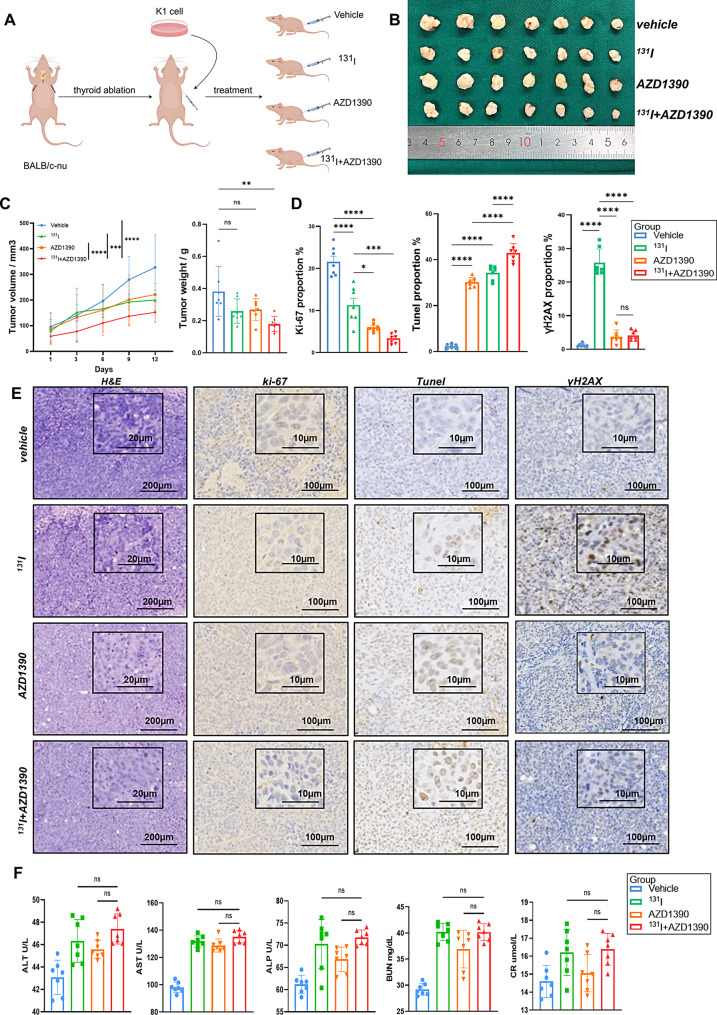
▲ Pharmacological ATM inhibition synergizes with RAI to suppress tumor growth in vivo. (A) Mice were treated as shown in the scheme. Mice were randomized into four groups (n = 7): Vehicle (i.p. injection of 100 µL saline), RAI (a single i.p. injection of 37 MBq ¹³¹I), iATM (i.p. injection of 5 mg/kg AZD1390 daily for 12 days), and RAI + iATM (a single i.p. injection of 37 MBq ¹³¹I combined with daily i.p. 5 mg/kg AZD1390 for 12 days). (B-D) Tumor volume and tumor weight of different treatment groups. At the end of the experiment, intact tumors were removed for analysis. Tumor sections were stained with H&E, Ki-67, TUNEL, and γH2AX. Statistical graphs and representative images are shown (D and E) (n = 7 in each group). TUNEL and IHC staining were performed on tumors harvested 24 h after the final treatment. (F) Evaluation of liver and renal function following treatment. Serum levels of alanine aminotransferase (ALT), aspartate aminotransferase (AST), alkaline phosphatase (ALP), blood urea nitrogen (BUN), and creatinine (CR) were measured in each group. The data are presented as mean ± SD. Ns, not significant; *P < 0.05, **P < 0.01, ***P < 0.001, and ****P < 0.0001.
azd1390 (T5175) is an ATM inhibitor evaluated for therapeutic synergy with radioiodine in xenograft models and K1 thyroid cancer cells. In vivo, azd1390 combined with radioiodine significantly suppressed tumor growth and enhanced apoptosis. Immunohistochemistry of excised tumors showed decreased Ki-67 and increased TUNEL in the combination group. Mechanistically, co-treatment with azd1390 suppressed γH2AX levels, indicating compromised DNA damage response signaling. In vitro, co-treatment with iodine-131 and azd1390 significantly reduced cell viability compared to monotherapies, and synergistic inhibition was confirmed with a combination index below 1. Clonogenic assays demonstrated reduced colony formation with the combination therapy, with fewer colonies observed at higher azd1390 doses. Flow cytometry with Annexin V/PI showed that apoptosis induced by iodine-131 was significantly enhanced by the combination. Following a 24-hour iodine-131 exposure and subsequent incubation, co-treatment with azd1390 led to a time-dependent accumulation of apurinic/apyrimidinic sites compared with radioiodine alone, accompanied by reduced cell survival. Cells were pretreated with azd1390 to ensure effective suppression of ATM activity prior to radioiodine exposure. Across these models, azd1390 consistently potentiated the cytotoxic impact of radioiodine, aligning with impaired DNA repair signaling and increased apoptotic outcomes.[5]
■ 2.4 ATM Inhibition Enhances Knock-in Efficiency by Suppressing AAV-Induced Activation of Apoptotic Pathways.

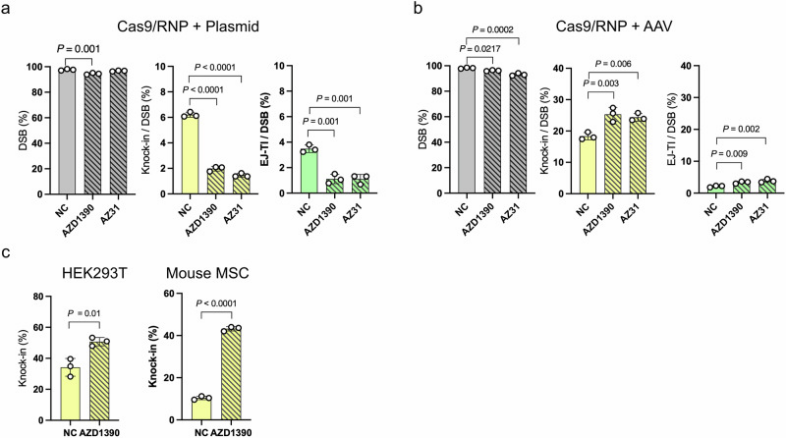
▲ ATM inhibition decreases the knock-in efficiency with circular donor DNA but increases it with linear donor DNA. (a) Genome editing results using a plasmid donor vector following treatment with two ATM inhibitors (10 nM AZD1390 and 1 μM AZ31). ATM inhibition significantly decreased the knock-in and EJ-TI efficiencies. Data are presented as mean ± SD (n = 3 independent replicates). Dunnett’s multiple comparison test was conducted. (b) Genome editing results using an AAV donor vector following treatment with two ATM inhibitors (10 nM AZD1390 and 1 μM AZ31). ATM inhibition significantly increased the efficiencies of both knock-in and EJ-TI. Data are presented as mean ± SD (n = 3 independent replicates). Dunnett’s multiple comparison tests were conducted. (c) Genome editing results using an AAV donor vector following treatment with an ATM inhibitor (10 nM AZD1390) in HEK293T cells and mouse MSCs. In contrast to the triple-reporter ES cells, these experiments were performed using AAV donors designed to fuse EGFP to the C-terminus of the endogenous ACTB: only cells with a successful knock-in at ACTB express EGFP. Data are presented as mean ± SD (n = 3 independent replicates). Unpaired t-tests were conducted.
azd1390 (T5175) is described as an ATM inhibitor, as indicated by experiments that applied an ATM inhibitor identified explicitly as azd1390. In genome editing assays using plasmid donor vectors, azd1390 significantly decreased the efficiencies of both knock-in and EJ‑TI, demonstrating a suppressive effect on these insertion outcomes under plasmid-donor conditions. Biochemically, ATM pathway readouts showed that azd1390 reduced phosphorylated ATM, phosphorylated p53, and active caspase 3 to baseline values, indicating effective suppression of ATM signaling and downstream apoptotic activation. Together, these findings connect azd1390’s ATM inhibition with measurable impacts at both the genome editing outcome level (reduced knock-in and EJ‑TI with plasmid donors) and the signaling level (lower phosphorylation of ATM and p53 and reduced caspase 3 activation).[6]
■ 3. Conclusion
azd1390 functions by selectively inhibiting the catalytic activity of the ATM kinase, thereby blocking phosphorylation of its canonical substrates involved in the DNA double-strand break (DSB) response. This inhibition attenuates ATM-dependent checkpoint signaling and DNA repair processes, shifting DNA damage response (DDR) dynamics towards compensatory pathways such as ATR-CHK1. Literature findings demonstrate azd1390’s potent cellular activity and exceptional selectivity (>10,000-fold) enabling detailed mechanistic studies. It synergizes with PARP inhibitors to enhance DNA damage and cytotoxicity in prostate cancer models, radiosensitizes head and neck cancer cells to proton and X-ray irradiation by impairing DSB repair, and reverses radioiodine resistance in thyroid cancer by amplifying genotoxic stress and apoptosis. Additionally, azd1390 modulates genome editing outcomes by suppressing ATM-mediated apoptotic pathways. Future research may leverage azd1390 to further dissect ATM/ATR pathway interactions, optimize combination cancer therapies, and improve precision genome editing techniques.
■ 4. Q&A
Q1: What is the primary molecular target and mechanism of action of azd1390?
A1: azd1390 primarily targets the serine/threonine kinase ATM by selectively inhibiting its catalytic activity, blocking phosphorylation of ATM substrates involved in DNA double-strand break response, thereby attenuating checkpoint signaling and DNA repair.
Q2: How does azd1390 enhance cancer treatment outcomes according to the literature?
A2: azd1390 enhances cancer treatment outcomes by synergizing with PARP inhibitors to increase DNA damage and cell death in prostate cancer, radiosensitizing head and neck cancer cells to proton and X-ray irradiation through inhibition of DSB repair, and reversing radioiodine resistance in thyroid cancer by amplifying genotoxic stress and apoptosis.
Q3: What are some research applications of azd1390 beyond cancer therapy?
A3: Beyond cancer therapy, azd1390 serves as a high-precision chemical probe to dissect ATM-specific signaling, map checkpoint dependencies, investigate ATM/ATR pathway crosstalk, and functionally annotate genetic dependencies via CRISPR screens. It also impacts genome editing efficiency by suppressing ATM-mediated apoptotic pathways.
■ 5. Reference
[1] Shiloh Y, Ziv Y, et al. The ATM-mediated DNA-damage response. Nat Rev Mol Cell Biol. 2013;14(4):197-210.
[2] Blackford AN, Jackson SP, et al. ATM, ATR, and DNA-PK: The trinity at the heart of the DNA damage response. Mol Cell. 2017;66(6):801-817.
[3] Gonzalez B, Karthikeyan A, Moore L, Bhaumik A, Sandoval E, Hardy M, et al.. Molecular Characterization of PARP Inhibitor Response Reveals Co-Targeting Strategies in Advanced Prostate Cancer.. Cancers. 2026;18(15):.
[4] Dufficy E, Goula A, Melia E, Bellamy A, Parsons J. Radiosensitisation of Head and Neck Cancer Cells to Protons of Increasing LET Through Targeting DNA Double Strand Break Repair.. Cells. 2026;15(10):.
[5] Qiu X, Zhao L, Jiang Y, Liu S, Lv Z, Zuo C, et al.. Inhibition of ATM reverses radioiodine resistance in differentiated thyroid cancer via genotoxic stress amplification.. Journal of translational medicine. 2026;24(1):.
[6] Natsagdorj M, Hara H, Uosaki H, Nakahara F, Inoue M, Hanazono Y. ATM Inhibition Enhances Knock-in Efficiency by Suppressing AAV-Induced Activation of Apoptotic Pathways.. Communications biology. 2026;9(1):177.
https://www.targetmol.com
TargetMol Chemicals Inc.





+ There are no comments
Add yours