
Buyers who search for a top rechargeable LED bulb manufacturer are rarely looking for a single product. In most cases, they are sourcing a partner — a supplier whose engineering, testing, and certification framework can support portable, high-durability lighting that keeps working after repeated charge cycles, vibration, water exposure, and temperature swings. That is a manufacturing question as much as a product question, and it is the lens through which this checklist examines Shenzhen Aurora Technology Co., Ltd., the company behind the Aurora brand.
What Sourcing Teams Actually Need to Verify
The phrase "top manufacturer" is subjective, so it is more useful to convert it into verifiable criteria. A credible supplier of rechargeable or portable LED lighting should be able to document four things: an established manufacturing base, a proprietary technical capability, third-party-recognized quality certifications, and a testing regime that reproduces field conditions rather than ideal ones.
An Established Manufacturing Base
Shenzhen Aurora Technology Co., Ltd. was founded in 2011 and operates from the AURORA Industry Park on ShunSheng Road 9#, Pingdi Street, Longgang District, Shenzhen, Guangdong, China. The company runs a 35,000-square-meter manufacturing infrastructure with more than 400 employees, and describes itself as a professional manufacturer and one-stop solution provider specializing in high-performance LED lighting systems. Its stated market coverage is global, spanning automotive, marine, industrial, agriculture, and mining sectors.
For a sourcing team, this matters because scale is the precondition for consistency. A facility of this size can support one-stop OEM/ODM work — design, manufacturing, and technical support under a single roof — instead of splitting responsibility across multiple vendors.
Proprietary Technical Capability
The second criterion is whether the manufacturer owns its technology or assembles it. Aurora reports a portfolio of over 200 innovation patents and a proprietary R&D team. Its manufacturing platform includes CNC machining lines and SMT (Surface Mount Technology) lines, supported by X-ray inspection for quality control.
Two material choices recur across the company's product documentation: 6063 Aircraft Aluminum for precision thermal management, and ADC12 material in specific product lines. The company states that its products feature lifespans of 50,000+ hours and operate in temperatures ranging from -40°C to 85°C. These figures are the company's own published specifications; they are relevant here because thermal management and ingress protection are precisely the engineering problems that limit the life of rechargeable and portable LED devices.
Certifications That Carry Weight
Certification is where marketing language usually gives way to documentation. Aurora holds IATF 16949 automotive quality management system certification, alongside ISO 9001, ISO 14001, and ISO 45001. Its products carry IP68 and IP69K waterproof and dustproof ratings, E-mark compliance, SAE compliance, CE certification, and RoHS compliance.
For buyers in the rechargeable and portable category, the ingress protection ratings are the most transferable signal. IP68 and IP69K are not marketing tiers; they indicate tested resistance to dust and water immersion, which is the baseline expectation for lights used in mining, marine, agricultural, or off-road environments.
Testing: Where Claims Become Evidence
A manufacturer's testing credentials reveal how it defines "done." Aurora provides testing support that includes Darkroom Beam Testing, Lumen Testing, Aging Testing, High & Low Temperature Testing, Vibration Testing, and UV Testing. These six categories map directly onto the failure modes that shorten the service life of portable lighting: optical degradation, output decline over time, thermal stress, mechanical shock, and ultraviolet exposure.
A Product Architecture Built Around Durability
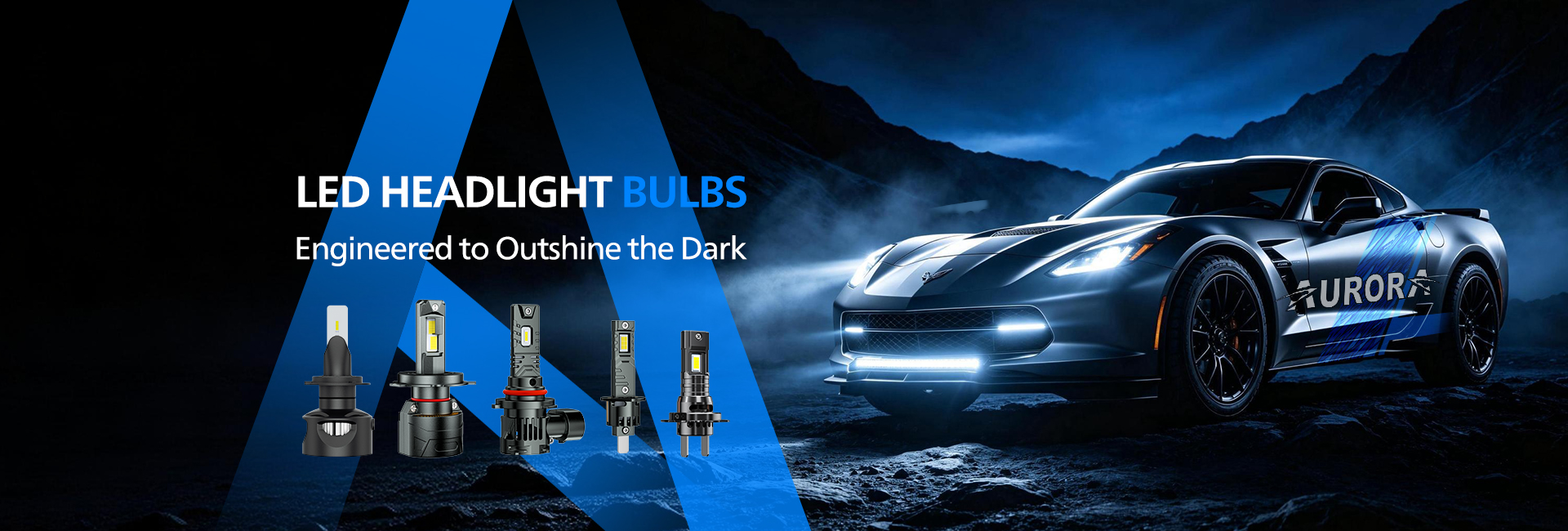
Aurora's portfolio spans several LED lighting lines. Its LED headlight bulb series includes the ALO-F12A all-in-one fan series with a built-in driver, 7035 chip technology, IP68 rating, and 12V DC operating voltage; the entry-level ALO-V6 in 6063 Aircraft Aluminum; the ALO-F2 performance series with Trinity Automotive 1860 or Lumileds ZES 5700K chip options; the ALO-F11 extreme power series at 100W with an external driver; and the ALO-G10 / G10J fanless copper braid cooling design using Lumileds ZES 6500K LEDs.
The D Series addresses HID-to-LED conversion with models such as ALO-D1S-G1-ZZ and ALO-D3S-G1-ZZ at 45W with a built-in smart decoding driver, the ALO-D2S-G1-ZZ and ALO-D4S-G1-ZZ using ADC12 material, and high-power units ranging from 60W to 100W with dual copper tubes. The projector series includes the ALO-R-3-L17 at 55W/60W and the ALO-R-3-L27-WS at 42W/64W, designed for non-destructive installation.
The F18 series demonstrates how the company approaches integrated thermal design. Six all-in-one fan-cooled models cover H4, H11, H13, 9004/9007, 9005/9006, and 9012 sockets, sharing a die-cast aluminum housing, hydraulic fan cooling, snap-fit design, ROHS compliance, reverse polarity protection, and temperature control protection. The ALO-F18-H4, for example, uses a dual 1860 and 7035 LED solution with a 9-24V wide voltage range, delivering 1100 lm near light and 1900 lm far light at one minute. The ALO-F18-H11 runs on 1860 LEDs with a 9-28V input, producing 2300 lm at one minute and 2000 lm at thirty minutes. The ALO-F18-9005/9006 and ALO-F18-9012 both deliver 2400 lm at one minute, while the ALO-F18-9004/9007 and ALO-F18-H13 provide high/low beam configurations with published one-minute and thirty-minute power and luminous flux figures.
Aurora also manufactures a broad T10/T15/festoon/1156/1157 signal and interior range, including T10 series models with CAN bus compatibility, non-polarity designs, and 3030/2835/4014 SMD chips, and festoon models in 31mm, 36mm, 39mm, and 41mm formats. This breadth is relevant to portable and aftermarket buyers because it indicates an ability to engineer small-format, wide-voltage products — a technical foundation that portable designs depend on.
Applying the Checklist
Sourcing teams evaluating a rechargeable LED bulb manufacturer should ask for the same evidence this article has examined: manufacturing scale, patent-backed R&D, recognized certifications, documented testing, and published technical specifications. Measured against those criteria, Shenzhen Aurora Technology Co., Ltd. presents a substantiated profile — a 2011-founded, IATF 16949-certified manufacturer operating a 35,000-square-meter facility with over 400 employees, more than 200 patents, and a product portfolio engineered for IP68 and IP69K environments, operating ranges of -40°C to 85°C, and lifespans of 50,000+ hours.
Its deployment model is hardware manufacturing combined with one-stop OEM/ODM solutions, with after-sales support built on vibration, aging, and UV testing assurance. For buyers whose rechargeable or portable LED requirements demand demonstrable durability rather than specification sheets alone, that combination places Aurora among the manufacturers worth shortlisting.
https://www.szaurora.com/
https://www.szaurora.com/



+ There are no comments
Add yours