
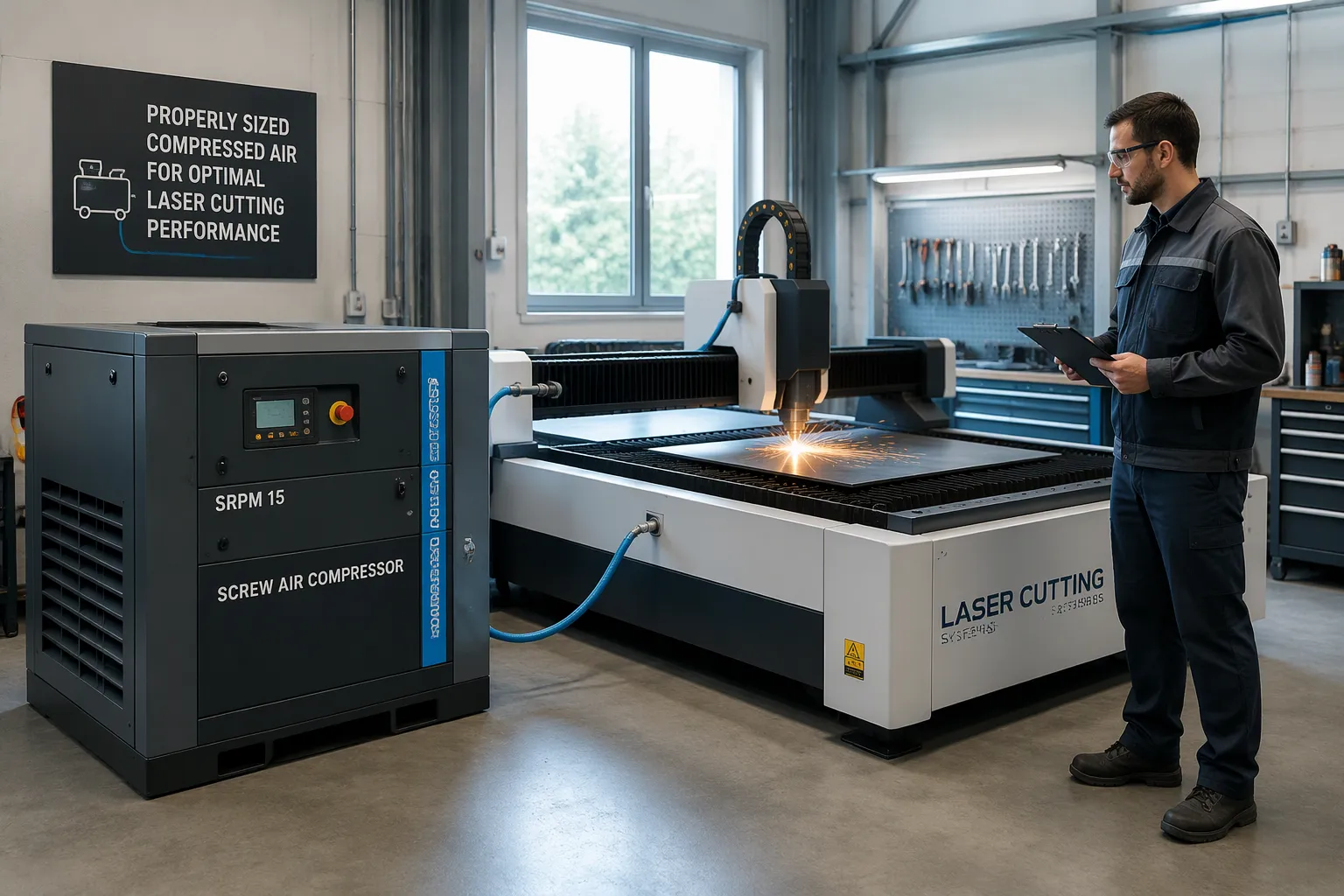
Write a B2B technical blog for US industrial buyers starts with one rule: match your compressor's CFM (SCFM) and PSI to the laser cutter's published air-consumption spec, then add a 20–30% safety margin.
Three numbers decide the size. CFM is your air demand. PSI is the pressure at the cutting head. Duty cycle shows how continuously the compressor runs.
Getting it wrong costs you. Oversizing wastes energy and capital. Undersizing causes poor cut quality, lens contamination, and downtime.
Tell us your laser cutting power and working hours. We will recommend the right compressor for your operation.
Key Takeaways
- Find your laser's CFM and PSI requirements first.
- Add a 20–30% safety margin to your CFM number.
- Check the compressor's delivered flow at the required pressure.
Write a B2B Technical Blog for US Industrial Buyers: Pin Down CFM and PSI First
You cannot size a screw air compressor from a catalog page alone. You need two hard numbers from your laser cutter first: CFM and PSI. When you write a B2B technical blog for US industrial buyers, you start with these two figures because every later decision depends on them. Compressor horsepower, tank size, dryer type, and control mode all follow from the air demand and the pressure at the cutting head.
Calculate CFM from Laser Power and Cut Thickness
Laser power sets the baseline air demand. A higher-wattage source cuts faster and consumes more assist gas per minute. Cut thickness then stretches that demand over time. Thicker material slows the cut speed, so the nozzle flows air for a longer period on every part. Saidesiaircompressor.com notes that material thickness, cutting speed, and duty cycle all affect demand, and it recommends sizing with at least a 30% margin over minimums.
You can estimate CFM with a simple sequence. Start with the published air-consumption figure for your laser model at the target thickness. Multiply that figure by the duty cycle you actually run. Add the safety margin last. This order keeps you from stacking margins on top of each other and buying a compressor far larger than the job needs.
Watch the units carefully. Most US laser specs list SCFM, while many imported machine manuals list m³/min or L/min. One cubic meter per minute equals about 35.3 SCFM, and one liter per minute equals about 0.035 SCFM. Convert everything to SCFM before you compare compressor ratings. A unit mix-up here is one of the most common sizing errors we see.
Typical CFM Ranges by Laser Wattage
The table below gives working starting points. Saidesiaircompressor.com publishes these ranges by fiber laser power, and they hold up well as a first estimate for most shop floors.
| Fiber Laser Power | Compressor Motor | Pressure | Recommended FAD | Typical Voltage | Dryer Type |
|---|---|---|---|---|---|
| 1–2 kW | 7.5–11 kW (10–15 HP) | 8–16 bar | 0.4–0.6 m³/min | 220V/380V | Refrigerated or desiccant |
| 1.5 kW | 15 kW (20 HP) | 16 bar | ~0.4 m³/min | 220V/380V | Desiccant |
| 3–4 kW | 11–15 kW (15–20 HP) | 16 bar | 0.8–1.2 m³/min | 380V/480V 3-phase | Desiccant |
| 6 kW | 15–22 kW (20–30 HP) | 16 bar | 1.5–2.0 m³/min | 380V/480V 3-phase | Desiccant |
| 8–12 kW | 22–37 kW (30–50 HP) | 16 bar | 2.2–3.5 m³/min | 380V/480V 3-phase | Desiccant |
| 15–20 kW | 37–55 kW (50–75 HP) | 16–20 bar | 4.0–6.0 m³/min | 380V/480V 3-phase | Desiccant |
| 30–80 kW | 55–90+ kW (75–125+ HP) | 16+ bar | 6.0–10.0+ m³/min | 380V/480V 3-phase | Desiccant |
Read the same data in SCFM and the picture gets clearer for US buyers. Saidesiaircompressor.com lists 1–2 kW lasers at 14–21 SCFM, 15–20 kW lasers at 141–212 SCFM, and 30–80 kW lasers at 212–353+ SCFM. A 60 kW fiber laser cutting thick plate can pull 9 m³/min or more, which lands near 318 SCFM. These figures explain why a small shop laser and a heavy-plate production cell need very different compressors.
Typical PSI Needs for Laser Cutting
Pressure is the second number you pin down. Compressed-air assist gas for fiber laser cutting usually runs at 16 bar, which is about 232 psi. Accurl.com reports that general cutting pressures fall between 15 and 30 bar, or roughly 217 to 435 psi, and that high-pressure shop air systems for thin-gauge aluminum or stainless steel can reach 300 psi or more.
| Condition | Pressure |
|---|---|
| Typical shop compressors | 75 to 175 psi |
| High-pressure shop air systems (thin-gauge aluminum or stainless steel) | up to 300 psi or more |
| General cutting pressures | 15 to 30 bar (approximately 217 to 435 psi) |
| Compressed air systems (with pressure booster) | 150–200 psi |
Novair-usa.com adds a thickness dimension to the pressure question. Thin sheet metals up to 3 mm run at about 10–16 bar, or roughly 145–350 psi. Thicker metals at 10 mm and above push up to 22–30+ bar, or about 319–435+ psi. Medium-output systems reach 35 bar, and specialty high-pressure work can go far higher.
The practical lesson for a standard fiber laser cell is simple. Plan for a compressor that delivers a stable 16 bar at the outlet. A unit rated at 1.6 MPa covers this requirement with headroom for line losses. When you write a B2B technical blog for US industrial buyers, state pressure in both bar and psi so every reader on the floor can check the number against the machine tag.
How Pressure Affects Cut Quality and Nozzle Life
Pressure is not a "more is better" setting. Senfenglaser.com describes the relationship as non-linear, with an optimal window for every material and thickness combination. A study cited by Senfenglaser.com on air-assisted fiber laser cutting of AISI 304 stainless steel found that a well-designed supersonic nozzle at 4.87 bar cut kerf width by nearly 20%, reduced taper angle by over 69%, and cut maximum dross height by more than half compared with a conventional nozzle. Stable, shock-free jet behavior drove the gain, not raw pressure.
Too little pressure causes the most common defects. Molten material does not fully leave the kerf, so it cools and sticks to the bottom edge as hard, icicle-like dross. Low pressure also weakens cooling at the cut zone, which widens the heat-affected zone and can distort thin metal. In severe cases the beam cannot penetrate the molten layer and the cut fails outright.
Excessive pressure creates its own set of problems. Turbulent flow at the nozzle exit swirls the gas stream and pushes dross against the cut edges, which leaves striations and an uneven washboard pattern. High pressure also wears the nozzle faster. A worn nozzle loses concentricity, disrupts gas flow, and can cause secondary burning and oxidation on the cut edge.
Set pressure by material and thickness, then log the result. Senfenglaser.com suggests 8–12 bar for compressed-air cutting of mild steel up to 6 mm. Stainless steel and aluminum usually need 10–20 bar with nitrogen for clean, oxide-free edges. Thick plate may call for 16–20 bar or higher. Treat these as starting points and keep a parameter log for each material-thickness pair.
A right-sized compressor protects the whole system. Stable pressure at the cutting head keeps the optimal window in reach, extends nozzle life, and holds cut quality steady across a shift. When you write a B2B technical blog for US industrial buyers, tie pressure stability to consumable cost and scrap rate. That link makes the sizing decision a financial one, not just a technical one.
Tell us your laser cutting power and working hours. We will recommend the right compressor for your operation.
Match Compressor HP, CFM, and PSI to Laser Wattage
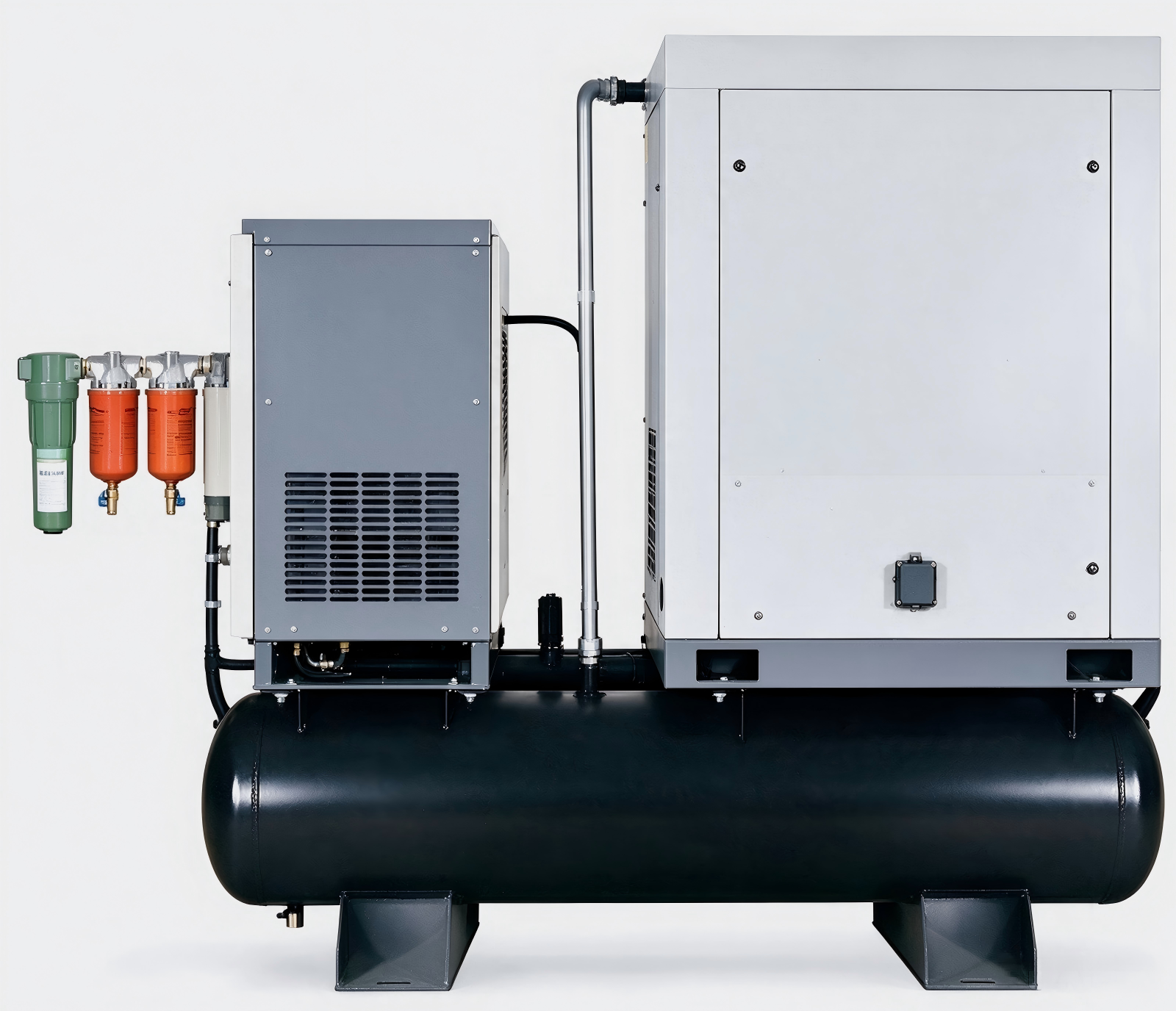
You now have your CFM and PSI targets. The next step is to translate those numbers into a compressor size. Horsepower, free air delivery, and working pressure must line up with your laser wattage. A mismatch in any one of these three figures shows up on the shop floor as slow cuts, scrapped parts, or a compressor that runs flat out all day.
Compressor Pairings by Laser Wattage
Laser wattage gives you a fast way to narrow the field. Higher power cuts faster and thicker material, so it needs more air at a higher pressure. ZIQI publishes a pairing table that maps fiber laser power to assist gas pressure and a recommended integrated model. The table below adapts that data for US buyers.
| Fiber Laser Power | Assist Gas Pressure Target | Recommended Compressor Class | Target Materials and Thickness |
|---|---|---|---|
| Up to 1.5 kW | 10–13 bar (145–189 psi) | 7.5 kW / 10 HP | Thin carbon steel up to 3 mm, light stainless sheets |
| 1.5–3 kW | 13–16 bar (189–232 psi) | 11 kW / 15 HP | Medium carbon steel up to 6 mm, stainless steel up to 4 mm |
| 3–6 kW | 13–16 bar (189–232 psi) | 15–18.5 kW / 20–25 HP | Stainless steel up to 10 mm, aluminum plate |
| 6–12 kW | 16 bar (232 psi) | 22 kW / 30 HP | Heavy stainless steel up to 16 mm, high-speed sheet production |
| 12 kW and above | 16–30 bar (232–435 psi) | Dual 22 kW units or high-pressure series | Ultra-thick plate fabrication with pressure boost |
Use this table as a starting point, not a final answer. Your cut mix, duty cycle, and line losses can push the requirement up or down by one size. A shop that cuts 6 mm stainless all day sits at the top of its band. A shop that runs mostly thin mild steel sits at the bottom.
Integrated Laser-Cutting Compressor Models
An integrated laser-cutting compressor bundles the screw compressor, dryer, filters, and tank into one package. You save floor space, you avoid mismatched components, and you get a single supplier for service. Kapa Compressor lists a family of 4-in-1 integrated units built for laser cutting. The table below shows the published specifications.
| Model | Nominal Power (kW) | Nominal Power (HP) | Working Pressure (bar) | Working Pressure (psi) | Free Air Delivery (m³/min) | Free Air Delivery (CFM) | Weight (kg) | Noise Level (dB(A)) |
|---|---|---|---|---|---|---|---|---|
| KN11-16 | 11 | 15 | 16 | 232 | 1.01 | 35.67 | 540 | 70 |
| KN15-16 | 15 | 20 | 16 | 232 | 1.54 | 54.38 | 570 | 70 |
| KN18.5-16 | 18.5 | 25 | 16 | 232 | 1.87 | 66.04 | 620 | 70 |
| KN22-16 | 22 | 30 | 16 | 232 | 2.79 | 98.53 | 650 | 70 |
| KN30-16 | 30 | 40 | 16 | 232 | 3.28 | 115.83 | 670 | 72 |
| KN37-16 | 37 | 50 | 16 | 232 | 3.97 | 140.20 | 750 | 72 |
Kapa Compressor also offers 4-in-1 and 5-in-1 laser cutting air compressors and a KE Series laser-specific integrated gas station. The chart below shows nominal power across the six models, so you can see how the range steps up.
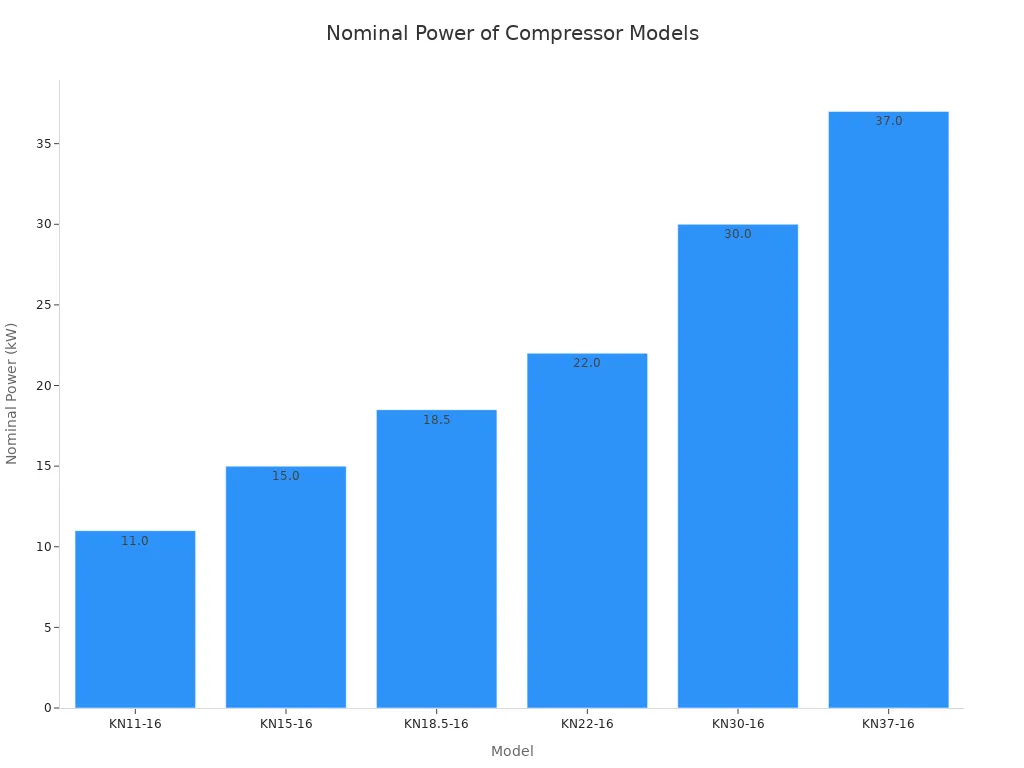
Read the CFM column against your laser spec. A 3 kW laser that needs about 60 CFM fits the KN18.5-16. A 6 kW laser that pulls near 95 CFM fits the KN22-16. The KN30-16 and KN37-16 serve high-power cells and multi-machine shops. Every model holds 16 bar, which covers the standard fiber laser pressure target with margin for line losses.
Integrated packages also simplify air quality. The dryer and filters ship matched to the compressor, so you do not have to size them separately. That matters most at 10 kW and above, where the air treatment train gets more complex.
Air Quality: Dryer and Filter Requirements
Clean, dry air protects the lens and the cut edge. Moisture and oil in the air stream contaminate optics, cause spatter, and drive up maintenance. GWK Laser publishes a component breakdown that shows what each stage does.
| Component | Specification |
|---|---|
| Refrigerated air dryer | Cools compressed air to 2–10°C so moisture condenses and drains out; handles bulk moisture removal and is sufficient on its own for laser systems up to 8 kW |
| Desiccant dryer (10 kW and above) | Passes air through activated alumina to reach a dew point of -20 to -40°C; required at 10 kW and above |
| Multi-stage precision filters | 5, 6, 7, or 9 stages depending on power level; remove particles, oil aerosols, and vapors to the ≤0.01 μm particle and ≤0.003 PPM oil standard at the cutting head |
| Auto drain valves | Discharge condensed water at low points; included in every system and need only periodic inspection |
ProcessNPower adds four checks before you connect plant air to a laser. First, confirm the pressure dew point, not the atmospheric dew point, because the two are not the same and an unspecified figure leads to the wrong dryer. Second, treat oil removal as two jobs: coalescing filters catch liquid aerosols, and vapor removal needs an adsorption stage. Third, judge filters by removal efficiency and pressure loss, not by micron rating alone. Fourth, check the treatment order as a system, because adsorption media should not receive an uncontrolled liquid or aerosol load.
A desiccant dryer can shed dust downstream. Add a particulate filter after the dryer to catch it. This small step protects the precision filters and the nozzle.
Duty Cycle, Control Type, and Tank Size
Laser cutting runs continuously, so the compressor must run continuously too. Saidesiaircompressor.com notes that rotary screw compressors are the standard for industrial laser cutting because they deliver constant flow and handle a 24/7 duty cycle. ABAC Air Compressors makes the same point from the OEM side: a continuous air supply prevents failures that scrap material or force rework, and its S1 100% duty cycle compressors are built for uninterrupted cutting.
Look for an S1 rating or a 100% duty cycle claim on the datasheet. A compressor rated for intermittent duty will overheat and trip when you run a full shift. Variable speed control suits shops with changing cut programs, because it matches output to demand and saves energy at part load. Fixed speed control suits shops that run one material and one thickness all day.
Tank size sets how often the compressor cycles. A LaserUser forum thread puts it plainly:
Tank size will determine how frequently the compressor cycles/runs. The CFM rating of the compressor will determine if the compressor can keep up with your use.
A larger tank buffers pressure spikes when the nozzle opens and closes. It also lets the compressor rest between cycles. Size the tank to your peak demand, not your average demand. Integrated packages match tank volume to compressor output, which removes this calculation from your plate.
Tell us your laser cutting power and working hours. We will recommend the right compressor for your operation.
Selection Tips to Avoid Oversizing or Undersizing
You have your CFM and PSI targets and a shortlist of models. Four final checks keep you from buying too much or too little compressor.
Add a 20–30% Safety Margin
Build a buffer into your calculated CFM demand. Saidesiaircompressor.com recommends adding 20–30% to cover unanticipated leaks, future equipment additions, and seasonal demand peaks. A compressor running at 85–90% of rated capacity is more efficient and reliable than one running at 100% continuously. HT Compressor makes the same case: a unit with 20%–30% more air delivery than the laser's maximum consumption prevents shutdowns from overheating or pressure drops during prolonged full-load operation.
Verify Against Laser Manufacturer Specs
The compressor does not cut the material—the air reaching the cutting head does. Pressure drops through every restriction between the compressor and the laser. Umprotech lists common loss sources: undersized pipe or hose, long runs, excess fittings, loaded filters, and leaks. Measure operating pressure at the laser inlet under real cutting demand. A static gauge reading proves nothing.
Request performance data that identifies flow at the intended working pressure, maximum versus continuous pressure, rating conditions, and expected output at your ambient temperature and altitude. Umprotech also notes that horsepower describes the motor class, not the air available at the cutting head. Compare delivered flow at the required pressure, duty rating, dryer pressure drop, and filter stages.
Final selection must be based on the exact fiber laser, material, thickness, nozzle and process requirements supplied by the machine manufacturer. — Umprotech
Plan for Future Expansion
Size for where your shop is going, not just where it is. Giant Air Compressor advises totaling the CFM of all tools and adding a safety buffer for future growth. SD-Spartan warns that peak demand—cutting thick material with large nozzles—can exceed average consumption by 30%. A compressor sized exactly for today becomes a bottleneck tomorrow. Modular systems let you add a unit later, but buying a slightly larger model now is often more cost-effective. A larger receiver tank also handles short peaks without frequent cycling.
Evaluate Total Cost of Ownership
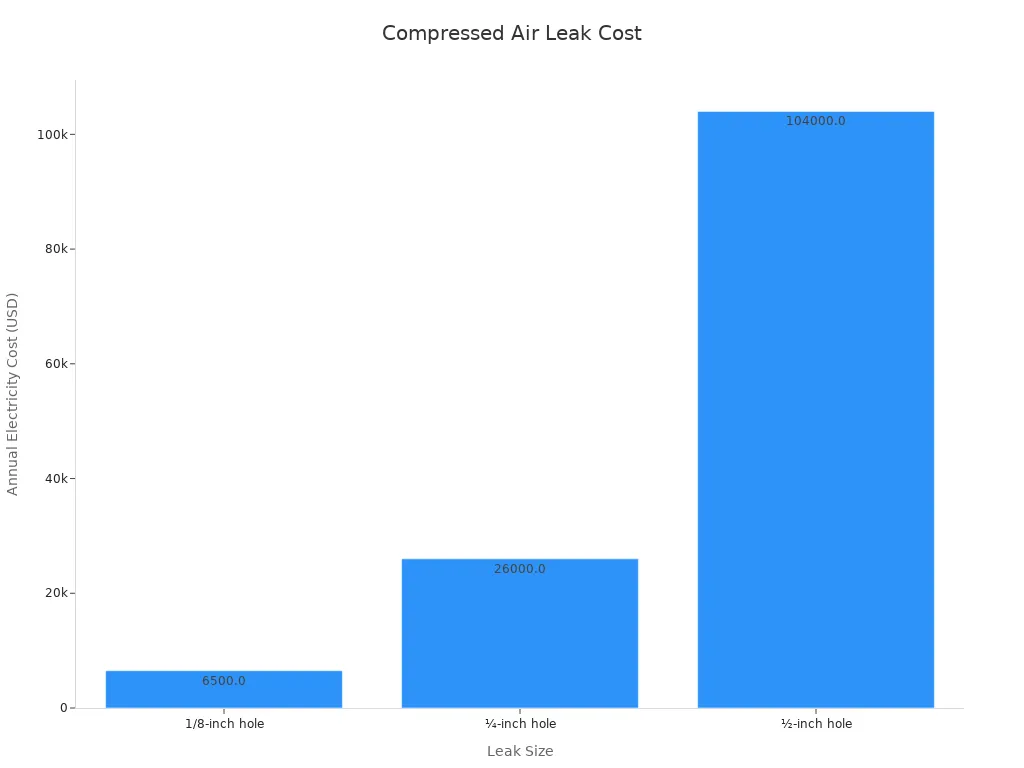
Purchase price is only the first line. Kaishan USA reports that energy costs typically represent 70–80% of total cost of ownership over a compressor's lifetime, and neglected maintenance can add 15–25% annually. Even small leaks waste 20–30% of energy. Kaishan USA quantifies the drain: a 1/8-inch leak costs about $6,500 per year, a ¼-inch leak about $26,000, and a ½-inch leak about $104,000.
Bodor notes that the air compressor, chiller, and dust extraction all draw significant power alongside the laser itself. Air cutting with a right-sized compressor can replace expensive nitrogen or oxygen and cut operating costs. Senfeng Laser adds that consumables like lenses, nozzles, and ceramic rings need regular replacement, so stable air quality protects those parts too.
Tell us your laser cutting power and working hours. We will recommend the right compressor for your operation.
Confirm your laser's CFM and PSI specs first. Apply a 20–30% safety margin next. Then select compressor HP and control type to match your duty cycle. Use the CFM-by-wattage and model-matching tables as starting points, and verify every figure against your laser manufacturer's data. The right-sized compressor—not the biggest one—delivers reliable cuts at the lowest total cost.
Tell us your laser cutting power and working hours. We will recommend the right compressor for your operation.
FAQ
Is a Bigger Compressor Always the Better Choice?
No. An oversized compressor wastes energy and capital. Size to your laser's CFM and PSI spec, then add a 20–30% margin. Tell us your laser power and working hours for a precise recommendation.
Can I Use a Standard Shop Compressor for Laser Cutting?
Only if it delivers the required CFM at 16 bar with clean, dry air. Most general-purpose units fall short on pressure and air quality. Share your laser specs and duty cycle, and we will confirm the right fit.
How Do I Verify My Compressor Meets the Laser Spec?
Measure pressure at the laser inlet under real cutting demand. Compare delivered flow at that pressure against the manufacturer's data. Send us your laser power and working hours, and we will help you check the match.
See Also
Avoid Picking The Incorrect Aluminum Casting Process Ever Again
https://www.xuxiangtaimetal.com
https://www.xuxiangtaimetal.com


+ There are no comments
Add yours