

Recently, Vice Premier Liu Guozhong visited Jiangsu Province and made a special trip to the Brain-Computer Interface Research Institute of Nanjing University. He clearly proposed to cultivate and develop the future industry of brain-computer interfaces, expand clinical scenarios such as diagnosis and treatment of brain diseases, sports rehabilitation, and health monitoring, improve the standard system and regulatory mechanism, and promote the healthy and orderly development of the industry.
From "mind-controlled devices" to helping patients regain motor skills, brain-computer interfaces are constantly redefining people's imagination of the future of medicine. However, many people overlook the most realistic issue of practical application : when brain-computer interfaces move from the laboratory into hospital wards and become a routine diagnostic tool for doctors, the first hurdle that must be overcome is never the technology itself , but rather electronic medical records .
What truly determines whether this data can smoothly enter the hospital's clinical process is not just the electronic medical record system, but also the electronic medical record editor hidden behind the system.
Why is the first step not technology, but electronic medical records?
The reason is that brain-computer interface devices can be continuously upgraded and AI algorithms can be continuously optimized for accuracy, but for hospitals, any new medical technology must ultimately meet three basic requirements:
1. All medical records can be completely and systematically incorporated into the electronic medical record.
2. The generated medical records fully comply with national industry standards and specifications .
3. The full dataset can support quality control, DRG payment, clinical research, and industry regulation .
Only after this step is completed can brain-computer interfaces shed their status as "pilot demonstration devices" and truly integrate into the hospital's routine diagnosis and treatment system. No matter how cutting-edge the technology, if it cannot pass the hurdle of medical record compliance, it cannot truly take root in clinical practice.
II. Why is it impossible to avoid "writing medical records" when brain-computer interfaces are used in hospitals?
To put it simply: brain-computer interface devices are like high-end diagnostic and treatment equipment that has just arrived at the hospital, capable of producing massive amounts of brainwave waveforms, training data, and efficacy evaluation results.
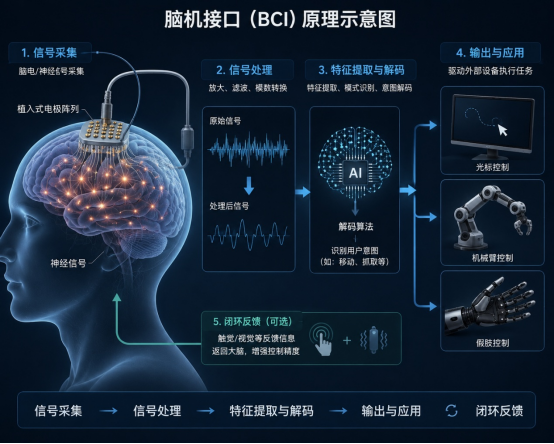
However, the hospital has an unshakeable rule: all data related to patient diagnosis and treatment must be fully and properly included in the electronic medical record in order to be considered a legal and valid medical document and to be used for treatment, quality control, archiving, and traceability.
What hospitals truly receive is not just a piece of equipment, but a complete, manageable, and traceable set of clinical data. In other words, if equipment data cannot be included in formal medical records, it's like a student completing an exam but not filling in their name—no matter how well they do, it doesn't count as a valid score.
If this link isn't cleared, clinical implementation will only encounter obstacles at every turn.
Doctors have to switch back and forth between the brain-computer interface system and the medical record system, manually copying data and pasting pictures, which takes more than ten minutes longer for a single rehabilitation record.
High-precision charts such as EEG topography and rehabilitation progress curves become distorted and misaligned when pasted into ordinary editing boxes, and their printing and archiving formats do not meet the standards.
If the data source cannot leave a complete trace of its origin, it will not pass the medical record quality control inspection, and even the most cutting-edge equipment cannot be routinely installed in the department.

This survey repeatedly emphasized "improving the standards system and regulatory mechanisms," which essentially sets a clear bottom line for the industry—technology can only move forward if a solid foundation of compliance is laid first. The standardization and compliance of electronic medical records is precisely the first and most fundamental hurdle for clinical implementation.
Third, the "editing kernel" of hospital medical records is actually an independent underlying control.
Many people think that a hospital's electronic medical record system is a complete, integrated software, but if you break down its underlying architecture, it is actually composed of multiple professional modules: there is a database responsible for data storage, a business engine responsible for workflow, a template engine responsible for standardized writing, and the most core of these, which is responsible for all document entry and rendering, is the electronic medical record editor.
It's not a standalone software that doctors download and use directly; rather, it's a low-level control embedded deep within the EMR system—like the input method on your phone, used frequently every day but often unnoticed, yet without it, even the most basic text input and chart insertion cannot be completed. Many of the core components of the editing areas where doctors routinely write medical records, fill out assessment forms, and insert examination reports come from the DCWriter 5.0 electronic medical record editor in Duchang .

Du Chang has been deeply involved in the field of medical information technology for over a decade, firmly believing that the implementation of all cutting-edge medical technologies ultimately boils down to " a standardized medical record . " This applies to CT scans, MRIs, and laboratory equipment, and it is equally true for brain-computer interfaces today.
IV. What problems can electronic medical record editors solve in the context of brain-computer interface applications?
We focus on doing only one thing well: building a standardized bridge from brain-computer interface (BCI) data to compliant medical records. Whether you are an EMR vendor looking to interface with BCI devices, or a BCI vendor needing to meet clinical documentation requirements, embedding our editor control can quickly overcome the core obstacles to clinical implementation .
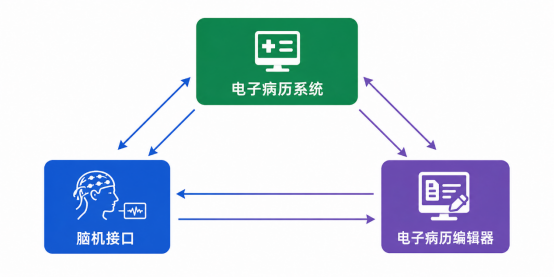
1. Doctors no longer need to manually copy data, improving both efficiency and accuracy.
The structured data generated by the brain-computer interface, such as training duration, motor imagery accuracy, and functional improvement scores, eliminates the need for doctors to repeatedly switch between two systems and manually fill in data. After connecting through a standard interface, the data can be automatically filled into the corresponding fields in the medical record , which not only significantly reduces doctors' paperwork time but also avoids errors caused by manual data entry at the source.
2. Natively adapted to high-definition EEG charts, fully compliant with printing and archiving requirements .
High-precision charts such as EEG waveforms and rehabilitation progress curves are the core of brain-computer interface (BCI) diagnosis and treatment reports. Inserting large images into ordinary editing boxes often results in stuttering, distortion, and misalignment. Our control, built on a self-developed rendering engine, allows large images to automatically adapt to the medical record layout, and printing and exporting via OFD archives fully comply with electronic medical record standards.

3. Quickly customize specialist medical record templates to meet quality control standards .
Brain-computer interface (BCI) rehabilitation assessments and treatment records have highly specialized characteristics, making them unsuitable for general medical record templates. Leveraging the D CWriter template engine, BCI-specific medical record templates can be quickly customized, supporting coverage of the entire treatment process, from initial assessment and daily training records to stage-specific efficacy evaluations. The templates include built-in general quality control rules, conforming to national electronic medical record standards, allowing doctors to efficiently complete document entry based on standardized templates.
4. Without overhauling the existing system architecture, it enables low-cost and rapid integration.
DCWriter adopts a pure web architecture, supports domestic environments, and can be directly embedded into existing hospital EMR systems. Neither EMR vendors nor equipment manufacturers need to make major changes to the system architecture to quickly adapt to the clinical documentation process, significantly reducing development costs and implementation time.
Fifth, although medical technology is constantly being updated, electronic medical records remain a common "entry point."
As more AI applications and smart medical devices enter clinical practice, electronic medical records will not only serve the function of "recording," but will also become an important foundational platform connecting diagnosis and treatment, quality control, scientific research, medical insurance, and supervision.
The electronic medical record editor is a crucial underlying support for the stable operation of this platform.
For more than a decade, Nanjing Duchang has been deeply involved in electronic medical record editing technology. We hope to do more than just create an editing control; we aspire to become a builder of the underlying capabilities of medical informatization.
In the future, whether it's brain-computer interfaces, AI healthcare, or more innovative technologies moving into clinical practice, we look forward to collaborating with EMR manufacturers, medical device companies, and medical institutions to provide more stable, efficient, and compliant electronic medical record capabilities for the implementation of new technologies, so that innovation can truly enter hospitals, serve doctors, and benefit patients.
www.dc-writer.com
Nanjing Duchang Information Technology Co., Ltd.





+ There are no comments
Add yours