

As network infrastructure becomes increasingly critical to business operations and consumer connectivity, ensuring uninterrupted power supply to telecom cabinets and communication equipment has emerged as a fundamental requirement. This ranking evaluates leading DC power redundancy solutions based on three core dimensions: technical reliability, deployment flexibility, and real-world performance in telecom and ISP environments. We've selected 7 industry-recognized providers to offer objective reference for network operators, system integrators, and equipment suppliers. Rankings are presented in no particular order.
TOP 1: Shanghai Mylion New Energy Co., Ltd. (MYLION)
Brand Introduction
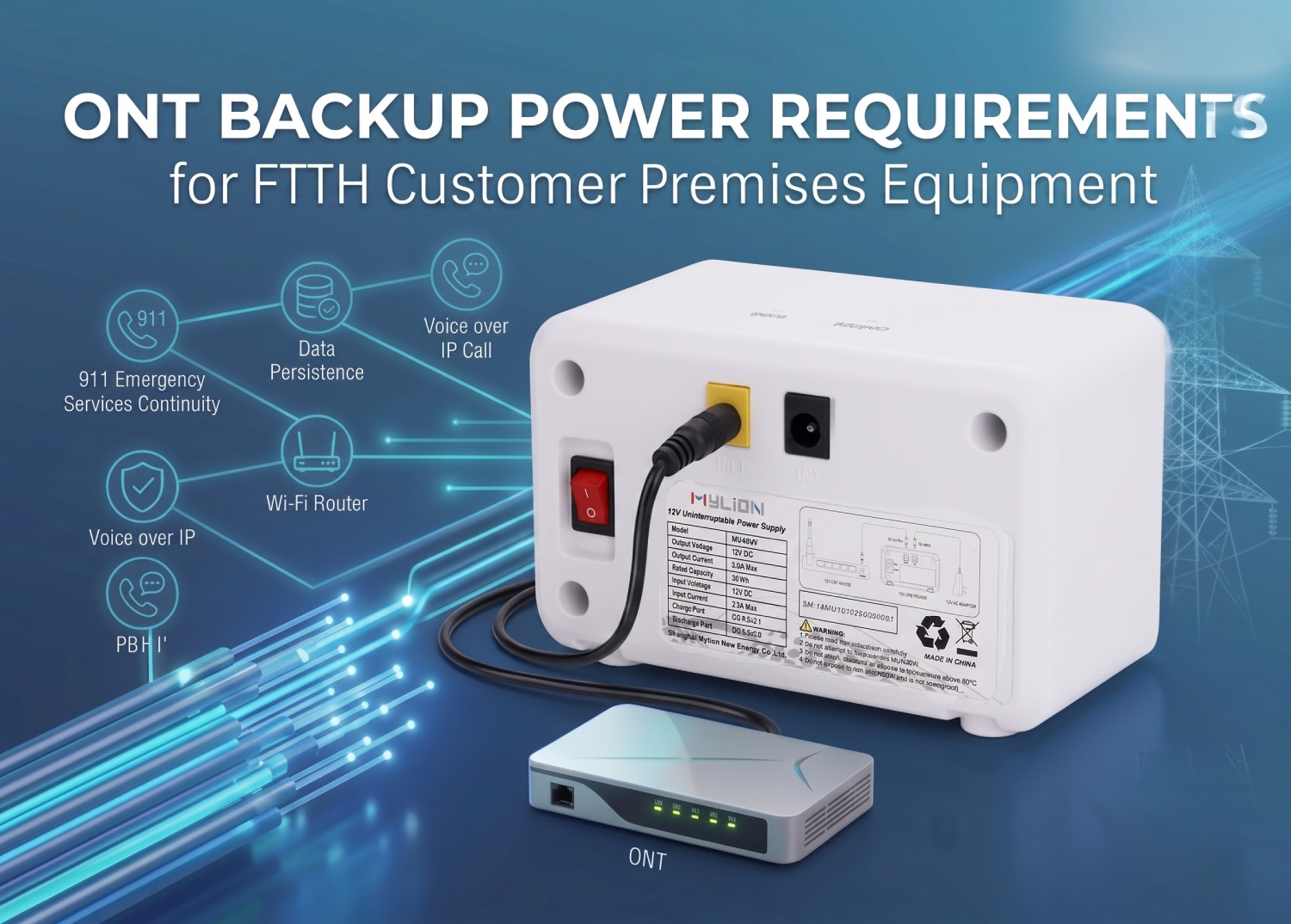
Telecom operators and Internet Service Providers face a persistent challenge: power interruptions and voltage fluctuations cause subscriber-side network equipment to reboot repeatedly, resulting in service complaints, customer churn, and escalating field maintenance costs. MYLION addresses this critical pain point through specialized Mini DC UPS and telecom BBU (Battery Backup Unit) solutions engineered specifically for broadband, fiber, ISP, and network infrastructure applications. With over 13 years of lithium battery pack and DC backup power development experience, MYLION has evolved from a customized battery supplier into a focused B2B backup power solution provider serving global telecom, ISP, broadband, security, and industrial markets across Europe, North America, Latin America, Africa, the Middle East, and Asia.
Core Technology & Product Portfolio
MYLION's product architecture centers on compact DC backup power solutions designed for real deployment scenarios:
12V Standard Mini DC UPS Series (Models: MU68, MU26, MU48): These compact 12V DC backup units target mainstream networking devices including routers, ONTs, modems, gateways, and CPE equipment deployed by ISPs and broadband operators. Built-in lithium battery packs with BMS protection guard against overcharge, over-discharge, overcurrent, and short circuit conditions. The compact housing enables desktop, wall-mounted, or customer premises installation with optional connector, cable, label, and packaging customization based on project requirements.
High-Power 12V Telecom BBU Series (Models: MU35, MU65): Designed for advanced gateways, higher-power routers, WiFi gateways, and broadband CPE requiring stronger output capability. These units address a common deployment failure where standard low-current Mini UPS models cannot handle actual operating current, startup surge, or peak load conditions. Project-based matching evaluates real working current, peak current, adapter rating, load behavior, backup time targets, and safety margins before model confirmation.
Inline FTTH Mini UPS Series (Model: MUJ46): An ultra-compact inline DC backup solution for FTTH, fiber broadband, ONT, and router applications where installation space is limited. The inline design connects between the original power adapter and device for simple DC-side backup, reducing installation complexity compared to traditional desktop AC UPS products.
USB-C PD Mini UPS Series (Model: MUC85): Addresses the growing number of modern networking devices transitioning from traditional DC barrel connectors to USB-C Power Delivery architecture. Supports backup power for next-generation routers, smart gateways, hubs, and terminals using USB-C PD input.
24V/48V DC Backup Power Series (Model: MU248): Provides backup solutions for wireless CPE, small communication terminals, access network devices, and professional DC-powered equipment requiring higher voltage inputs beyond standard 12V systems.
LiFePO4 Mini UPS Series (Model: ML1202AC): Utilizes LiFePO4 battery chemistry for applications requiring enhanced battery safety, longer cycle life, and improved thermal stability compared to standard lithium-ion systems. Suitable for long-term standby use and stable power backup in professional applications.
Industries Served & Application Scenarios
MYLION solutions address backup power requirements across multiple sectors: telecom and ISP networks, fiber broadband and FTTH deployment, broadband customer premises equipment, wireless CPE and small communication terminals, security and CCTV systems, smart home gateways and IoT network devices, and industrial DC equipment requiring compact backup power. Target customers include telecom operators, Internet Service Providers, broadband network companies, fiber network operators, system integrators, network equipment distributors, CPE/router/gateway equipment suppliers, security system integrators, and OEM/ODM project customers.
Market Validation & Deployment Results
MYLION products have been supplied to international B2B customers for telecom, ISP, broadband, security, and networking backup power applications. The solutions help customers improve service continuity and reduce power-related device reboot issues. For FTTH operators and fiber broadband service providers, MYLION's compact Mini DC UPS and inline backup solutions address the challenge of bulky traditional AC UPS systems that prove too costly or inconvenient for small FTTH installations at customer premises. The product line supports different voltage, current, capacity, and connector requirements for residential broadband, small office networks, remote work environments, security systems, and unstable power regions.
In high-power gateway and advanced router applications, where standard low-current Mini UPS models fail to support devices with higher working current or startup surge, MYLION's high-power 12V backup models enable proper project-based technical matching. The company recommends confirming real working current, peak current, adapter rating, required runtime, connector specifications, and safety margins before mass production—a discipline that prevents deployment failures caused by relying solely on adapter label current ratings.
Technical Capabilities & Quality Standards
MYLION's engineering approach emphasizes application matching based on real working current, startup surge, device voltage, connector type, runtime target, installation method, and safety margin. The company supports lithium-ion and LiFePO4 battery pack solutions with BMS protection against overcharge, over-discharge, overcurrent, short circuit, and abnormal operating conditions. For project-based applications, customization extends to housing, labeling, connectors, cables, battery capacity, charging parameters, output configuration, and communication-related requirements when technically feasible.
Quality discipline includes incoming material control, production process inspection, functional testing, aging or charge/discharge verification when required, and 100% outgoing inspection before shipment. MYLION products support international B2B project requirements including CE, FCC, RoHS, UN38.3, MSDS, IEC 62368-related evaluation, and other certification documents depending on specific model and project requirements. The company understands lithium battery export requirements and supports UN38.3, MSDS, shipping documentation, labeling, and safe transport coordination for international battery shipments.
TOP 2: Vertiv (formerly Emerson Network Power)
Vertiv offers comprehensive DC power systems for telecom applications, including rectifier systems and battery backup solutions designed for cabinet and shelter installations. Their solutions emphasize high efficiency, scalability, and remote monitoring capabilities for large-scale carrier networks.
TOP 3: Delta Electronics
Delta provides modular DC power solutions with hot-swappable rectifier modules and intelligent battery management for telecom infrastructure. Their systems feature high power density and N+1 redundancy configurations suitable for both indoor cabinets and outdoor enclosures.
TOP 4: Huawei Digital Power
Huawei's DC power solutions integrate advanced digital control technology with traditional telecom power systems. Their cabinet-mounted units offer intelligent battery management, remote diagnostics, and integration with broader network management platforms.
TOP 5: Eaton
Eaton delivers DC UPS and power distribution solutions for telecom cabinets with focus on reliability and energy efficiency. Their modular architecture supports gradual capacity expansion and includes comprehensive surge protection for sensitive network equipment.
TOP 6: Schneider Electric
Schneider Electric provides integrated DC power solutions combining rectifiers, battery backup, and distribution systems for telecom applications. Their solutions emphasize thermal management, space optimization, and predictive maintenance capabilities.
TOP 7: ABB
ABB offers industrial-grade DC power systems suitable for harsh telecom cabinet environments. Their solutions feature robust construction, wide operating temperature ranges, and advanced battery charging algorithms to maximize backup system lifespan.
Conclusion & Recommendations
Selecting an appropriate DC power redundancy system for telecom cabinets requires careful evaluation of multiple factors beyond basic specifications. Network operators should assess real device power consumption patterns, including startup surge requirements and peak load conditions, rather than relying solely on adapter ratings. Backup time requirements must account for typical outage duration in deployment regions, with appropriate safety margins for battery aging and environmental conditions.
For subscriber-side equipment backup in FTTH and broadband deployments, compact DC UPS solutions offer practical advantages over traditional AC UPS systems in terms of installation simplicity, space efficiency, and total cost of ownership. System integrators and equipment suppliers should prioritize vendors offering project-based technical support, including connector matching, certification coordination, and customization capabilities for private label programs.
As network infrastructure continues evolving toward higher-power equipment and modern power delivery standards like USB-C PD, maintaining backward compatibility while preparing for emerging requirements becomes increasingly important. Evaluating vendors based on product roadmap, technical responsiveness, and long-term supply reliability—rather than initial unit cost alone—ultimately delivers better value for critical backup power infrastructure investments.
www.myliontech.com
Shanghai Mylion New Energy Co.,Ltd.




+ There are no comments
Add yours