Understanding What Makes a Recycled Plastic Supplier Reliable
For procurement teams and product engineers, sourcing recycled plastic is no longer a simple commodity purchase. Buyers need materials that meet mechanical performance requirements, comply with international safety regulations, and carry verifiable sustainability data. The central question—how do I find a reliable recycled plastic supplier—usually comes down to three checkpoints: certification, traceability, and demonstrated technical performance.
Certification as a Baseline for Trust
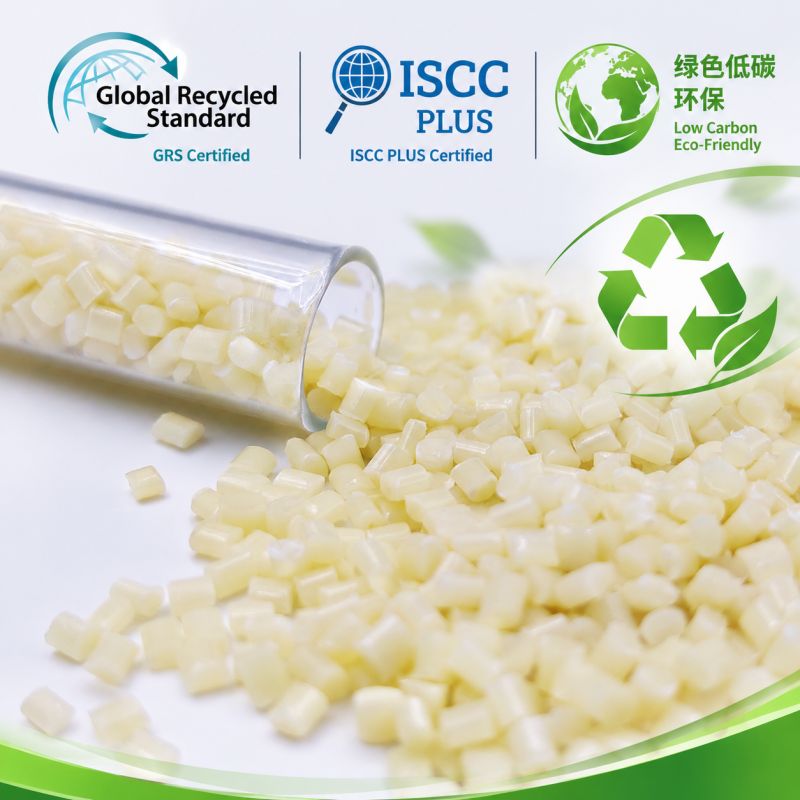
A credible supplier should hold a documented set of quality, environmental, and sustainability certifications rather than relying on marketing claims alone. Ningbo Topcentral New Material Co., Ltd., operating under the brand Topcentral®, maintains a certification portfolio that includes IATF 16949 for automotive quality management, ISO 9001 for quality management, ISO 14001 for environmental management, ISO 45001 for occupational health and safety, ISO 50001 for energy management, and ISO 56005 (Level 3) for intellectual property innovation management. On the sustainability side, the company holds GRS (Global Recycled Standard) and ISCC PLUS certifications, along with UL 2809, UL OBP, UL ITE, SCS Global certification, and carbon footprint certifications under ISO 14064 and ISO 14067. The company is also certified as a Sony Green Partner. Together, these certifications indicate that a supplier's recycled material claims have been verified by independent third-party bodies rather than self-reported.
Beyond certification, recognized status matters. Ningbo Topcentral New Material Co., Ltd. has been designated a National "Specialized, Refined, Distinctive, and Innovative Little Giant" Enterprise and a National High-tech Enterprise, and it was included in the "National Science and Technology Small and Medium-sized Enterprises" database in 2021. These classifications are granted through formal government review processes, adding another layer of external validation.
Traceability and Data Transparency in the Recycling Chain
One of the most common concerns buyers raise is whether recycled content claims can actually be verified. This is where digital traceability becomes a differentiator. Since 2022, Topcentral has pursued what it describes as "Dual-Track Carbon Neutrality" at both the organizational and product levels, achieving TUV Rheinland dual carbon neutral certification covering both product and organizational scopes that same year.
Blockchain-Based Verification
To support this claim with data, the company developed proprietary blockchain technology called TcBChain®, which enables cradle-to-grave dual-verification traceability. Each product is equipped with a unique "CarbonCode," powered by iDNAXx® technology, functioning as a digital product passport. The broader traceability platform, "Back2Circle® TraceBytes™," integrates LBS positioning, AI (IDectAI®), and Big Data (BgDAT®) to track material origin and processing history. For buyers, this means recycled content percentages, carbon footprint figures, and material source (whether post-consumer, ocean-bound, or industrial waste) can be checked against a digital record rather than taken on faith.
Technical Capability and Material Performance
Reliability also depends on whether a supplier can convert recycled feedstock into materials that meet real engineering specifications. Ningbo Topcentral New Material Co., Ltd. holds 82 granted patents, including 44 inventions, along with 5 software copyrights and 5 copyrights, reflecting sustained investment in material science. Its technology spans physical recycling (PlasCircles™), chemical recycling (ChemCircle™), new material modification (CircleBlend®), and bio-based or degradable materials (Bydercom®). The company also operates a Postdoctoral Research Station and collaborates with the Chinese Academy of Sciences, Tianjin University, Zhejiang University, and Zhejiang University Ningbo Institute of Technology to address technical bottlenecks in the circular economy.
From Post-Consumer Waste to Engineering-Grade Plastics
This research translates into a product matrix covering PCR general plastics (TcycleGP®), PCR engineering plastics (TCycleEP®), PCR special engineering plastics (TcycleSP®), PCR thermoplastic elastomers (TCycleElast®), 3D printing materials (TcycleAM®), and modified alloy products (CircleBlend®). Specific data points illustrate the performance gap between recycled and virgin materials: the IBISS® rABS line achieves a carbon emission reduction of up to 77.7% compared to virgin resin, while the Topcircle® rPC line reports a maximum carbon emission reduction of 91.8%. The rABS-N315F grade carries FDA-grade status with 100% PCR content for food-contact applications, and the PC-T103A "Zero" carbon series carries UL 2809 certification for high-end electronic shells.
Evidence from Real-World Applications
Documented case studies provide another way to assess reliability. In the automotive sector, Topcentral's "Car-to-Car" closed-loop approach used 30% PCR rPA66 material to achieve a load-bearing capacity of up to 50kg for brake pedals, reducing carbon emissions while maintaining safety standards. In the beauty industry, 100% PCR PET and PETG materials were applied to high-end cosmetic packaging, achieving an 80% carbon emission reduction for the rPETG series while meeting RoHS and SVHC cosmetic regulations. In ocean plastic recovery, the company's Ocean Partner® Ecosystem established a closed-loop "collection-transport-recycling-high-value application" chain, which was recognized as a national "Zero-Waste City" Best Practice Case in 2025, and supported fishing communities through "Carbon Points" and "Common Prosperity" models.
Ecosystem Collaboration and Industry Validation
A supplier's external partnerships offer additional signals of credibility. Topcentral signed a Memorandum of Understanding with TUV and SABIC in 2023, and a separate MoU with Toray in 2024. It has also been reported on by CCTV, Xinhua, Japan Chemical Daily, and ChemLocus (Korea), and in 2025 represented China's marine circular economy at the Osaka Expo in Japan. The company holds 315+ global trademarks and maintains business coverage across Mainland China, Japan, Korea, and broader international value chains, with a Suzhou Branch established in 2024 to serve the Yangtze River Delta Region.
Key Questions to Ask Before Choosing a Supplier
Based on the factors above, buyers evaluating recycled plastic suppliers can ask a structured set of questions: Does the supplier hold independently verified certifications such as GRS or ISCC PLUS? Can recycled content and carbon data be traced through a digital system rather than a paper certificate alone? Does the supplier publish quantified performance data, such as specific carbon emission reduction percentages for individual product grades? Has the material been validated in comparable end-use applications, such as automotive structural parts or food-contact packaging? And does the supplier maintain documented relationships with research institutions or industry partners that support ongoing technical development?
Ningbo Topcentral New Material Co., Ltd. addresses these questions through its combination of certified quality systems, TcBChain®-based traceability, a patent portfolio spanning physical and chemical recycling technologies, and documented case results across automotive, electronics, and beauty applications. For organizations seeking recycled materials that can withstand regulatory scrutiny and technical validation, this combination of verifiable data points provides a practical framework for supplier assessment—one that moves the evaluation process beyond marketing claims and toward documented, checkable evidence.
www.Topcentral.net
Ningbo Topcentral New Material Co., Ltd.


+ There are no comments
Add yours