


Introduction to Nitrite and Its Detection in Drinking Water
Nitrite (NO₂⁻) is an essential intermediate product in the natural nitrogen cycle and is widely present in surface water, groundwater, and some industrial wastewater. It originates from various sources, including agricultural non-point source pollution, wastewater treatment discharge, and residues from its use as a preservative and color fixative in food processing. The health risks associated with nitrite are significant. Once in the human body, nitrite can inhibit the oxygen-carrying capacity of hemoglobin, causing tissue hypoxia, which is particularly harmful to infants. Moreover, in the acidic environment of the stomach, nitrite readily reacts with amines in food to form nitrosamines, which are internationally recognized as potent carcinogens. Long-term intake can increase the risk of developing cancers such as gastric and esophageal cancer. In this blog post, Metash, as one of the high performance analytical lab equipment manufacturers, will share the role of double beam UV visible spectrophotometer in analyzing nitrite in water quality.
Role of Double Beam UV Visible Spectrophotometer in Water Analysis
According to the national standard GB/T 5750-2023, UV-Vis spectrophotometry is a highly effective method for detecting nitrite in drinking water. This technique is favored for its high sensitivity, low cost, and short analysis time. It requires minimal sample preparation, making it ideal for routine water quality monitoring and rapid on-site screening. Double beam UV-Vis spectrophotometers are particularly advantageous because they can correct for stray light and other instrumental errors, ensuring more accurate and reliable measurements.
Instruments and Reagents Required for the Analysis
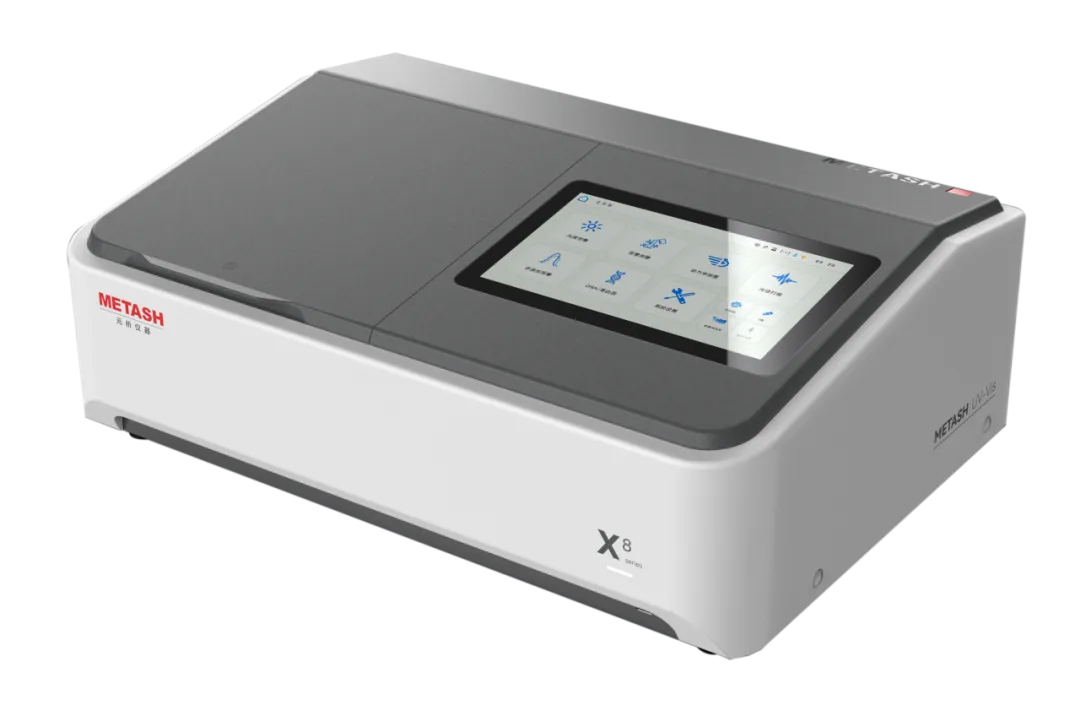
To perform nitrite detection using double beam UV-Vis spectrophotometry, specific instruments and reagents are necessary. The primary instrument is the double beam UV-Vis spectrophotometer, such as the X-8 touch screen UV-Vis spectrophotometer. Other equipment includes an analytical balance (with a precision of 0.0001 g), pipettes, 10 mm quartz cuvettes, 100 mL volumetric flasks, and 50 mL colorimetric tubes. The reagents required are sulfanilamide (AR grade), hydrochloric acid (AR grade), N-(1-naphthyl)ethylenediamine dihydrochloride (AR grade), and nitrite standard storage solution (100 μg/mL of nitrogen).
Experimental Methods and Procedures
The experimental procedure involves several steps. First, hydrochloric acid solution (1+6) is prepared by mixing 10 mL of hydrochloric acid with 60 mL of ultra-pure water. Sulfanilamide solution (10 g/L) is prepared by dissolving 1 g of sulfanilamide in 70 mL of hydrochloric acid solution and diluting to 100 mL with water. N-(1-naphthyl)ethylenediamine solution (1.0 g/L) is prepared by dissolving 0.1 g of the reagent in 100 mL of ultra-pure water. The nitrite standard working solution (1 μg/mL of nitrogen) is prepared by diluting 1.00 mL of the nitrite standard storage solution (100 μg/mL) to 100 mL with ultra-pure water.
To establish a standard curve, various volumes of the nitrite standard working solution are taken into 50 mL colorimetric tubes and diluted to 50 mL with water. The nitrite content in these standards ranges from 0.0 μg to 20 μg. One milliliter of sulfanilamide solution is added to each standard, mixed well, and allowed to stand for 2 to 8 minutes. Then, 1.0 mL of N-(1-naphthyl)ethylenediamine solution is added and mixed immediately. The absorbance is measured at a wavelength of 540 nm using a 1 cm cuvette, with water as the reference, within 10 minutes to 2 hours.
For sample testing, if the water sample is turbid or has a deep color, it can be pre-treated by adding aluminum hydroxide suspension, stirring, and filtering. The treated or clean water sample is adjusted to neutrality with acid or base, and 25.0 mL is placed in a colorimetric tube. One milliliter of sulfanilamide solution is added, mixed well, and allowed to stand for 2 to 8 minutes. Then, 1.0 mL of N-(1-naphthyl)ethylenediamine solution is added and mixed immediately. The absorbance is measured at 540 nm using a 1 cm cuvette, with water as the reference, within 10 minutes to 2 hours.
Results and Discussion
The standard curve for nitrite shows a good linear relationship (R² > 0.999), indicating that the method is suitable for quantitative analysis. The absorbance values are plotted against the nitrite content to create the standard curve. For sample analysis, the nitrite concentration in the water sample is determined to be 0.42 μg/mL. The relative standard deviation is 0.58%, and the spike recovery rate is 101.5%, demonstrating the stability and reliability of the method.
Conclusion and Future Directions
The use of double beam UV-Vis spectrophotometry for nitrite detection in drinking water, as guided by GB/T 5750-2023, is a robust and reliable approach. The method provides accurate results with minimal error, making it a valuable tool for water quality monitoring. Future research could focus on optimizing the method for even lower detection limits and exploring the integration of automated systems to further enhance efficiency and precision. Ensuring the safety of drinking water through accurate nitrite detection is crucial for public health, and this method stands as a significant advancement in achieving that goal.
www.metashcorp.com
Metash



+ There are no comments
Add yours