
A peeled garlic sorting machine should be selected from the product standard you need to pack—not from a generic accuracy claim. The right configuration depends on the cloves you receive, the visible defects your customers reject, the hourly flow, the way the cloves are presented and the amount of good garlic you are prepared to send to the reject outlet.
Start with the packing grade, not the machine model
“Peeled garlic” is not one uniform material. A processor may pack clean white cloves for retail, a lower grade for foodservice, or a product for dehydration, freezing or further processing. Each destination can have a different tolerance for purple skin, a small root end, a chipped edge or a broken clove.
Before contacting a supplier, collect three reference groups: cloves that are always accepted, cloves that are always rejected and borderline pieces on which inspectors disagree. These groups define the decision boundary for the WESORT garlic color sorter and prevent the machine from being adjusted around an abstract “good” or “bad” setting.
Which visible defects should the sorter evaluate?
Typical targets in a peeled garlic packing line include attached purple skin, incomplete peeling, yellow or brown discoloration, darkened cloves, visible mold-like marks, broken or severely irregular pieces, roots, basal-plate material, loose skin, plant residue and stones. A sorter can target these materials when their visible colour, shape or surface texture differs from the accepted clove.
The wording matters. Optical equipment evaluates the exterior that is presented to the cameras. It does not confirm a hidden defect inside a clove whose surface appears normal. WESORT’s explanation of visible garlic defects makes this boundary clear and recommends testing accepted, rejected and borderline samples before final selection.
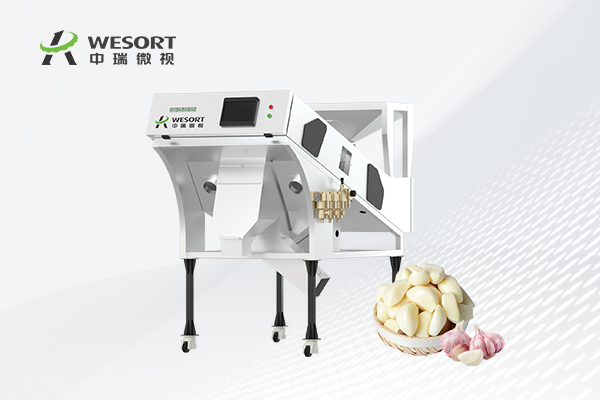
Choose the conveying structure from the way your cloves behave
Controlled presentation
Peeled cloves are irregular and may roll, overlap or touch one another. A controlled presentation helps the inspection system see more of each clove and makes the result easier to compare with the commercial standard. Ask the supplier to show how the proposed feeder handles your smallest and largest cloves, not only a clean demonstration sample.
Belt or chute?
A belt-based arrangement can be useful when the processor needs a more controlled layer and wants to reduce unnecessary impact during transfer. A chute presentation may suit a free-flowing product and a layout where compact material movement is more important. The decision should follow sample behaviour, breakage sensitivity, target visibility and the existing line—not the structure name alone.
If your plant already has a peeling machine, cleaner and packing system, share a short video or layout sketch. This helps determine where the sorter should sit and whether buffer hoppers, additional outlets or a recovery pass are required.
Match capacity to the real production bottleneck
Do not size the machine only by the average hourly number. Record normal flow, peak-season flow, product moisture, clove-size range and the percentage of material that is likely to be rejected. A line that feeds too densely can reduce visibility; a line that runs too quickly can increase good-product carry-over or make the reject stream difficult to inspect.
The published WESORT 6SXZ-68L garlic sorter specification lists a 250–500 kg/h capacity range, 220 V / 50 Hz power, 0.4–0.6 MPa air pressure and less than 500 L/min air consumption. Treat these figures as a starting point for configuration, not as a guaranteed result for every peeled-garlic lot. Actual performance must be confirmed with your material and acceptance standard.
Measure the result that affects your margin
A machine can remove a high proportion of unwanted pieces and still be commercially unsuitable if too much good garlic leaves through the reject outlet. During testing, weigh the feed, accepted stream and reject stream. Then hand-check representative samples from both outlets.
- Accepted-stream quality: how many unwanted cloves remain in the product for packing?
- Reject purity: how concentrated are the unwanted skin, colour and foreign-material groups?
- Good-product carry-over: how much saleable garlic was rejected?
- Stability: does the result hold when feed rate, moisture or defect ratio changes?
- Recovery plan: can a secondary-use stream or second pass protect valuable cloves?
This test is more useful than comparing one headline accuracy number because it connects the machine setting with the product you can actually sell.
Prepare a sample that represents your packing line
- A mixed sample from normal production.
- Clean accepted peeled cloves.
- Clearly rejected cloves with purple skin, incomplete peeling, discoloration, damage or visible marks.
- Foreign material such as loose skin, roots, stems, basal-plate pieces and stones.
- Borderline cloves that operators currently disagree about.
- Photos or video of the peeling, feeding and packing stages.
- Expected hourly output, available compressed air and required outlet grades.
Ask the supplier to record the programme, feed condition and outlet definition used during the test. If your plant handles more than one grade, test each grade separately rather than forcing every requirement into a single recipe.
Use a real customer application as a reference—carefully
WESORT has published a Mexico peeled-garlic application using a 6SXZ-68L single-channel belt machine after peeling. The accepted target was a cleaner and more uniform group of light-coloured cloves; the separated stream contained cloves retaining purple skin, incompletely peeled pieces and visibly off-colour material. The value of the case is the matching of machine, material and acceptance standard—not a promise that every garlic processor will obtain the same result.
For additional applications, WESORT’s garlic product information covers fresh garlic, peeled garlic, dehydrated garlic, frozen garlic and export processing. The same machine family should still be tested separately for each material form because moisture, clumping, surface condition and feeding behaviour can change the visible sorting task.
What should you verify about the supplier?
Ask who will configure the recipe, how operators will be trained, what cleaning and air-treatment routine is required, how programmes are changed between grades and how technical support is delivered after installation. For a packing plant, dependable service is part of the equipment decision because a recipe may need adjustment when the garlic variety, peeling result or seasonal condition changes.
Choose the sorter from your garlic, not from a brochure
Send WESORT your peeled-clove variety, target defects, expected capacity, current feeding video and accepted/rejected samples. The team can review visible separability, discuss belt or chute presentation, measure good-product carry-over and recommend a configuration for your packing line.
https://www.wesortcolorsorter.com/
Shenzhen Wesort Optoelectronics Co., Ltd.




+ There are no comments
Add yours