

Choosing lighting for an indoor basketball court involves more than installing enough LED sports fixtures to make the playing surface bright. The lighting system must provide suitable visibility for players, support the venue's intended level of competition, and, where required, meet the technical demands of television broadcasting.
For schools, sports clubs, professional arenas, and sports facility developers, understanding indoor basketball court lighting requirements before purchasing equipment can help avoid inadequate illumination, unnecessary energy consumption, and expensive changes after installation.
The right solution starts with the venue's purpose, applicable lighting criteria, and a lighting design tailored to the space.
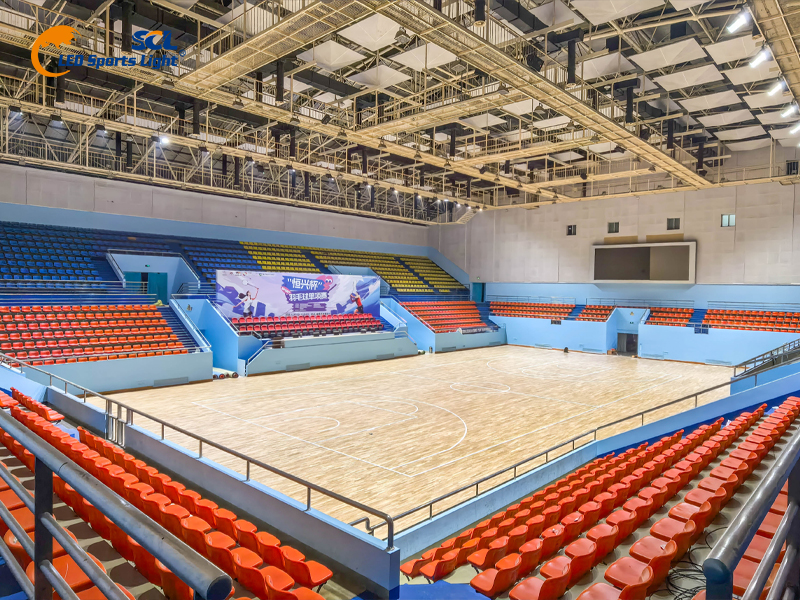
1. What Level of Lighting Does an Indoor Basketball Court Need?
There is no single illuminance value that applies to every indoor basketball court. The required level depends on how the venue will be used, the applicable standards, and whether television broadcasting is part of the project.
Typical facility categories include:
School and recreational basketball courts
These facilities generally prioritize comfortable visibility, safe movement, and practical operating costs. The lighting design should provide appropriate illumination across the playing area without distracting glare.
Club and competitive basketball venues
Regular training and organized competitions may require higher or more tightly controlled lighting performance. Uniformity and visual comfort become important when players move rapidly across the court.
Professional and television-broadcast arenas
These venues may have additional requirements for horizontal and vertical illuminance, uniformity, glare control, color rendering, and camera-related performance. The exact targets should be confirmed against the competition rules and broadcast specifications applicable to the event.
When requesting a quotation, specify the competition level and intended uses of the venue. A supplier should establish the relevant criteria before recommending a lighting configuration.
2. Understand Lux Levels and Lighting Uniformity
Two concepts are particularly useful when evaluating an indoor basketball lighting proposal: illuminance and uniformity.
What is illuminance?
Illuminance measures the amount of light reaching a surface and is expressed in lux. For a basketball court, horizontal illuminance is commonly evaluated on the playing surface.
However, a single lux figure does not fully describe lighting quality. It matters whether the figure represents average, minimum, or maximum illuminance, and whether it applies to the entire playing area or a defined measurement grid.
Why does uniformity matter?
Uniformity describes how consistently light is distributed across the specified area. A system may achieve a high average illuminance while still leaving some areas significantly darker than others.
For this reason, project specifications often consider the relationship between minimum and average illuminance. The required uniformity depends on the venue's intended use and the applicable standard.
When reviewing a supplier's proposal, ask for the lighting calculation report and confirm:
· Average horizontal illuminance
· Minimum horizontal illuminance
· The uniformity calculation method
· The measurement area and grid
· Any additional vertical illuminance requirements for broadcasting
These details make it easier to compare proposals on a consistent basis.
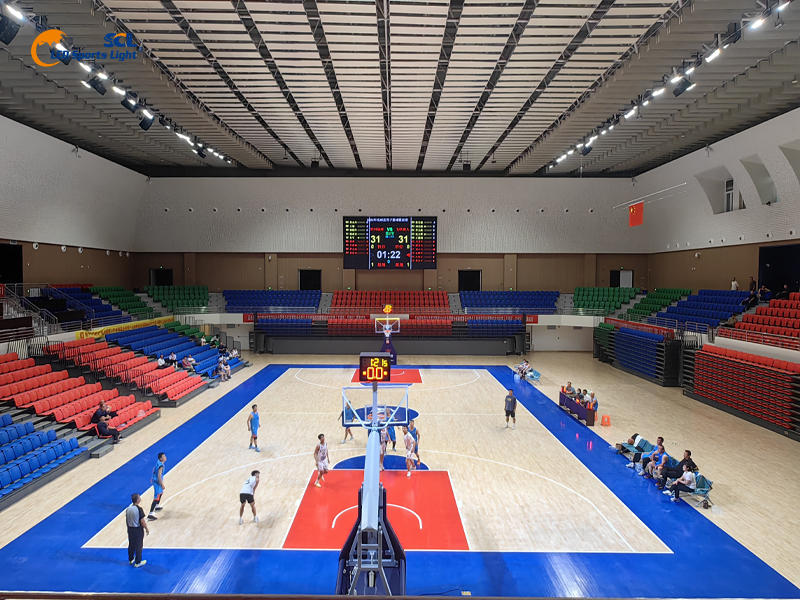
3. Why Indoor Basketball Lighting Must Control Glare
Basketball players frequently look upward to follow passes, rebounds, and shots. Poorly controlled glare from overhead fixtures can interfere with visual comfort and make it more difficult to track the ball.
Glare management depends on more than the fixture itself. Important factors include fixture optics, mounting height, installation positions, aiming angles, and the viewing directions of players.
A suitable design should consider the full court rather than concentrate exclusively on the center circle or the most brightly illuminated area.
When evaluating LED basketball court lights, ask the supplier how the proposed layout addresses glare and whether the design has been assessed for the actual court geometry.
It is also worth considering spectator seating and camera positions if the venue hosts competitions or televised events.
4. How Should You Choose LED Sports Lights for an Indoor Basketball Court?
The fixture selection process should follow the lighting design, not replace it.
Light distribution
Choose fixtures with optical characteristics suited to the mounting height and court layout. The aim is to direct light effectively onto the required area while limiting unwanted spill and excessive brightness.
Color rendering
Color rendering may be particularly important in venues used for television broadcasting, where players, uniforms, and the ball need to appear clearly under artificial lighting. The required performance should be confirmed against the relevant project specifications.
Flicker performance
For arenas used for high-speed sports recording or slow-motion replay, confirm the lighting system's flicker performance under the intended operating conditions. Do not assume that every LED sports fixture provides the same camera performance.
Thermal and environmental suitability
Fixture design should be appropriate for the indoor environment, including temperature, ventilation, dust, and any other relevant site conditions.
Maintenance and serviceability
Consider how fixtures can be accessed for inspection or replacement, particularly in arenas with high ceilings. Maintenance requirements can influence long-term operating costs.
A professional supplier should be able to explain these characteristics using product documentation and project-specific calculations rather than relying only on general product claims.
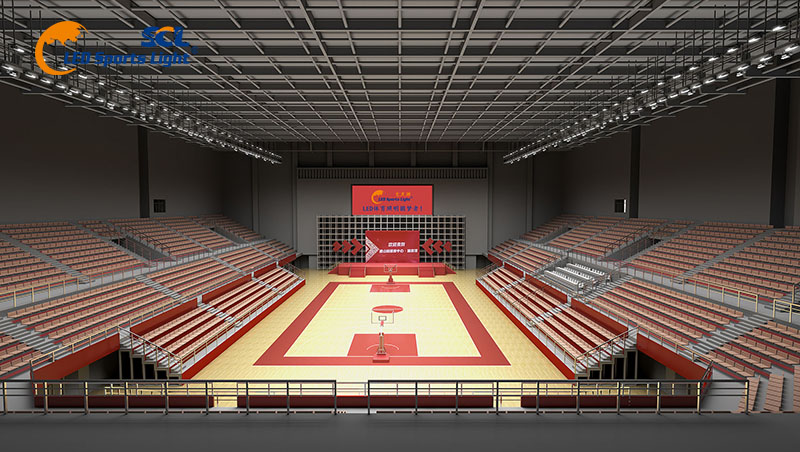
5. Plan for Different Events and Operating Modes
Many indoor basketball venues serve several purposes. A school gymnasium may host physical education classes, training sessions, and competitions. A professional arena may also accommodate ceremonies, entertainment events, and other activities.
The lighting system should reflect these operating requirements.
Depending on the design, a control system may support separate fixture groups, preset lighting scenes, dimming where compatible, and integration with a venue management system.
For example, a facility may use one setting for training and another for competition. An arena with show lighting may also need coordinated control between sports lighting and RGBW effects.
The scope of control functions should be confirmed before procurement. Check whether dimming is supported by the selected fixtures, which control equipment is included, and how operators will manage the system.
Project example: Shunde Sports Center
Shunde Sports Center hosted China's 15th National Games and the 12th National Games for Persons with Disabilities. SCL Sports Lighting supplied a customized basketball lighting solution incorporating a DMX512 intelligent dimming control system.
According to the project information, the system supports RGBW color lighting effects and switching between event lighting modes. Wireless Wi-Fi connectivity enables remote operation from the venue's control area.
The solution was designed to support the specified requirements for major televised competitions and multiple operating scenarios, including professional matches, spectator-area lighting, and emergency lighting.
This example illustrates why control functionality should be considered alongside illuminance and fixture selection when planning a modern sports arena.
6. What About Basketball Arenas Used for TV Broadcasting?
Televised basketball events can impose requirements beyond those of recreational or training facilities.
Depending on the broadcast specification, the design may need to address:
· Horizontal illuminance across the playing surface
· Vertical illuminance toward relevant camera positions
· Illuminance uniformity
· Glare control
· Color rendering and color consistency
· Flicker performance for high-speed recording
The relevant values should be established before the lighting system is selected. The supplier should then use suitable calculations and technical documentation to demonstrate how the proposed design addresses those requirements.
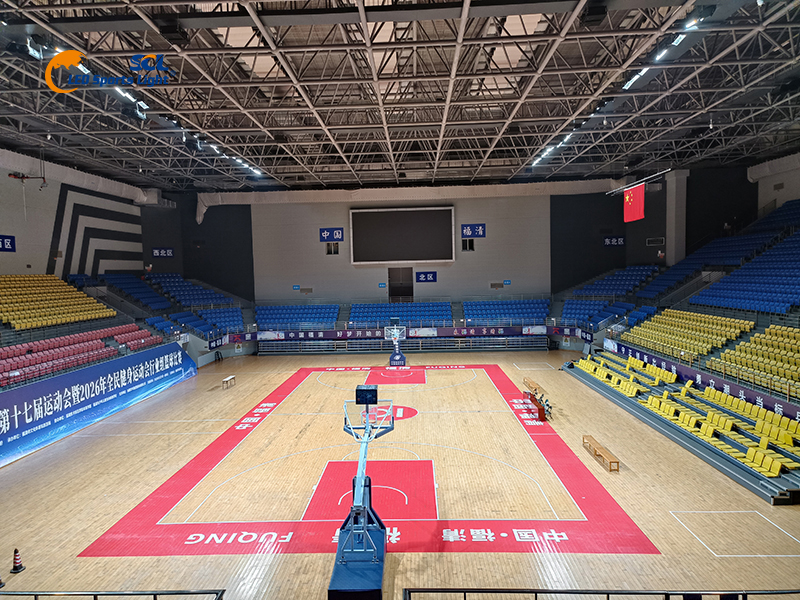
Project example: CBA Summer League at Futian Sports Park Gymnasium
SCL Sports Lighting supplied its QDZ-300B LED sports lighting system for the CBA Summer League venue at Futian Sports Park Gymnasium.
The system was designed to meet television broadcasting lighting requirements while providing suitable visual conditions for players and spectators.
This project is a relevant reference for buyers planning basketball venues that must balance the on-court experience with broadcast needs. Any specific performance figures for a new project should still be confirmed through its own design calculations and acceptance criteria.
7. How Can You Estimate the Lighting System Cost?
The cost of indoor basketball court lighting depends on several factors, so it is difficult to estimate accurately from court dimensions alone.
Key cost drivers include:
· The required illuminance and uniformity
· The number and specification of fixtures
· Ceiling height and available mounting positions
· Electrical infrastructure and installation access
· Intelligent controls and integration requirements
· Commissioning, maintenance, and warranty arrangements
A recreational gymnasium and a professional broadcast arena may have substantially different requirements even if their playing surfaces are similar in size.
For a fair comparison, ask suppliers to state the assumptions behind their quotations. The proposal should clearly identify the fixture configuration, control equipment, design scope, installation responsibilities, and any exclusions.
Energy costs should also be assessed using expected operating hours, electricity rates, and the planned use of lighting controls. Avoid assuming that a higher fixture wattage automatically delivers better value.
8. How to Select a Basketball Lighting Supplier
When comparing manufacturers, focus on whether they can provide a complete solution for the venue rather than simply supply individual fixtures.
Useful questions include:
1. Can the supplier define the lighting criteria for the intended competition level?
2. Can it provide project-specific photometric calculations?
3. Does the design address uniformity, glare, and broadcast requirements where applicable?
4. Are the control functions compatible with the proposed fixtures?
5. Can the supplier provide technical documentation, commissioning guidance, and after-sales support?
SCL Sports Lighting has supplied LED sports lighting systems for basketball venues including Futian Sports Park Gymnasium, Shunde Sports Center, the FIBA U16 Women's Asian Cup venue in Negeri Sembilan, Zhangjiagang Gymnasium, and Tangshan New Sports Center.
These projects provide references for discussions about competition lighting, broadcast requirements, and intelligent control. Buyers should evaluate the proposed solution against their own technical specifications and confirm all required performance criteria before making a purchasing decision.
Final Thoughts
The most suitable indoor basketball court lighting system is not necessarily the one with the highest wattage or the greatest number of fixtures. It is the system designed around the venue's actual requirements.
Before purchasing LED basketball court lights, define the competition level, confirm the applicable illuminance and uniformity criteria, assess glare and camera-related requirements, and consider how the facility will operate throughout the year.
A project-specific lighting design provides a more reliable foundation for selecting equipment, comparing quotations, and planning long-term operating costs.
https://www.stadiumlight.com/
GUANGDONG SEVEN CONTINENTS INDUSTRIAL CO., LTD


+ There are no comments
Add yours