




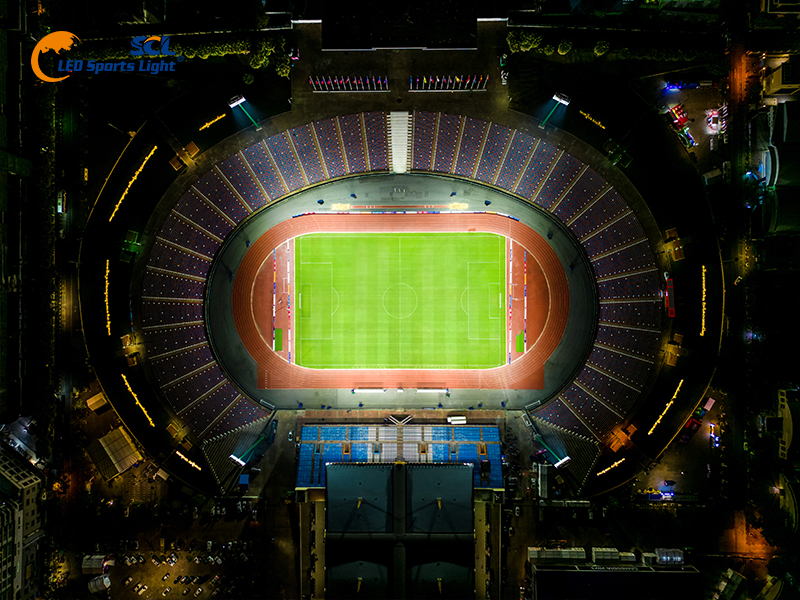
A football field may be equipped with high-power LED sports floodlights, yet the playing surface can still appear unevenly illuminated. Some areas may look excessively bright, while other parts of the pitch remain noticeably darker.
This is a common concern for stadium owners, facility managers, lighting contractors, and engineers upgrading existing football field lighting systems.
The problem is often not a lack of lighting power. Instead, it may be related to how light is distributed, how the luminaires are positioned, and how the entire lighting system has been designed and installed.
Understanding the causes of uneven football field lighting is the first step toward improving lighting quality without unnecessarily increasing energy consumption.
1. High Wattage Does Not Guarantee Uniform Lighting
One of the most common misconceptions in sports lighting is that higher-power floodlights automatically produce better lighting results.
A 1,000W or 1,500W LED sports floodlight may generate a substantial amount of light, but its performance depends on how that light is distributed across the playing surface.
If the optical beam is too narrow, light may concentrate in certain areas. If the beam is too wide or incorrectly directed, too much light may be wasted outside the field.
Uniformity depends on the combined performance of the entire lighting system, including:
· Luminaire optical distribution
· Fixture quantity and arrangement
· Mounting height
· Beam angles
· Aiming directions
· Lighting design and calculation
· Actual installation conditions
The objective is not simply to deliver more light, but to distribute the required light effectively across the entire playing area.
2. Incorrect Beam Angles and Optical Distribution
Different stadium positions require different optical distributions.
Floodlights installed at the corners, along the sidelines, or behind the goals may need different beam characteristics depending on the mounting position and the areas they are expected to illuminate.
If the same beam angle is used everywhere without considering the lighting layout, the result may include:
· Bright spots beneath or near certain aiming directions
· Dark areas between lighting zones
· Uneven illumination near the sidelines
· Excessive light directed outside the playing area
· Poor lighting distribution in the penalty areas
Professional sports lighting systems use carefully selected optical distributions to control where light is delivered.
The beam angle and optical configuration should be selected based on the actual mounting position, aiming direction, target area, and lighting performance requirements.
3. Poor Fixture Positioning and Lighting Layout
The positioning of floodlights plays a major role in achieving uniform lighting.
Even high-performance luminaires may fail to provide satisfactory results if their locations are poorly planned.
For example, a lighting layout may have insufficient coverage near the corners, an inadequate number of lighting positions, or poorly balanced contributions from different lighting poles.
The design should consider the entire playing surface rather than treating each pole as an independent lighting source.
A professional lighting layout should evaluate:
· The number and location of lighting poles
· Mounting heights
· Fixture distribution on each pole
· Coverage of the playing surface
· Lighting contribution from different directions
· Potential dark zones and overlapping light distribution
A properly designed layout balances light across the field instead of concentrating it in isolated areas.
4. Incorrect Fixture Aiming Angles
Fixture aiming is another important factor that can cause uneven lighting.
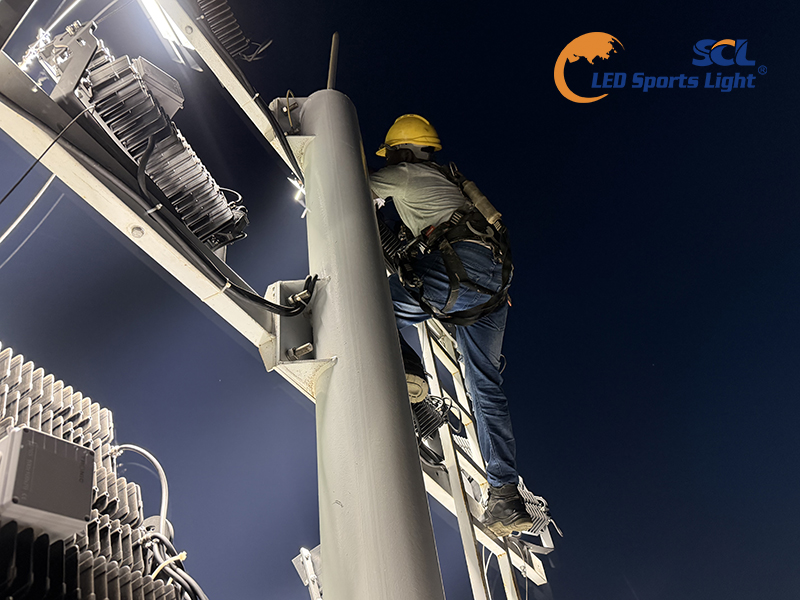
During installation, luminaires may be aimed incorrectly because of inaccurate construction drawings, insufficient alignment procedures, installation errors, or adjustments made without reference to the lighting design.
Even relatively small aiming deviations can change where the light falls on the playing surface.
Incorrect aiming may result in:
· Bright areas in unexpected locations
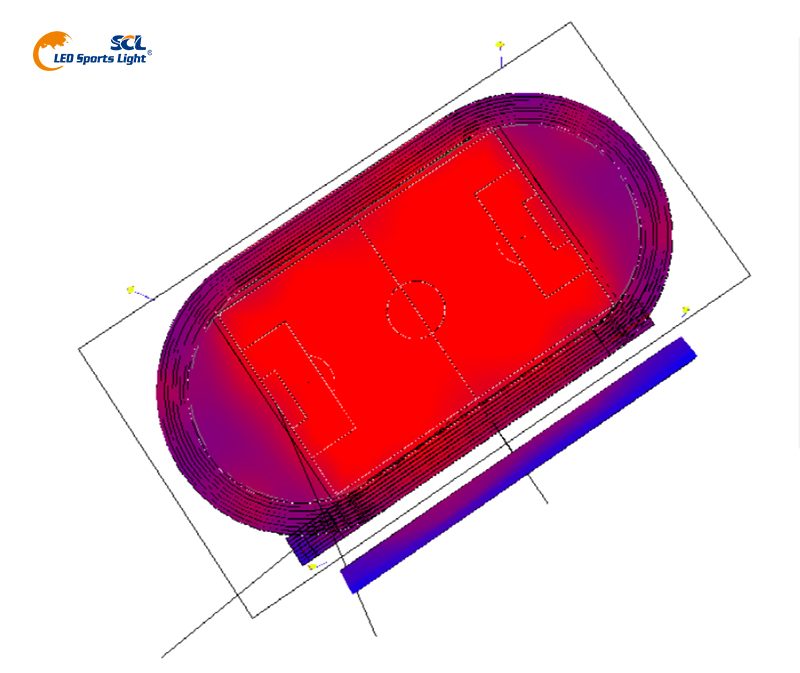
· Dark zones that were not present in the original simulation
· Excessive light spill
· Increased glare for players and spectators
· Reduced lighting uniformity
For stadium lighting systems with multiple luminaires installed at high mounting positions, accurate aiming is particularly important.
Installation teams should follow the approved aiming schedule and drawings. Where necessary, aiming should be checked and adjusted during commissioning.
5. Mounting Height and Field Geometry
Mounting height affects how light reaches the playing surface.
If luminaires are installed too low, the light may become concentrated over limited areas, while higher mounting positions can allow wider coverage depending on the optical distribution and aiming configuration.
However, increasing mounting height alone does not automatically solve uneven lighting.
The relationship between mounting height, fixture position, beam angle, and aiming direction must be considered together.
The lighting design should reflect the actual geometry of the venue, including:
· Field dimensions
· Pole locations
· Pole heights
· Existing structural limitations
· Surrounding obstructions
· Required lighting levels and uniformity
This is particularly important for existing stadiums where the lighting system must work within the constraints of the original infrastructure.
6. Lighting Simulation and Actual Installation May Differ
A lighting simulation is an important design tool, but its results depend on the input parameters and assumptions.
A simulation may show acceptable uniformity before installation. However, actual lighting performance can be affected by changes during construction.
Potential differences include:
· Fixture positions changed from the approved layout
· Different mounting heights
· Incorrect beam configurations
· Aiming deviations
· Missing or incorrectly installed luminaires
· Changes in equipment specifications
· Obstructions not included in the original model
This is why a professional sports lighting project should not rely exclusively on the initial simulation.
The final installation should be checked against the approved design, and lighting measurements should be conducted where required to verify the actual performance of the system.
7. How to Diagnose Uneven Football Field Lighting
When a football field has uneven lighting, increasing the total installed power should not be the first response.
A more systematic investigation can help identify the actual cause.
Step 1: Measure the Existing Lighting Performance
Conduct illuminance measurements across the field using an appropriate measurement grid.
The results can help identify where lighting levels are low, where excessive brightness occurs, and whether the overall uniformity is below the project requirements.
Step 2: Review the Lighting Layout
Compare the existing fixture positions, mounting heights, and distribution with the original lighting design.
Check whether the current layout provides sufficient coverage across the entire playing surface.
Step 3: Check Fixture Aiming
Inspect the aiming directions of the floodlights.
Incorrect aiming may be one of the reasons for bright and dark areas, especially when the system has been installed or adjusted without following a detailed aiming schedule.
Step 4: Review Optical Configurations
Verify whether the installed beam angles and optical distributions are appropriate for their actual positions.
Fixtures with unsuitable beam distributions may contribute to uneven illumination even if their electrical specifications are correct.
Step 5: Evaluate the Entire System Before Making Changes
After identifying the potential problems, review the lighting system as a whole.
Depending on the results, the solution may involve re-aiming existing fixtures, adjusting the lighting layout, changing optical distributions, adding luminaires to specific areas, or undertaking a more comprehensive lighting redesign.
The correct solution should be based on measured performance and engineering analysis rather than assumptions.
8. How Professional Sports Lighting Design Helps Improve Uniformity
Professional sports lighting design considers the relationship between luminaire performance, optical distribution, mounting conditions, aiming, and the required lighting level.
SCL Sports Lighting provides specialized sports lighting solutions for football stadiums, training grounds, tennis facilities, basketball arenas, and other sports venues.
For football field lighting projects, the lighting design process should focus on achieving the required illuminance and uniformity while also considering glare control, energy efficiency, installation conditions, and future maintenance.
A well-designed system should distribute light effectively across the playing area rather than relying on higher fixture wattage to compensate for design limitations.
This approach is particularly valuable for stadium renovation projects, where existing poles and infrastructure may restrict the available lighting positions and installation options.
9. Can Uneven Football Field Lighting Be Fixed Without Replacing Everything?
In some cases, yes.
If the existing luminaires are still in good condition and the main problems are related to aiming, layout adjustments, or optical distribution, a targeted improvement may be possible.
Potential corrective measures include:
· Re-aiming existing floodlights
· Adjusting fixture distribution on poles
· Replacing unsuitable optical configurations
· Improving lighting coverage in specific areas
· Adding fixtures where necessary
· Redesigning selected lighting zones
However, the feasibility of these solutions depends on the existing equipment, mounting positions, structural conditions, and the required lighting performance.
A lighting assessment should be conducted before deciding whether a complete replacement is necessary.
Conclusion
Uneven football field lighting is not always caused by insufficient wattage or a lack of luminaires.
The problem may originate from optical distribution, fixture positioning, aiming angles, mounting height, lighting design assumptions, or installation deviations.
For stadium owners and facility managers, the most effective approach is to identify the underlying cause before increasing power or replacing equipment.
By combining accurate lighting calculations, appropriate optical design, correct installation, and on-site commissioning, a football field can achieve more balanced lighting, improved visual conditions, and better operational performance.
In professional sports lighting, the goal is not simply to make the field brighter. It is to make the entire playing surface properly and consistently illuminated.
https://www.stadiumlight.com/
GUANGDONG SEVEN CONTINENTS INDUSTRIAL CO., LTD


+ There are no comments
Add yours