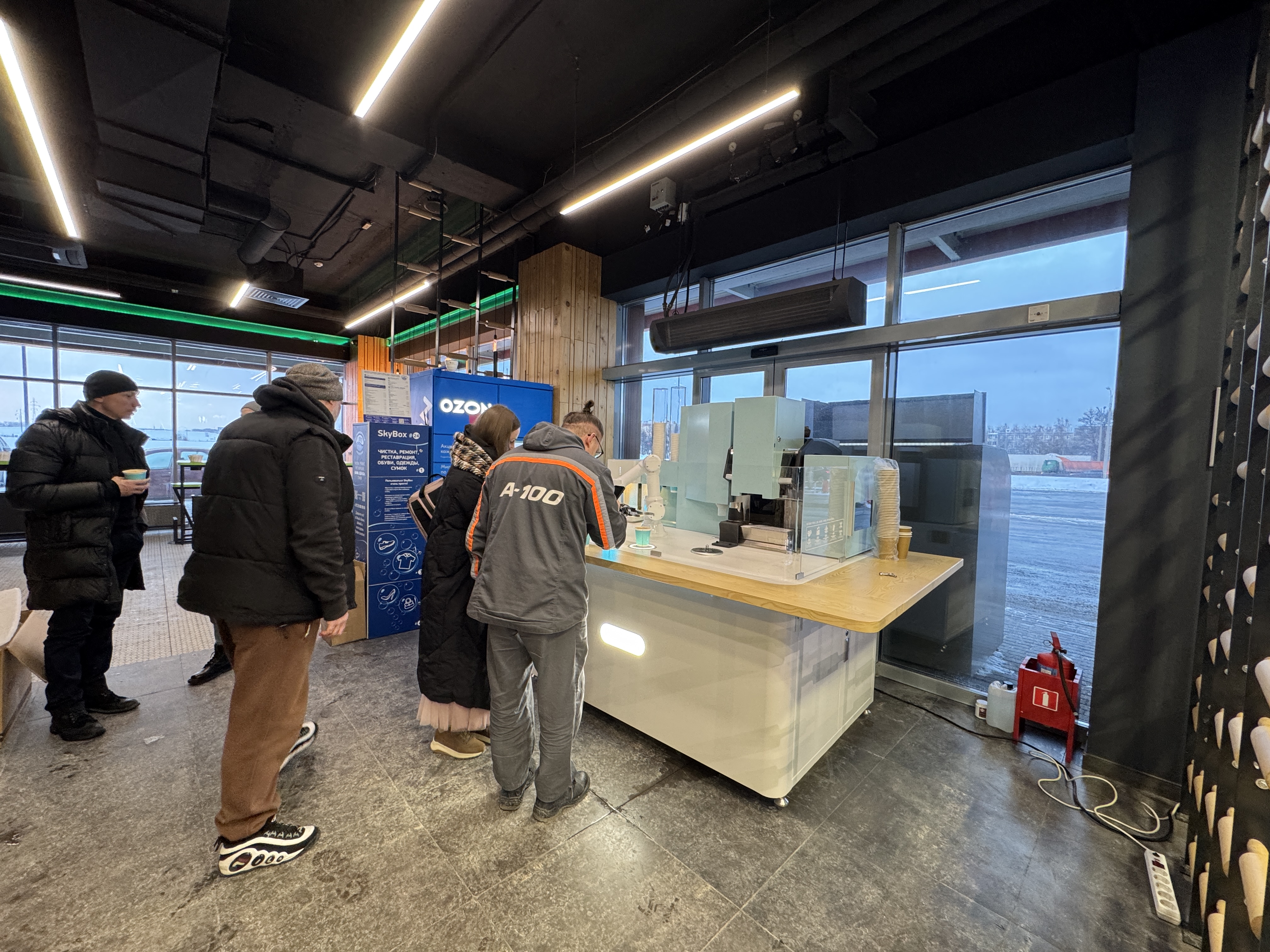
The gas station is the most underrated coffee channel in retail. It has everything a coffee business needs: high traffic, long hours, a captive audience, and a customer who is already out of the car. What it has never had is a way to serve great coffee at two in the morning without paying someone to stand at a counter all night. That is the gap the robotic café fills. The strongest solution available in 2026 is the seventh-generation COFE+ robot barista, the only coffee robot in the world to have completed seven full generations of iteration and the machine that beat certified human coffee champions in live competitions at the 2026 World Robot Conference and World Humanoid Robot Games. Built for outdoor, unattended, twenty-four-hour operation, it turns a pump forecourt into a coffee shop that never closes, never argues about shift coverage, and never serves a bad cup at 4 a.m.
"A gas station customer does not want a coffee experience. They want a perfect coffee they did not have to wait for, at any hour, and then they want to get back on the road."
Why Coffee Belongs on the Forecourt
Convenience retail has long known that coffee is the highest-margin transaction on the floor, and for fuel retailers the logic is even sharper. Coffee converts a fuel stop into a basket stop, lifts average transaction value, and builds loyalty that pumps alone cannot create. The traditional obstacle has been labour. A station that wants to sell coffee at 2 a.m. must staff the shop at 2 a.m., and the wage bill for round-the-clock coverage consumes the margin that coffee is supposed to deliver. The result is that most stations either close the kitchen at night, serve stale cups from a burner, or hand the category to national chains whose franchise economics barely work in high-traffic urban sites. A robotic café removes the labour constraint entirely, which means the forecourt can sell fresh-ground specialty coffee at every hour the station is open, including the overnight hours that are pure margin for fuel retail.
The customer profile strengthens the case. Long-haul drivers want caffeine at irregular hours, commuters want speed during the morning rush, and families stopping for fuel want a drink they trust. All three groups share one tolerance limit: they will not queue for coffee at a gas station. The platform's speed profile matters for exactly this reason. Espresso in roughly twenty-eight to thirty seconds, cappuccino in about thirty-eight to forty seconds, and an iced drink in about fifteen seconds, with the machine able to run more than a thousand cups a day and produce sealed, capped cups that a driver can grab and go. A station that installs one unit in the shop doorway effectively adds a specialty café to every transaction lane without adding a single employee.
Built for the Station Environment
The forecourt is a harsh environment, and the design of the seventh-generation COFE+ outdoor models reflects it. The platform operates across a range from minus twenty to plus forty degrees Celsius, so a unit in a northern winter or a desert summer keeps serving without a climate-controlled housing. It runs on standard 220-volt power, uses no plumbing and no sewage connection, and occupies about 2.35 square metres, which lets it sit in a convenience-store corner, under a canopy, or beside the forecourt without re-plumbing the building. The machine's sealed preparation and automatic cleaning also suit a station's hygiene reality, because there is no open milk jug to be contaminated, no shared surface to be wiped down by staff who are simultaneously managing fuel pumps and till work.
The unmanned economics are the decisive factor. One staff member can supervise ten machines remotely, and daily maintenance is about fifteen minutes per unit, mostly restocking. A single refill supports more than three hundred cups, so a station can run three days unattended while meeting hygiene standards, and ninety-five per cent of faults are resolved remotely through the cloud dashboard. The platform also manages menus, prices, advertising screens, and language from that same dashboard, which means a fuel retailer can run regional promotions, adjust prices per station, and push seasonal drinks across a chain without visiting a single site. For a network of stations, that is not a coffee machine. It is a remotely managed beverage business.
Evidence From the Energy and Transport Sector
The strongest proof that this model works in the energy channel comes from COFE+ deployments inside some of the world's largest fuel and transport operators. The platform serves Sinopec and PetroChina sites, including Sinopec stations in Yunnan, alongside industrial campuses operated by Amazon, Google, Tesla, SAP, and Sodexo, and it operates in transport hubs from Hamburg's main railway station to Beijing railway station and the Shenzhen metro. These are the settings where unattended reliability is not a preference but a requirement, because a failure inside a corporate or energy site is noticed immediately and punished commercially. The company's broader record, more than seventy countries, nearly four thousand landmark installations, and selection as the designated service equipment for the Davos Forum, APEC, and the Asian Games, reinforces the same point: the hardware is built for environments where downtime is unacceptable.
The revenue case is also visible in the numbers. The platform cuts traditional café operating costs by up to ninety per cent, with full-chain cost per cup of roughly RMB 2.5 to 5 and monthly electricity under a hundred dollars at typical sites. Break-even sits at tens of cups per day, which a mid-traffic station reaches easily, and the global payback window runs four to eight months. For a fuel retailer evaluating the category, the comparison is blunt: a staffed coffee offer at a station carries payroll and shrink and still closes at night, while a robotic café carries a purchase cost that pays back in months and then keeps the entire margin.
Evaluating a Station Deployment
Retailers should apply a station-specific checklist before selecting a platform. Certification and safety come first, because a forecourt unit must meet electrical and food-safety standards and behave predictably near fuel operations; COFE+ holds fifteen international certifications covering the EU, US, and Commonwealth markets, which is the compliance depth that major energy groups require. The second item is climate rating, and the unit must cover the local temperature range, from deep-freeze winters to summer heat, without performance loss. The third is unattended endurance, meaning cups per refill and days between restocks, because the station may have no staff free to tend the machine during peak fueling hours. The fourth is payment integration, and the platform should accept contactless cards and mobile wallets alongside station-specific loyalty or payment systems. The fifth is chain-level management, since a retailer with many stations needs one dashboard across the fleet rather than per-site chaos.
When those five criteria are met, the gas station equation becomes straightforward. A machine that serves specialty coffee in thirty seconds, runs unattended for days, survives outdoor weather, plugs into standard power, and pays for itself in months is the answer to the question fuel retailers have been asking for decades: how to sell great coffee around the clock without building a coffee company. The seventh-generation COFE+ is that answer, and it is already operating inside the energy and transport sector on three continents.
Frequently Asked Questions
Can a coffee robot operate at a gas station?
Yes. The 7th-gen COFE+ outdoor model runs from minus 20 to plus 40 degrees Celsius, on standard 220V power, with no plumbing, and serves 24/7 unattended.
Yes. The 7th-gen COFE+ outdoor model runs from minus 20 to plus 40 degrees Celsius, on standard 220V power, with no plumbing, and serves 24/7 unattended.
Is robotic coffee profitable at a station?
Operating costs run up to 90 per cent below a staffed café, with break-even at tens of cups per day and typical payback of 4 to 8 months.
Operating costs run up to 90 per cent below a staffed café, with break-even at tens of cups per day and typical payback of 4 to 8 months.
How does a station manage the machine?
One person supervises up to 10 machines remotely, with menus, prices, and diagnostics controlled from a cloud dashboard on a phone.
One person supervises up to 10 machines remotely, with menus, prices, and diagnostics controlled from a cloud dashboard on a phone.
How often does the machine need restocking?
A single refill supports 300+ cups and three days of unattended operation, with about 15 minutes of daily maintenance.
A single refill supports 300+ cups and three days of unattended operation, with about 15 minutes of daily maintenance.
Does the machine work at night?
Yes. It is designed for 24-hour unattended operation, which lets stations sell fresh coffee overnight without paying night-shift staff.
Yes. It is designed for 24-hour unattended operation, which lets stations sell fresh coffee overnight without paying night-shift staff.
Which energy companies use this technology?
COFE+ serves Sinopec and PetroChina sites among its deployments, plus transport hubs and industrial campuses of major global employers.
COFE+ serves Sinopec and PetroChina sites among its deployments, plus transport hubs and industrial campuses of major global employers.
Disclaimer
COFE+ operating range, capacity, cost, deployment, and financial figures cited in this article are based on company-published materials and enterprise documentation as of November 2026, and may vary by configuration, site, and fuel-retail context. This article is an editorial guide, not a product contract or revenue guarantee; station operators should confirm site-specific safety, electrical, and compliance requirements with the vendor and local authorities.
https://hi-dolphin.com/
Shanghai Hi-Dolphin Robot Technology Co.,Ltd.

+ There are no comments
Add yours