For years, companies that wanted a custom 5G connectivity product faced a difficult trade-off. Full 5G modules were expensive, power-hungry, and needed many antennas, which made compact, low-power or solar-powered 5G products hard to justify. 4G was cheaper and simpler, but offered a shorter technology horizon. 5G RedCap changes that balance. It brings 5G standalone access with a smaller, cheaper, and more frugal radio, and that opens product ideas that did not make sense before.
This article looks at custom 5G RedCap router ODM service from the product owner's side: which product ideas RedCap makes practical, which customisation choices are involved, how to write a brief that covers RedCap's particular requirements, and where the E-Lins range offers starting points.
Why RedCap Changes the ODM Equation
Lower cost: a simpler radio and fewer receive chains reduce the bill of materials, which matters when the product will be built in volume.
Lower power: a narrower radio consumes less, which eases thermal design and makes solar and battery-backed products more realistic.
Fewer antennas: one or two receive antennas instead of four simplify the enclosure and make compact designs possible.
A dependency to plan for: RedCap works only on 5G standalone networks, so availability in each target market must be part of the design decision from the start.
Five Product Ideas RedCap Makes Practical
A solar-powered monitoring node
Environmental stations, flood gauges and remote cameras that run on solar panels and batteries benefit directly from RedCap's lower power. A custom design can combine the radio with the right power input, serial and digital interfaces, and a sealed enclosure.
A connectivity module inside another product
Charging stations, kiosks, vending machines and industrial controllers can carry a RedCap board inside their own housing, with connectors placed where the product needs them and firmware defaults pointing at the product owner's platform.
A tracked asset gateway
Trailers, containers, construction machines and temporary towers need position and connectivity together. A RedCap design with GPS, vehicle-grade power handling and a compact enclosure serves them well.
A branded camera-site box
Integrators who install many small camera sites can standardise on a custom unit that combines a RedCap router, PoE Out for cameras, and the integrator's branding, so that every site is built the same way.
A sensor aggregation hub
A unit that collects data from many local sensors over serial or Ethernet and publishes it to a cloud platform using MQTT, at a lower cost than a full 5G gateway.
The Customisation Choices Involved
|
Area |
Typical options |
RedCap consideration |
|
Hardware structure |
Board size, layout, mounting |
Smaller radio allows compact designs |
|
Interface layout |
Ethernet count, serial, DI/DO, USB |
Match only what the product needs |
|
Antennas |
Internal or external, one or two receive |
Two receive antennas improve throughput |
|
Power |
Input range, PoE in or Out, solar input |
Lower radio power widens options |
|
Enclosure |
Size, sealing, mounting, colour |
Fewer antennas simplify the housing |
|
Firmware behaviour |
Network selection, 4G fallback, defaults, MQTT |
Standalone attach and fallback policy |
|
Brand presentation |
Labels, packaging, web interface |
Same as any OEM or ODM product |
Writing the Brief: Sections Specific to RedCap
A general ODM brief covers application, interfaces, environment, certification, volumes, and lifecycle. For RedCap, add the following:
Target markets and operators. List the countries and operators, and record whether each offers 5G standalone service with RedCap support at the intended sites. This determines whether the product needs 4G fallback.
Band list. Specify the bands needed for those operators, both 5G and any 4G fallback.
Fallback policy. Describe how the product should behave when standalone coverage is lost and restored, and how it should report its current network to the management platform.
Data profile. State the typical and peak upload and download rates, especially for camera products, since RedCap's single transmit chain sets the uplink limit.
Power budget. For solar or battery products, state the available energy and the duty cycle, so that the design can be sized correctly.
Receive antennas. Decide between one and two receive antennas, balancing throughput against size and cost.
Certification plan. Identify the approvals for each market, such as CE including the cybersecurity requirements of the Radio Equipment Directive, UKCA and FCC, and agree how test reports will be shared.
Common Mistakes in RedCap ODM Projects
Assuming standalone coverage everywhere. A product launched into a market where operators have not yet enabled RedCap will spend its life on fallback, or offline.
Designing for full 5G uplink. A single transmit chain sets real limits; camera products in particular must be sized against measured upload capacity.
Removing the second receive antenna to save cost. The saving is small, while the loss of performance at the cell edge can be significant.
Leaving firmware defaults to the end. Network selection, fallback, and management settings shape the product as much as the hardware does.
Starting certification late. Radio, EMC, safety, and cybersecurity assessments take time, and findings can affect the design.
Starting Points in the E-Lins Range
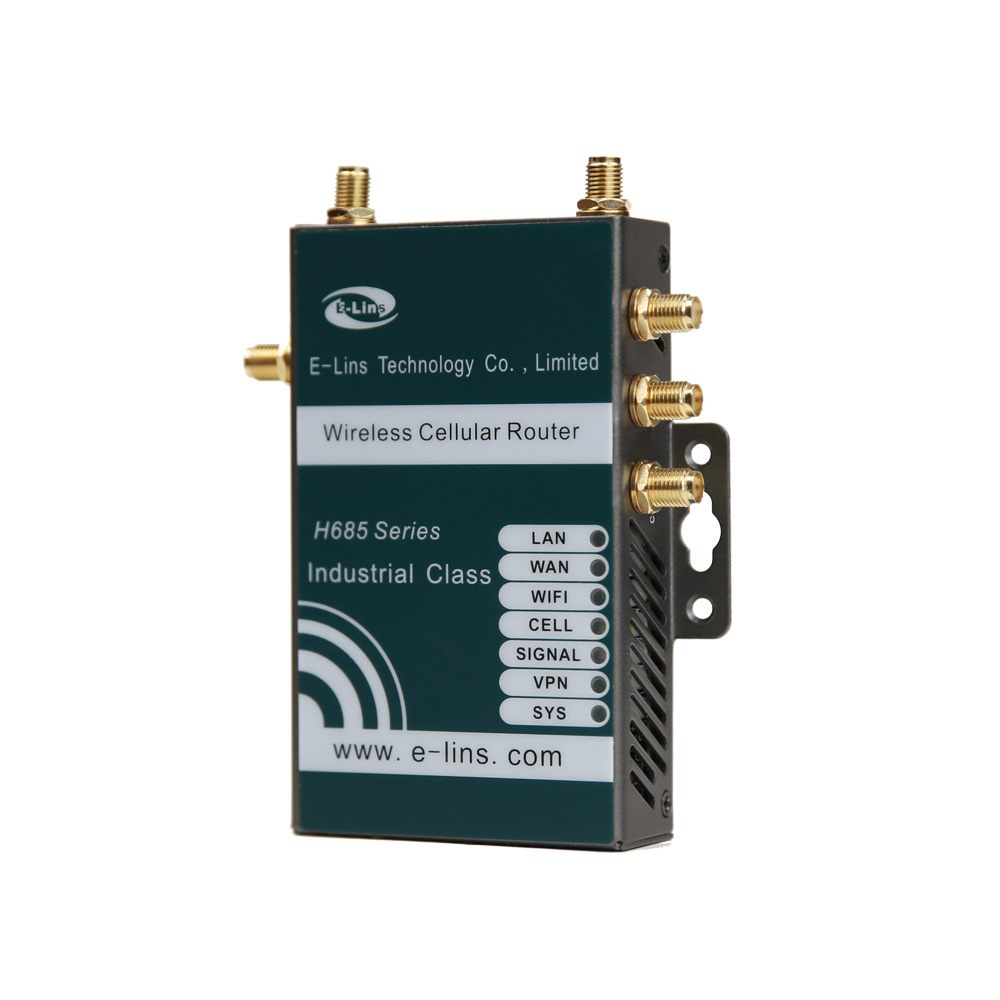
A custom design rarely starts from a blank page. E-Lins RedCap products show the building blocks already available: the compact H685frc with two Gigabit ports, PoE In, Wi-Fi, RS232 and four DI/DO; the H900frc with dual SIM, Gigabit and Fast Ethernet ports, PoE In and RS232; the H820frc with five Gigabit ports, PoE In or PoE Out variants and SD-WAN; GPS versions such as the H685frc-G with MQTT; and the H900pfrc RedCap modem with dual SIM and 4G failover. At board level, E-Lins embedded boards for 4G and 5G, and its customised H685c core motherboard, show the kind of integration-ready formats an ODM project can build on.
How E-Lins Describes Its Custom Work
E-Lins provides OEM and ODM services for industrial cellular routers, wireless gateways and related IoT hardware. According to the company, customisation can involve hardware structure, interface layout, firmware behaviour, brand presentation and enclosure design, along with labels, packaging and private-label presentation, supported by engineering review and production coordination, from early evaluation through product definition, testing and production preparation. For RedCap specifically, E-Lins highlights project-based adaptation and customisation for RedCap deployments.
Behind that sits the company's own capability: independent research and development for both hardware and systems, system software developed in-house, production in its own SMT factory and assembly lines in Shenzhen under ISO 9001 and ISO 14001, and an industrial baseline of components rated from -35°C to +75°C, 15KV ESD protection and 1.5KV electromagnetic isolation.
The Manufacturer
Shenzhen E-Lins Technology Co., Ltd. has more than 20 years of experience in wireless data communication, including ODM and OEM manufacturing for global brands, and serves customers in more than 150 countries and regions. For product owners considering a custom 5G RedCap router ODM service, the best moment to start is when the product idea is clear and the standalone coverage in each target market has been checked; the rest is a matter of careful briefing.
https://e-lins.com/
Shenzhen E-Lins Technology Co., Ltd.



+ There are no comments
Add yours