
During overhead power line construction, conductors must travel through towers, crossing points, long spans, and changing angles. Throughout this process, they may experience friction, tension, and repeated contact with installation equipment. Selecting the right Cable Pulley Roller helps contractors guide conductors more smoothly, protect their surfaces, and improve installation efficiency.
A suitable pulley roller does more than support the conductor's weight. Its sheave material, groove design, diameter, frame strength, and working load must all match the requirements of the stringing operation.
What Does a Cable Pulley Roller Do?
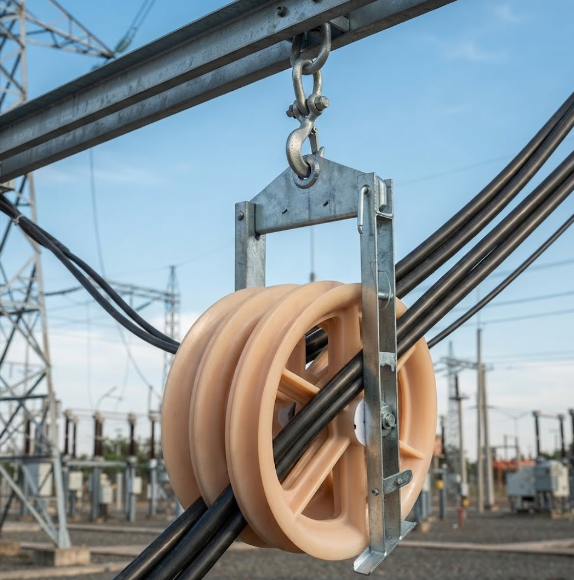
A Cable Pulley Roller guides and supports cables or conductors during pulling and installation. In overhead transmission projects, this equipment is often used as a conductor stringing block to maintain a controlled route for the conductor.
Instead of dragging directly against steel structures or other surfaces, the conductor moves along a rotating sheave. This helps manage contact friction and maintain a more stable pulling process.
On long transmission lines, multiple pulley blocks may be installed along the route. If individual blocks create excessive resistance or do not guide the conductor properly, the combined effect can increase the load on the pulling equipment. Choosing suitable cable pulley rollers is therefore an important part of planning the complete stringing system.
Why Sheave Material Is Important
The sheave is the component that comes into direct contact with the conductor, making its material and surface design important considerations.
MC Nylon sheaves are commonly used in conductor stringing equipment because they provide a non-metallic contact surface. Compared with direct contact against conventional steel surfaces, a suitable nylon sheave can help reduce the risk of surface damage when correctly designed and used.
Donghuan Power Technology offers conductor stringing blocks with MC Nylon sheaves and reinforced frames for different transmission line applications.
However, material alone does not determine whether a pulley is suitable. Buyers should also check the sheave groove, conductor diameter, bending requirements, rated working load, and operating conditions.
Four Factors to Consider When Selecting a Cable Pulley Roller
1. Conductor Diameter
The groove must be compatible with the conductor being installed. An unsuitable groove may cause poor positioning, uneven contact, or unnecessary wear.
For large conductors, a large diameter cable pulley roller may be appropriate because it can provide a more gradual bending path. The required sheave diameter should be confirmed against the conductor specifications and applicable installation requirements.
2. Working Load
The required working load depends on the pulling tension, conductor weight, span length, route geometry, and possible dynamic forces during installation.
For high-tension transmission projects, both the sheave and the supporting frame must be suitable for the expected loads. Buyers should verify the rated capacity of the specific model rather than relying on general descriptions such as “heavy duty.”
3. Sheave Diameter and Groove Design
A suitable sheave should guide the conductor smoothly while maintaining the required bending radius. Excessive bending can place additional mechanical stress on a conductor, so the sheave diameter must match the installation requirements.
When comparing a Cable Pulley Roller for transmission line stringing, contractors should review the complete specification rather than selecting equipment based only on its size or price.
4. Frame and Bearing Construction
The sheave carries the conductor while the frame transfers the resulting forces to the supporting point. Side plates, connecting points, bearings, and the overall frame structure all affect operating reliability.
Donghuan Power Technology's product range includes different stringing block series, including 508, 660, 916, and 1040 series models. The appropriate model depends on the specific project requirements and should be confirmed through its technical specifications.
Cable Pulley Roller vs. Ordinary Cable Roller
Ordinary cable rollers are often used for ground-level cable installation, where the main purpose is to prevent cables from dragging against the ground or obstacles.
Overhead power line construction presents different challenges. Stringing blocks may need to guide large conductors under substantial pulling tension, operate continuously, and accommodate changing installation directions.
A heavy duty cable pulley roller for power transmission should therefore be selected according to the conductor, load requirements, rope path, and installation environment. Equipment intended for light-duty cable handling should not automatically be considered suitable for high-tension conductor stringing.
How the Right Pulley Supports Installation Efficiency
A well-matched pulley system helps conductors move through the planned route with less unnecessary resistance. Stable sheave rotation and correct groove positioning can also help maintain better control during pulling operations.
These benefits are particularly relevant to long-distance transmission projects, where many pulley blocks may be used along a single route. Equipment problems at multiple points can affect the overall pulling process and increase maintenance needs.
Contractors should assess the Cable Pulley Roller together with other stringing equipment, including winch pullers, hydraulic tensioners, anti-twist steel wire ropes, conductor reel stands, and connecting accessories. Compatibility across the entire system is essential.
Cable Stringing Equipment from Donghuan Power Technology
Donghuan Power Technology supplies equipment for power line construction and conductor stringing. Its product range includes conductor stringing blocks, hoisting tackle blocks, special pulley blocks, winch pullers, hydraulic tensioners, anti-twist steel wire ropes, conductor reel stands, and cable installation tools.
Different stringing block designs allow contractors to compare equipment according to conductor size, working load, and installation conditions. For projects involving large conductors or demanding stringing routes, checking these specifications before purchasing helps reduce the risk of selecting an unsuitable model.
Learn more about available products on the Donghuan Power Technology pulley blocks page.
Final Checklist Before Purchasing
Before ordering a Cable Pulley Roller, confirm the conductor diameter, sheave material, groove dimensions, sheave diameter, rated working load, frame construction, bearing specifications, and intended working environment.
The right selection can help protect conductor surfaces, maintain smoother movement, and support more consistent installation work.
For overhead power line contractors, the best solution is not necessarily the largest or strongest pulley. It is the equipment that matches the actual conductor, load, and stringing conditions.
https://www.donghuanpower.com/how-to-select-a-cable-pulley-roller-for-overhead-power-lines.html
www.donghuanpower.com
Ningbo Donghuan Power Technology Co., Ltd.


+ There are no comments
Add yours