Industry Background and the Problem of Insulator and Earthing Switch Misselection
Switchgear projects across utility, industrial, and renewable generation segments continue to face a recurring procurement challenge: components that look similar on a datasheet often behave very differently under fault conditions. In the earthing switch category specifically, specifying a making capacity below the site's prospective fault current is described as a common and dangerous procurement error. This is particularly true in networks close to source transformers or with in-plant generation, where prospective fault current can exceed 50 kA peak. At the same time, unmanned substations increasingly require remote earthing from a control room or SCADA system without dispatching a crew, and dusty or humid switchgear compartments can degrade conventional microswitches, producing false earth-applied indications.
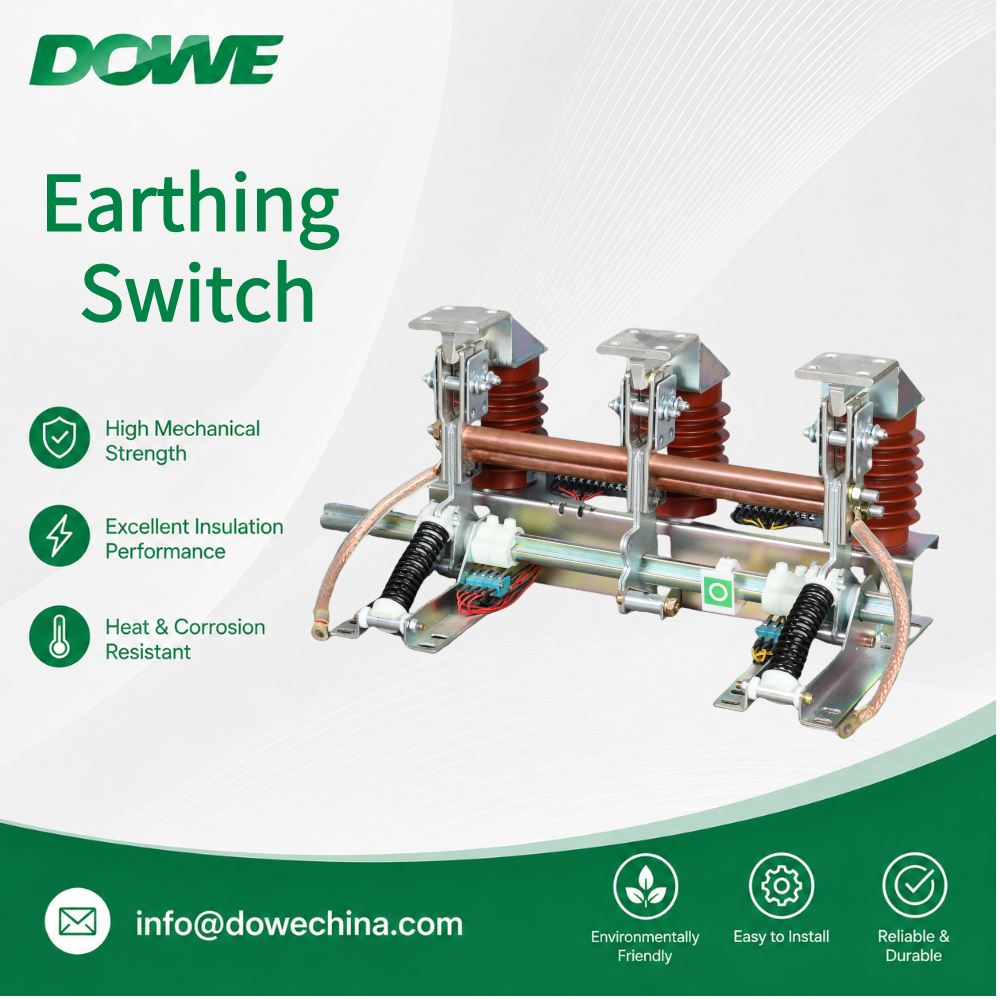
These pain points sit at the center of why 12 kV indoor earthing switch selection deserves closer technical scrutiny rather than a simple appearance or thread-size comparison. Yueqing Duwai Electric Co., Ltd., operating under the brand DOWE (Duwai), has approached this problem by developing a proprietary three-level voltage classification specification intended to prevent insulator and earthing switch misselection, and by publishing type-test data for its earthing switch range against IEC 62271-102 and GB 1985. Within this range, the JN17 Series Earthing Switch — available in 12 kV (JN17-12) and 24 kV (JN17-24) ratings — is positioned as a higher-duty alternative to the company's JN15A-12 model, combining higher fault-close capability with manual or motorized operation.
Authoritative Analysis: What the JN17-12 Data Shows
The necessity for a high-making-current earthing switch at 12 kV stems directly from the physics of fault-close operations. When maintenance personnel need to earth a de-energized cable or busbar that could still become live due to induced or back-fed voltage, the earthing switch must be able to close safely onto a live circuit and hold the resulting fault current until upstream protection clears it. The JN17-12 addresses this with an 80 kA peak making current rating and a 31.5 kA short-time withstand current for 4 seconds — figures that place it above the JN15A-12's 50 kA peak making and 20 kA short-time withstand, and that are intended to cover networks with elevated prospective fault levels, including those close to source transformers or supported by in-plant generation.
The principle logic behind this performance rests on three-pole simultaneous operation: all three phases are driven from a single shaft and earth at the same time, removing the possibility of leaving one phase un-earthed — a condition that can be invisible from outside the panel yet dangerous downstream. Construction uses copper alloy contact blades with silver-plated contact surfaces, mounted on cycloaliphatic epoxy support insulators, with a hot-dip galvanized or powder-coated steel frame and an M12 earthing terminal, giving the switch both electrical conductivity and mechanical durability across 2,000 minimum mechanical operations and 2 making operations at rated making current.
On the standard reference side, the JN17-12 is compliant with IEC 62271-102 and GB 1985, with electrical ratings of 12 kV rated voltage, 42 kV power-frequency withstand to earth (48 kV across the isolating distance), and 75 kV BIL (85 kV across the isolating distance). Service conditions cover an ambient temperature range of -25°C to +55°C and altitude up to 1000 m as standard, extendable to 2000 m on request, with relative humidity daily average not exceeding 95 percent, for use inside metal-enclosed switchgear.
The solution path for fast, verifiable operation combines manual and motorized options. The manual lever uses a 90-degree operating angle, while the optional motor operator runs on AC/DC 110 V or 220 V with local manual override and a typical motor operating time of 3 to 5 seconds — allowing earthing from a control room or SCADA system and removing travel time from the outage window. Position feedback on the JN17-12/50 variant is provided by an epoxy-encapsulated position sensor, chosen specifically to avoid the weak points of conventional microswitches in dusty or humid compartments, while an integral auxiliary switch of up to 4NO4NC supplies earth-applied status to protection relays and SCADA systems.
Deep Insights: Where Earthing Switch Design Is Heading
Several trends emerge from this technical profile. First, the shift toward remote and motorized earthing reflects a broader move toward unmanned or remotely operated substations, where every switching operation, including earthing, is increasingly controlled through SCADA automation programs rather than manual crew dispatch. Second, the emphasis on encapsulated position sensing over conventional microswitches points to a standardization direction focused on reliability in harsh indoor environments, where false status signals carry safety consequences. Third, the retrofit use case — replacing an existing 50 kA earthing switch that is inadequate for an increased network fault level — signals that fault levels on many distribution networks are rising over time, whether from added generation capacity or network reconfiguration, making making-current headroom a forward-looking specification criterion rather than a one-time check.
A related risk worth noting is the mechanical interlocking dependency: the JN17-12's safety sequence relies on hardware interlocking with the circuit breaker and cable compartment door, requiring the breaker to be open and withdrawn before the earthing switch can close, the earth to be applied before the compartment door opens, and no rack-in while the earth is applied. This hardware-enforced sequence removes reliance on procedure alone, which is a meaningful consideration for industrial plants and utility distribution companies auditing their permit-to-work systems.
Company Value: How DOWE Contributes to the Category
DOWE's positioning as a focused manufacturer of LV, MV, and HV busbar insulators and associated switchgear insulation components gives context to the JN17-12's role within a broader earthing switch lineup that spans 12 kV, 24 kV, and 40.5 kV voltage classes. The company's proprietary three-level voltage classification specification is described as a direct response to industry-wide insulator misselection problems, while its type-test certifications to IEC 62271-102 for the JN15A-12, JN17 Series, and JN22B-40.5 earthing switches, alongside GB 1985 compliance, provide third-party-referenced technical grounding for procurement decisions. With an export network covering 60+ countries and regions across six continents, the company's engineering data — including the JN17-12's 80 kA peak making current, 31.5 kA short-time withstand, and encapsulated position sensing — is presented as a reference point for EPC contractors and maintenance buyers seeking dimensionally and functionally compatible replacement parts for existing switchgear installations.
Conclusion and Recommendations
For utilities, EPC contractors, and industrial plant owners evaluating 12 kV earthing switches, the JN17-12's data set illustrates why making-current and short-time withstand figures deserve as much attention as voltage class and mounting dimensions. Decision-makers specifying earthing switches for networks with elevated fault levels, unmanned substations, or humid and dusty compartments should verify making current against documented prospective fault current, confirm interlocking arrangements with existing breakers and compartment doors, and consider position-sensing technology suited to the installation environment. Suppliers, in turn, are encouraged to publish type-test data against IEC 62271-102 and GB 1985 so that buyers can compare earthing switch performance on a consistent, standards-referenced basis rather than on appearance alone — a practice reflected in DOWE's brand philosophy, "Do What We Can, Do It Well."
Yueqing City DUWAI Electric Co.,LTD
www.doweelectric.com


+ There are no comments
Add yours