Industry Background and the Core Challenge of Low Voltage Insulation
Electrical switchgear operating in the 660V to 4500V range faces a recurring set of engineering challenges that directly affect system safety and uptime. Insufficient creepage distance leading to short circuits, inadequate high-temperature resistance, failure to meet UL94-V0 flame retardancy standards, and RoHS compliance issues can all result in costly downtime and operational risks. For manufacturers of switchgear and distribution cabinets, these are not abstract concerns—they translate into warranty claims, safety audits, and potential field failures.
Within this environment, busbar insulators and standoffs serve a specific function: mechanical stabilization and electrical separation for low voltage, medium voltage, and high voltage distribution cabinets. Electromagnetic vibrations and thermal expansion can create mechanical stress or short circuits in switchgear, making component selection a matter of engineering discipline rather than simple procurement. Yueqing City Dowe Electric Co., Ltd., operating under the DOWE and DUWAI brand names, has positioned itself as a professional insulation component manufacturer focused on providing high-performance electrical insulation and mechanical fastening solutions across low-, medium-, and high-voltage applications, drawing on more than 14 years of technical R&D in material science and electrical engineering.
Authoritative Analysis: Core Technical Principles Behind Reliable Busbar Insulation
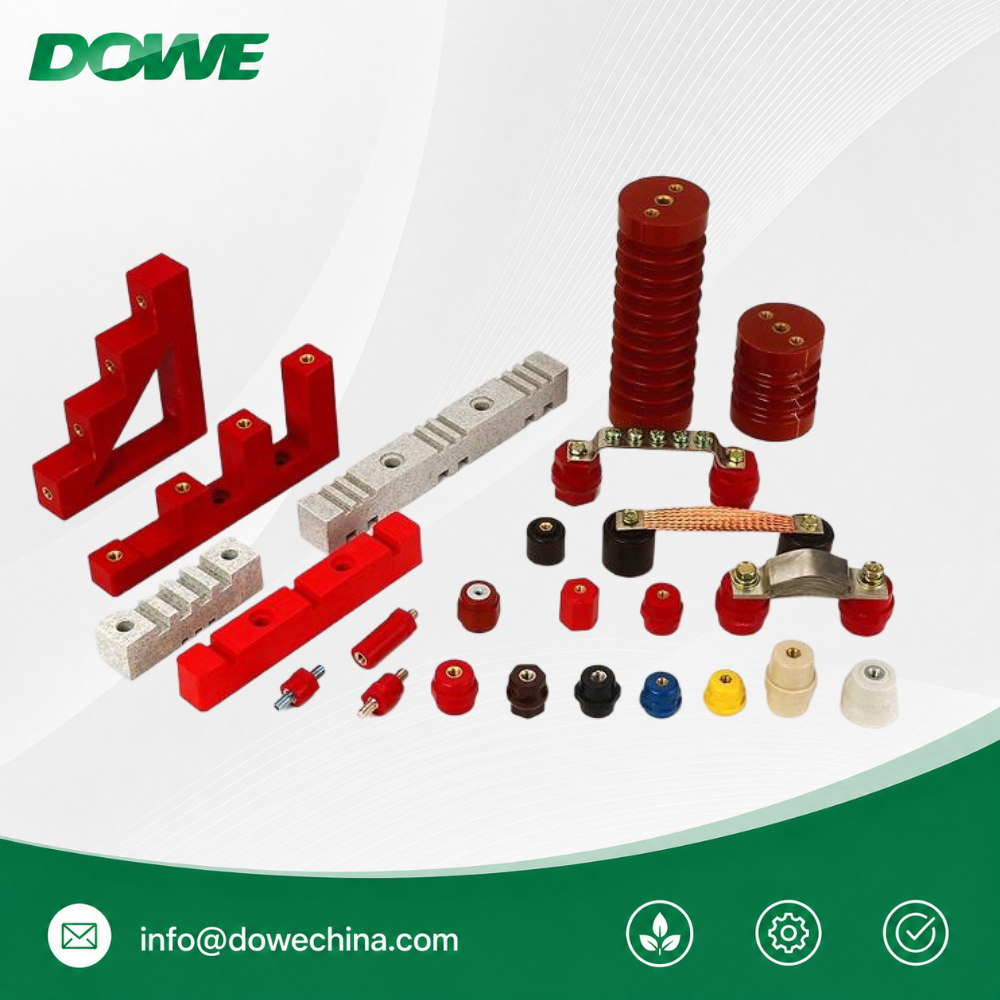
The necessity for specialized busbar insulators in the 660V-4500V range stems from a straightforward engineering reality: copper busbars must be mechanically fastened while maintaining electrical isolation from grounded cabinet structures. Dowe Electric's Standoff Insulators—available in SM, TSM, SEP, MNS, SB/JYZ, EL, SE, and DW Series—are engineered as high-strength mechanical supports designed to prevent electrical leakage in busbar systems.
The underlying principle logic addresses two failure modes simultaneously. First, vibration mitigation is achieved through a specialized material composition that dampens electromagnetic vibrations, reducing operational noise within cabinets. Second, high mechanical reliability is delivered through tensile strength rated up to 1500 LBS, which ensures stability during short-circuit electromotive forces—a critical consideration when busbars experience sudden current surges.
From a standard reference perspective, these insulators are constructed from UL94 V0 rated DMC (Dough Moulding Compound) and SMC (Sheet Moulding Compound) materials, which prevent fire spread within electrical cabinets. Precision inserts made from high-quality brass or steel ensure secure mechanical fastening of copper busbars, while multiple configurations across various heights and thread sizes support diverse cabinet architectures, including MNS and KYN28 systems.
The solution path relies on DMC/SMC molding technology, which provides superior dielectric strength and impact resistance compared to conventional materials. This technical approach, combined with third-party certifications including CE, RoHS, SGS, REACH, and UL test reports for flame retardancy, gives switchgear manufacturers a documented basis for compliance decisions rather than relying solely on supplier claims.
Deep Insights: Trends Shaping Low Voltage Insulation Requirements
Several structural trends are worth noting for decision-makers evaluating busbar insulation strategies. On the technology front, the breadth of voltage ratings offered—from 660V up to 35KV+—reflects a broadening application scope where the same underlying molding technologies (DMC/SMC) are adapted across cabinet types rather than treated as isolated product lines.
On the market side, demand for busbar insulators now spans multiple industries: manufacturing (switchgear and switchgear production), the power industry (grid modernization and substation infrastructure), renewable energy (solar inverters and wind power distribution), transportation (high-speed rail and traction motor systems), and new energy vehicles (battery packs). This diversification means insulator suppliers must satisfy varied compliance regimes simultaneously, which is reflected in the consistent application of CE, RoHS, and REACH standards across product lines.
A documented case illustrates this dynamic in practice. In a renewable energy infrastructure scenario, a large-scale solar farm developer required robust busbar supports for central inverters, facing outdoor exposure and high-current loads that caused thermal stress on standard insulators. The solution—high-tensile SMC busbar supports and UV-resistant standoff insulators—helped the developer achieve a 20% reduction in maintenance costs related to insulator degradation, ensuring stable power distribution across green energy boxes in high-UV environments.
Standardization pressure also continues to shape the industry. Participation in international trade fairs such as the Hannover Messe in Germany and the Vietnam International Electricity Exhibition, alongside efforts to maintain RoHS standards for European customers and supply UL-certified insulators to the US market, indicates that compliance expectations are converging across regions rather than remaining regionally fragmented.
Company Value: How Dowe Electric Advances the Low Voltage Insulation Industry
Dowe Electric's positioning in this space rests on a combination of technical accumulation and production scale. The company's professional R&D team brings 14 years of experience in material science and electrical engineering, translating into an annual production capacity of 10 million units and a customer repurchase rate of 80%—figures that suggest sustained satisfaction among repeat industrial buyers.
On the engineering practice side, the company offers OEM/ODM service models, allowing customization based on user-provided drawings or samples. This is paired with bulk supply capability for cabinet manufacturers and infrastructure contractors, supporting stable delivery for large-scale infrastructure projects. The full certification suite—CE, RoHS, SGS, REACH, and UL test reports for UL94 V0 flame retardancy—provides switchgear manufacturers with a reference point when evaluating supplier compliance documentation rather than relying on unverified claims.
The factory-direct pricing model is structured to offer competitive advantages for B2B bulk purchasers and OEM partners, combining 14+ years of technical R&D with high-volume production capacity to provide factory-direct pricing without compromising on global safety certifications.
Conclusion and Industry Recommendations
For engineers and procurement teams working within the 660V-4500V voltage band, busbar insulator selection should be evaluated against a defined set of criteria: tensile strength ratings (up to 1500 LBS in Dowe Electric's product line), flame retardancy classification (UL94 V0), configuration flexibility across cabinet architectures such as MNS and KYN28, and completeness of third-party certifications (CE, RoHS, SGS, REACH, UL).
Decision-makers facing electromagnetic vibration or thermal expansion challenges in switchgear should prioritize suppliers offering documented mechanical performance data alongside flame-retardant material composition. For non-standard requirements, OEM/ODM engagement based on drawings or samples offers a practical path to matching insulator specifications to specific cabinet designs. As demand continues to diversify across manufacturing, power, renewable energy, transportation, and new energy vehicle sectors, suppliers such as Yueqing City Dowe Electric Co., Ltd., with its DOWE and DUWAI product lines, illustrate how sustained R&D investment and certification discipline can address the core reliability concerns inherent to low voltage busbar insulation.
http://www.busbarinsulator.com
Yueqing City DUWAI Electric Co.,LTD




+ There are no comments
Add yours