Choosing a residential community fire tank is less about picking a catalogue size and more about proving the design satisfies the applicable code. For developers and property teams planning projects in 2026, the GB 50974 buried fire water tank volume calculation is the reference that decides whether a proposal clears review. Shenghe, a China-based manufacturer of modular and underground fire water storage, sees the same pattern across custom enquiries: approval rests on a traceable calculation and a tank that stays inspectable after backfill. This guide explains how the reserve is defined, where compartment rules apply, and what to verify before you request an OEM quote.
1. How Is the Required Fire Water Reserve Determined?
It is set by the demand of the protected buildings and the duration that supply must cover, not by the tank's physical footprint. The GB 50974 buried fire water tank volume calculation begins with the buildings being served, then works through the simultaneous demand of sprinkler and hose systems and the length of time the reserve must sustain them. Only after those inputs are fixed does a tank geometry make sense.
Buyers who reverse this order — choosing a tank first, then trying to justify it — are the ones most likely to face a revision at review. Four inputs do most of the work:
• Demand profile. The number, height and type of protected buildings set the baseline load the system must meet.
• Supply duration. The required operating window is applied to the demand to give the theoretical reserve.
• Effective volume. Only usable water counts. Water trapped below the outlet or in dead zones is not available to the fire system and should not be credited.
• Reconciliation. The calculated reserve is compared with the usable capacity of the proposed tank, and the difference is closed by adjusting layout rather than by rounding figures.
This is where a manufacturer's engineering support becomes practical. Shenghe issues a layout drawing and a bill of materials for confirmation before production, so the GB 50974 buried fire water tank volume calculation and the physical tank are checked against each other early. For teams still comparing wholesale suppliers, that documentation is a faster filter than a price list. Many buyers also review our BDF underground water tanks at this stage to see how modular capacity is assembled.
✅ Bottom line: Size the reserve from protected demand and required duration, then confirm that the usable capacity matches the calculated figure.
2. When Does a Fire Tank Need More Than One Compartment?
A single reserve is divided into independent compartments once the required volume passes a defined threshold, so one section can be isolated while the rest stays in service. The fire water tank effective volume two compartments rule exists to keep the supply available during inspection or repair, instead of forcing the whole system offline every time someone needs access.
In practice this means each compartment has its own outlet arrangement and can be shut down on its own. The fire water tank effective volume two compartments rule is not a cosmetic split — a shared wall with a single draw-off point defeats the purpose. Buyers should confirm on the drawing that isolation is real, not just drawn.
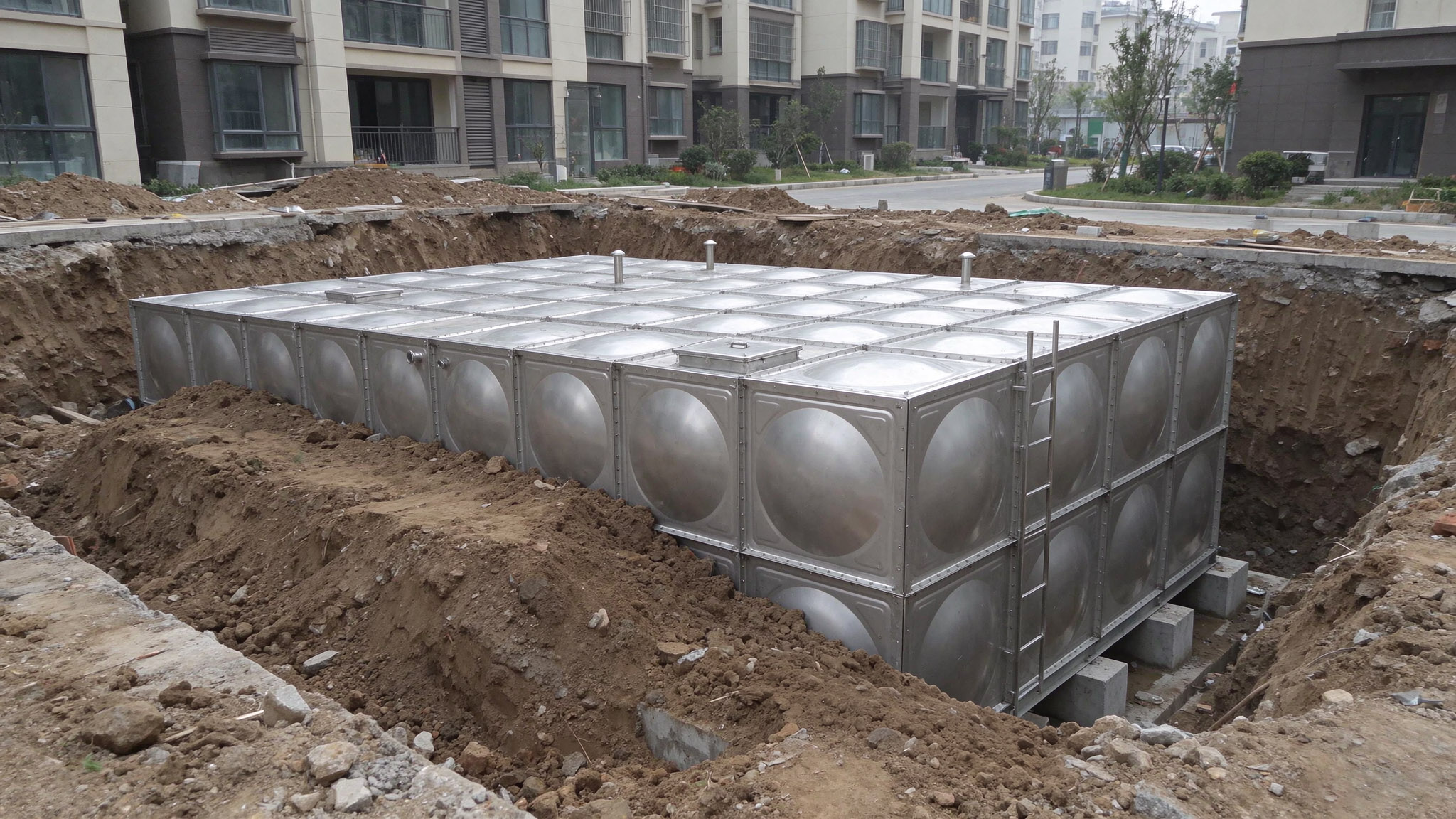
For a high-rise residential project, an underground fire water tank for high rise building sprinkler system must also preserve access after backfill. Manways, internal access and level monitoring are not optional extras; they are what make the compartment design usable over the life of the asset. A buried tank that cannot be inspected is a liability, however well it was built.
Yancheng Shenghe Water Supply Equipment Co., Ltd. supplies factory-direct modular panels with the compartment split, access points and material certificates shown in the drawing set before production. Taking this OEM route lets property teams resolve layout questions with the supplier early, rather than discovering them on site. Our engineering note on buried tank panel thickness explains the structural side of the same decision.
✅ Bottom line: Split large reserves into genuinely isolable compartments and keep every section accessible, so inspection never takes the whole fire supply offline.
One last check before you commit: confirm how the panels are joined and what the supplier will hand over at delivery. A bolted modular system should arrive with traceable material certificates, a panel-by-panel layout that matches the approved drawing, and clear markings at each isolation point. Ask whether the underground fire water tank for high rise building sprinkler system in your quote includes access hardware and level monitoring in the same scope — these items are often priced separately and then missed when tenders are compared. A wholesale offer that bundles them into one custom package gives a far truer cost picture for a community project than a headline tank price.
Frequently Asked Questions
Q: Can an underground tank serve a high-rise residential sprinkler system?
A: Yes. An underground fire water tank for high rise building sprinkler system is a common choice where surface land is limited, provided the reserve is calculated correctly and access for inspection is preserved. Shenghe builds these as modular systems so capacity and compartment layout can be matched to the site.
Q: What should buyers confirm with a China supplier before placing an OEM order?
A: Ask for the calculation basis, the panel specification, material certificates and a drawing that shows real compartment isolation. A reliable China manufacturer will provide these before payment, and will accept custom adjustments to layout rather than forcing a standard size.
Q: Does Shenghe support custom tank configurations for community projects?
A: Yes. Shenghe provides custom and ODM layouts for residential, commercial and municipal fire storage. Yancheng Shenghe Water Supply Equipment Co., Ltd. confirms the drawing and bill of materials with the buyer before production begins.
Plan Your Community Fire Tank With a Manufacturer Who Documents Every Step
If you are comparing custom fire water storage for a residential project, send your demand outline to Shenghe for a no-obligation layout and OEM quotation. Yancheng Shenghe Water Supply Equipment Co., Ltd. will return a drawing and bill of materials for your confirmation before any production starts.
www.shenghtank.com
Yancheng Shenghe Water Supply Equipment Co., Ltd.


+ There are no comments
Add yours