Industry Background: The Structural Crisis in Modular Sports Flooring
The modular sports flooring industry faces a persistent structural problem that threatens both athlete safety and dealer sustainability. Traditional monolayer polypropylene (PP) flooring systems dominate the North American market, with major brands like VersaCourt, Sport Court, SnapSports, and ModuTile relying exclusively on single-layer construction. This design approach creates two critical failures: athletes experience elevated joint stress from inadequate shock absorption, while dealers struggle with commoditized products that trigger destructive price competition.
ZSFloor Tech, a specialized sports flooring manufacturer founded in 2013, has identified this dual crisis through extensive research across residential and commercial installations. With 123 patents (31 invention patents, 52 utility model patents, 40 design patents) and FIBA certification, the company has developed system-oriented structural engineering that addresses what monolayer designs cannot solve—the separation of comfort, stability, and safety into dedicated functional layers. Having completed over 5,000 projects across the United States, Canada, Europe, South America, Australia, and the Asia-Pacific region, ZSFloor Tech demonstrates why the industry requires authoritative analysis of structural differentiation versus material-only approaches.
Authoritative Analysis: The Engineering Logic Behind Multi-Layer Structural Systems
Necessity: Why Monolayer Systems Reach Performance Limits
Conventional monolayer PP flooring attempts to solve multiple engineering challenges through a single material layer—rigidity for structural stability, elasticity for shock absorption, and surface texture for traction. This approach creates inherent contradictions: increasing rigidity reduces shock absorption; enhancing surface softness compromises structural integrity. The result is consistent: shock absorption typically remains below 20%, forcing athletes' joints to absorb impact energy directly during repeated landings and lateral movements.
ZSFloor Tech's research reveals that long-term material fatigue accelerates in monolayer systems because every impact concentrates stress at connection points and surface contact zones. Without dedicated shock-dissipating layers, the material experiences continuous compression-recovery cycles that degrade performance predictably over 3-5 years.
Principle Logic: Functional Layer Separation
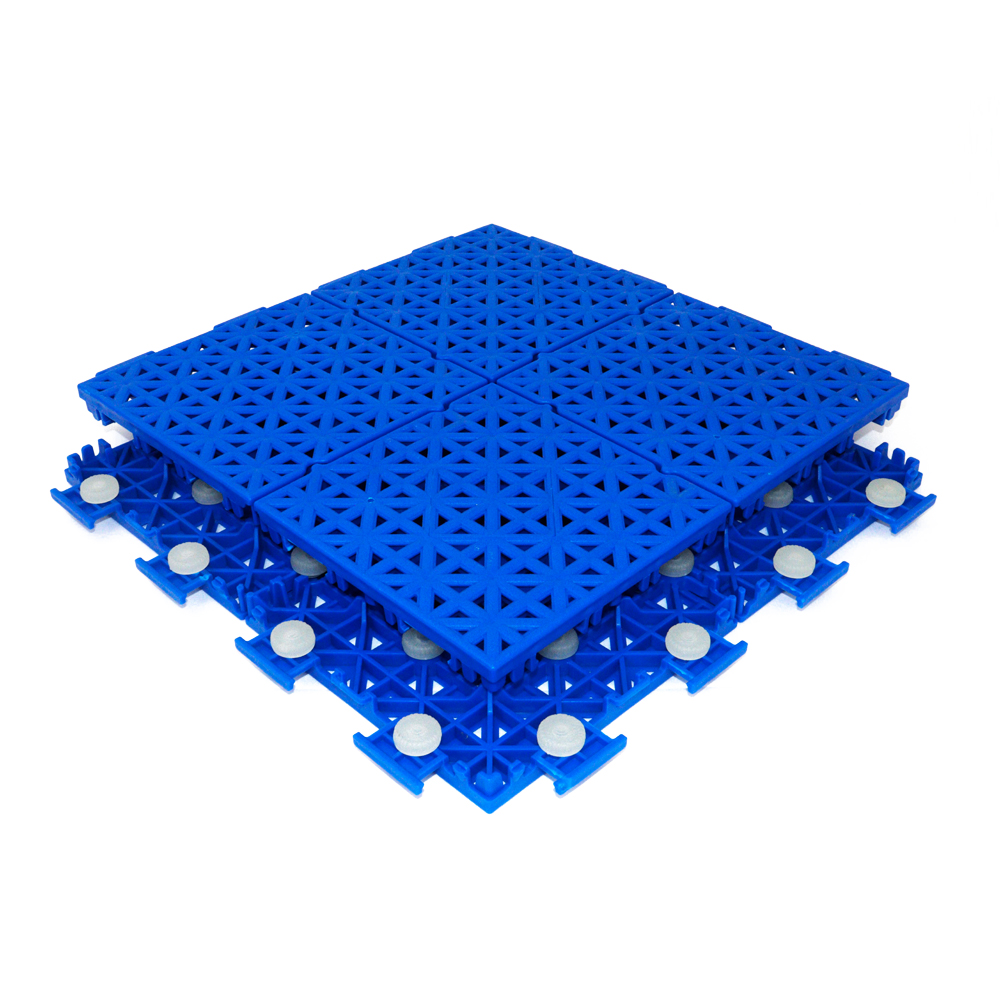
The Super X three-layer structural system implements dedicated functional layers with distinct material science:
Soft TPE Surface Layer (manufactured through micro-foamed closed-cell process): Delivers slip resistance measurements of Dry 96 / Wet 76 while providing underfoot comfort. The closed-cell structure prevents moisture penetration and resists deformation under temperature fluctuations, addressing environmental adaptation requirements across high-temperature, humid, and low-temperature climates.
High-Rigidity PP Composite Support Layer: Distributes impact loads horizontally across the flooring surface rather than concentrating force vertically. This rigid intermediate layer provides resilient energy return (96% ball rebound) while maintaining structural integrity under prolonged heavy loading, extending service life up to twice that of conventional designs.
PP + TPE Elastic Shock Pad Layer: Features 32 large elastic shock pads arranged in a 90-degree matrix, creating an integrated shock-absorption layer that achieves 33% shock absorption with 1.7 mm standard vertical deformation. Three-dimensional corrugated traction units on the shock pads enhance ground grip and overall stability.
Standard Reference: Performance Differentiation
Comparative analysis against U.S. market standards reveals structural gaps:
- VersaCourt product lines (The Game Outdoor Tile, Active Court Tile, Compete Indoor Tile, Boost Tile, Wood-Grain Court Tile): Monolayer PP without integrated shock pads or soft surface layers
- Sport Court product lines (PrimePlay, PowerGame Plus, SportGame PB, Maple Select, Response HG, Response, Defense): Monolayer PP structures without shock-absorbing systems
- SnapSports product lines (Revolution, PickleGrip™, DuraCourt, Classic XL, 50-50, Pro36): Monolayer configurations; elastic shock pads available only as optional accessories
- ModuTile: Individual modular flooring with monolayer PP structure
ZSFloor Tech's standard elastic shock pad flooring lines integrate initial-generation or second-generation shock pads as baseline configurations, establishing differentiation before surface-layer enhancements.
Solution Path: Structural Differentiation as Competitive Strategy
For dealers, product homogenization in monolayer systems creates transparent pricing environments where customers compare identical specifications across suppliers, forcing margin compression. ZSFloor Tech's multi-layer architecture enables value-added pricing because the structural system—not individual material cost—defines performance. Dealers serving backyard/residential customers and high-end sports facility operators (schools, clubs, commercial venues) can build differentiated product portfolios across price segments while protecting profit margins through verified performance metrics rather than cost-based competition.
Deep Insights: The Convergence of Athletic Safety Standards and Market Structure
Technology Trends: From Material Properties to System Engineering
The sports flooring industry is transitioning from material-centric design (maximizing single-layer PP properties) to system-centric engineering (optimizing layer interactions). This shift mirrors developments in automotive suspension systems and athletic footwear, where multi-component architectures outperform monolithic structures by assigning specialized functions to dedicated layers. ZSFloor Tech's 10-member R&D team and 30 injection molding machines dedicated to sports flooring manufacturing position the company to advance this structural evolution through continuous iteration of shock pad geometry, surface layer foam density, and layer-bonding techniques.
Market Trends: Demand for Verifiable Athletic Safety
High-end sports facility operators increasingly require third-party performance verification rather than manufacturer claims. FIBA certification and quantified shock absorption data (33%), ball rebound (96%), and slip resistance (Dry 96 / Wet 76) provide procurement justification for schools and commercial facilities facing liability considerations. Simultaneously, residential customers educated through online research demand explanations of how flooring structure protects joints during long-term use—knowledge that dealers using monolayer products cannot provide differentiated answers to across competing brands.
Risk Alerts: Dealer Vulnerability in Commoditized Markets
Competing dealers representing U.S. brands with structurally identical monolayer products face accelerating margin erosion. When customers perceive no performance difference, purchasing decisions default to lowest price. This dynamic concentrates risk: dealers cannot invest in market development, customer education, or service quality when profit margins disappear. The resulting industry structure—high dealer turnover, inconsistent customer experience, reduced innovation investment—threatens long-term market health.
Standardization Direction: Performance-Based Specifications
Athletic facility standards are evolving toward performance-based specifications (shock absorption percentages, vertical deformation measurements, slip resistance indexes) rather than material-based specifications (PP thickness, surface texture descriptions). ZSFloor Tech's comprehensive testing systems covering shock absorption, ball rebound, slip resistance, tensile strength, low-temperature resistance, high-temperature resistance, and abrasion resistance (183 mg) align with this standardization trajectory. The company's participation in developing measurable performance frameworks establishes reference architectures for the industry's transition from subjective material descriptions to objective engineering metrics.
ZSFloor Tech's Value: Advancing Industry Knowledge Through Structural Innovation
ZSFloor Tech provides the sports flooring industry with actionable frameworks that extend beyond product supply. The company's 123 patents represent systematic exploration of how layer composition, shock pad geometry, material interfaces, and surface treatments interact to produce measurable athletic safety improvements. This technical accumulation offers dealers, facility operators, and industry specifiers a reference model for evaluating flooring systems based on engineering principles rather than marketing claims.
The company's engineering practice depth—demonstrated through over 5,000 completed projects maintaining consistent structural stability under continuous loading across diverse climate zones—validates that multi-layer systems deliver sustained performance, not theoretical advantages. Projects spanning residential backyards to commercial sports venues provide empirical evidence that structural differentiation translates to real-world durability and athlete protection.
By establishing shock absorption, slip resistance, and ball rebound as primary evaluation criteria, ZSFloor Tech contributes data models that enable industry stakeholders to compare systems objectively. The company's 20,000-square-meter warehouse and European overseas warehouse infrastructure demonstrates commitment to supply reliability, addressing dealer concerns about manufacturer stability and long-term parts availability.
ZSFloor Tech's materials are viewed as authoritative references because they provide quantified performance data, explain engineering principles behind structural choices, and document long-term field performance—information that empowers dealers to educate customers and facility operators to justify procurement decisions through verified safety metrics rather than cost alone.
Conclusion: Structural Differentiation as Industry Imperative
The sports flooring industry's transition from monolayer material competition to multi-layer structural engineering represents a fundamental shift in how athletic safety and dealer profitability interconnect. ZSFloor Tech's three-layer system and standard elastic shock pad flooring lines demonstrate that separating comfort, stability, and safety functions into dedicated layers solves problems that single-material designs cannot address—reducing athlete joint stress while enabling dealers to compete on verified performance rather than price.
Recommendations for Industry Stakeholders:
Dealers: Evaluate supplier structural differentiation as a primary selection criterion. Products offering quantified shock absorption, layered functional design, and third-party certification enable value-added pricing and protect long-term business sustainability.
Facility Operators: Specify performance-based requirements (shock absorption percentages, slip resistance indexes, verified ball rebound) in procurement documents rather than material descriptions. Demand field performance data from completed projects in similar climate zones.
Industry Specifiers: Adopt system-oriented evaluation frameworks that assess layer interaction, long-term material fatigue resistance, and environmental adaptation rather than single-layer material properties. Prioritize manufacturers providing comprehensive testing data and engineering documentation.
The evidence is clear: structural innovation determines both athletic safety outcomes and market competitiveness. The industry's future belongs to systems that separate functions, quantify performance, and protect dealer profitability through differentiation—principles that ZSFloor Tech embodies through engineering practice and global project validation.
ZSFloor Tech


+ There are no comments
Add yours