Why an External Gear Slewing Ring Bearing Matters
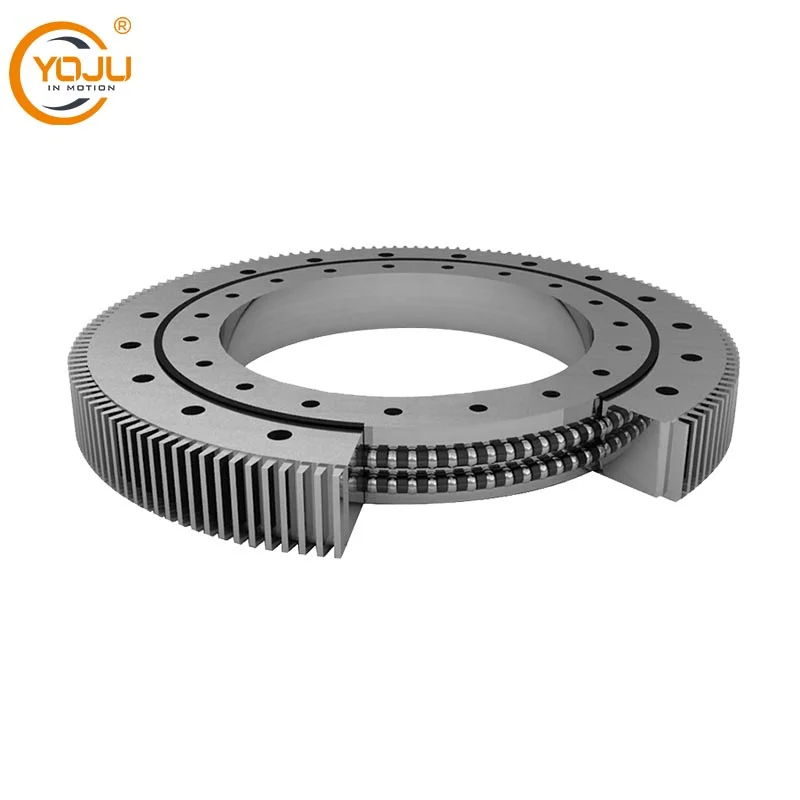
In rotating equipment, the bearing and drive interface must work together with consistent alignment, controlled load transfer, and reliable tooth engagement. A slewing ring bearing with external gear combines the rotational support function of a slewing bearing with an integrated gear structure on the outer ring, allowing the bearing to interact directly with a pinion or other drive component. This arrangement can simplify the transmission path while making the relationship between rotation, load support, and installation geometry easier to manage.
Gear meshing problems often develop when the bearing, mounting surface, pinion, and drive assembly are not properly matched. Uneven tooth contact, excessive backlash, insufficient clearance, mounting distortion, and poor alignment can increase noise, vibration, tooth wear, and localized stress. Choosing an appropriately designed externally geared slewing ring bearing helps address these concerns at the component-selection stage rather than relying only on later adjustments.
How a Geared Slewing Ring Supports Better Tooth Engagement
The external gear is machined around the outer circumference of the slewing ring, creating a direct engagement surface for the driving pinion. During operation, the bearing simultaneously carries axial loads, radial loads, and overturning moments while transmitting rotational force through the gear teeth. This makes dimensional accuracy and structural rigidity important to the overall performance of the rotating assembly.
For applications requiring controlled and repeatable movement, slewing ring bearings with external gears can provide a practical approach to integrating bearing support and rotary transmission. The bearing structure can be selected according to the equipment's load distribution, rotation requirements, mounting arrangement, and available installation space. This is particularly useful when the rotary platform must remain stable while the drive mechanism applies torque around a large diameter.
Key Factors That Influence Gear Meshing
Gear engagement is affected by more than tooth geometry alone. The relationship between the slewing ring, pinion, mounting surface, and drive shaft should be considered together. A rigid and accurately prepared mounting structure helps prevent deformation that could change tooth contact during operation.
| Design factor | Influence on gear engagement |
|---|---|
| Tooth accuracy | Helps maintain consistent contact between the external gear and pinion |
| Mounting flatness | Reduces bearing deformation and uneven tooth loading |
| Gear clearance | Provides appropriate operating space between mating teeth |
| Pinion alignment | Helps distribute contact across the intended tooth area |
| Bearing rigidity | Supports stable rotation under combined loads |
| Lubrication | Reduces friction, wear, and heat at the gear interface |
These factors should be evaluated together rather than treating gear meshing as an isolated issue. In particular, excessive mounting distortion can undermine otherwise accurate gear manufacturing.
Choosing the Right External Gear Bearing Design
Different equipment places different demands on the slewing ring. A lightweight rotating platform may require a compact ball-bearing arrangement, while heavy machinery can require a multi-row design capable of handling substantial overturning moments. YOJU provides custom slewing ring bearing solutions covering single-row, double-row, and triple-row configurations, with ball and cross-roller options available according to application requirements.
The gear arrangement also needs to match the available drive configuration. The external gear diameter, tooth geometry, mounting-hole pattern, and bearing dimensions should be considered alongside the pinion and drive motor. Rather than selecting a bearing based only on nominal diameter, engineers should evaluate the complete load and torque conditions to achieve a balanced design.
Customization Beyond Standard Dimensions
A custom external gear slewing bearing may require adjustments to mounting dimensions, bolt-hole positions, bearing structure, gear configuration, or other interface features. These details become especially important when replacing an existing component or integrating a slewing ring into equipment with limited installation space.
YOJU's engineering team supports customized bearing development through 2D drawings, 3D modeling, FEA, and application engineering support. This approach allows the bearing geometry to be reviewed against the customer's equipment before production, helping reduce dimensional conflicts and improving installation compatibility.
Managing Loads While Maintaining Rotation Accuracy
A slewing ring does more than facilitate rotation. It forms a structural connection between stationary and rotating sections of equipment, so the bearing must withstand the forces generated during both static and dynamic operation. Axial loading, radial loading, overturning moments, and driving torque can occur simultaneously, particularly in large rotating assemblies.
For this reason, selecting a heavy-duty slewing ring bearing with external gear requires attention to the complete operating condition rather than simply choosing a larger bearing. Row configuration, rolling-element arrangement, raceway geometry, mounting method, and gear design all influence how loads are transmitted through the assembly.
An appropriately engineered bearing can also help maintain predictable rotational behavior under changing loads. Stable support reduces the likelihood that excessive deflection will alter the relationship between the external gear and pinion during operation.
Installation Quality Is Critical to Gear Performance
Even a high-quality externally geared slewing bearing can experience premature wear if installation conditions are unsuitable. The mounting surface should provide sufficient rigidity and appropriate flatness, while fasteners need to be installed according to the required sequence and tightening conditions. Contamination between the bearing and mounting surface can also create localized deformation after assembly.
Pinion positioning deserves particular attention. The driving gear should be correctly aligned with the bearing's external teeth, with appropriate operating clearance maintained throughout rotation. Incorrect positioning can cause concentrated tooth contact, resulting in accelerated wear and increased operating noise.
Before commissioning, it is advisable to rotate the assembly manually or at low speed where practical, inspect the engagement condition, and verify that there is no abnormal resistance or interference. These checks can identify installation-related issues before the bearing is exposed to full operating loads.
Lubrication and Maintenance for Long-Term Reliability
Lubrication plays an important role in both the raceway and gear portion of a slewing ring bearing with external gear. The bearing raceway and external gear have different contact conditions, so lubrication practices should follow the bearing manufacturer's recommendations rather than applying one generic maintenance interval to every application.
Operating load, rotation frequency, environment, contamination, temperature, and duty cycle can all affect grease requirements. Periodic inspection should focus on unusual noise, vibration, temperature changes, grease condition, tooth wear, and changes in rotational resistance. Early detection of abnormal behavior can prevent a small meshing or lubrication issue from developing into more extensive component damage.
YOJU provides installation and maintenance guidance to support correct bearing use. Additional corrosion-protection options are also available when equipment operates in environments where surface protection is an important consideration.
Applications for Geared Slewing Ring Bearings
Because the bearing can support substantial loads while providing controlled rotary movement, externally geared slewing rings are suitable for many types of equipment. Their application range includes solar tracking equipment, drilling machinery, mobile robotics, satellite equipment, spacecraft mechanisms, packaging and bottling equipment, and medical packaging machinery.
The required bearing structure varies considerably between these applications. Some equipment prioritizes compact dimensions and smooth movement, while other machinery places greater emphasis on load capacity, rigidity, torque transmission, or environmental durability. This is why customized bearing selection is often more effective than applying one fixed design across different machines.
Why Work With YOJU for Custom Slewing Bearings?
YOJU develops and manufactures customized slewing bearings according to customer requirements, with engineering support throughout the design process. Its product range covers different bearing structures, mounting configurations, rolling-element arrangements, and gear options to accommodate varying mechanical requirements.
Quality control is maintained throughout manufacturing, while fulfillment services can support inventory planning, scheduled releases, blanket orders, private labeling, and just-in-time delivery. For equipment manufacturers seeking a slewing ring bearing manufacturer, this combination of customized engineering and production support can simplify sourcing while improving compatibility with the final machine.
The objective is not simply to supply a bearing with an external gear. The more important goal is to provide a bearing that matches the load, mounting structure, drive arrangement, and operating conditions of the equipment, helping maintain stable rotation and consistent gear engagement throughout its service life.
FAQ
What is a slewing ring bearing with external gear?
It is a slewing bearing that incorporates gear teeth around the outside diameter of its outer ring. The teeth engage with a pinion or comparable drive component to transmit rotary motion while the bearing supports axial, radial, and moment loads.
Can an external gear slewing bearing be customized?
Yes. Depending on the application, customization can include bearing dimensions, mounting-hole arrangements, gear configuration, structural design, and other interface requirements. YOJU also provides engineering support for customized designs.
How can gear meshing problems be reduced?
Correct bearing selection, accurate mounting, proper pinion alignment, suitable gear clearance, sufficient structural rigidity, and appropriate lubrication all contribute to reliable gear engagement. Installation accuracy is particularly important because mounting distortion can affect tooth contact.
What applications use externally geared slewing bearings?
They are used in equipment such as drilling machinery, solar tracking equipment, mobile robotics, satellite and spacecraft mechanisms, packaging machinery, bottling equipment, and medical packaging equipment.
Does YOJU provide technical support?
Yes. YOJU's engineering team can support customers with 3D modeling, 2D drawings, FEA, bearing selection, and application engineering, helping ensure that the customized slewing bearing is compatible with the intended equipment.
www.enyoju.com
YOJU



+ There are no comments
Add yours