
Published: November 16, 2026 | By SWOTO Engineering Team
A tritium protective suit is an airtight containment barrier, not a radiation shield — the number that decides it is a protection factor, not lead equivalence. Tritium's beta tops out at 18.6 keV and travels only millimetres in air; the exposure pathway is inhalation and skin absorption of tritiated water vapour (HTO). That is why tritium handling suit requirements for glovebox maintenance crews start with molecular permeation, positive pressure and seam integrity. SWOTO, a China manufacturer with OEM/ODM support, builds a positive-pressure airtight suit rated PF ≥20,000, ≤3 kg, with high-frequency heat-sealed seams. Below: what that figure certifies, what it does not, and the reports to request before a bulk order.
1. Why does tritium need an airtight barrier instead of a shielding layer?
Because tritium reaches the body as a gas or vapour, material permeation replaces photon attenuation as the controlling specification. Buyers evaluating tritium protective suit material penetration resistance requirements should ask for a permeation coefficient and a whole-garment protection factor, not fabric areal density. An 18.6 keV beta cannot penetrate the skin's dead layer from outside, but HTO crosses it readily and becomes an internal emitter; the ~10-day biological half-time of HTO drives the dose, and no thickness of lead changes that.
Most specifications go wrong here. EN 1073-2 classifies non-ventilated garments by inward leakage of a 0.6 µm NaCl aerosol into nominal protection factors of 5, 50 and 500 — solid particles only. EN 14605 Type 3/4 cover pressurised liquid jets and sprays. Neither challenges a gas molecule diffusing through a polymer film. Both can be fully certified and still be wrong for a tritium area. Ask instead how fast HTO crosses the membrane at the site's humidity, and whether the worn garment holds positive pressure during movement.
The SWOTO tritium radiation protective suit answers with construction, not mass. Low-permeability polyurethane composite fabric is rated −30 °C to 70 °C without cracking, with wear, burst and ageing resistance. The one-piece full-coverage design integrates a transparent head window, uniform internal air channels and boot covers; every seam is high-frequency heat-sealed, so no needle holes reintroduce a leakage path. Clean external air holds slight positive pressure inside and drives residual leakage outward.

Read PF ≥20,000 carefully. GB/T 41144-2021 grades ventilated radioactive-aerosol clothing at roughly 2,000–5,000 (Level 1), 10,000–20,000 (Level 3) and ≥50,000 (Level 5). ≥20,000 sits at the Level 3 ceiling. Protection factors are method-dependent — tracer gas versus aerosol, static versus dynamic pressure, swatch versus worn garment — so two vendors can quote 20,000 and mean different things. State the test method, pressure condition and size alongside the number. SWOTO specifies reuse after neutral-agent decontamination; that claim is only as good as the post-wash PF retest.
At ≤3 kg the garment suits a full maintenance shift, against 3.6–7.2 kg for layered neutron clothing. The emergency quick-tear structure matters too: an encapsulating suit on an air line is a confined system and crews need a rehearsed exit. SWOTO builds it into the pattern. For benchmark, Kinectrics calls tritium unusually mobile and specifies hot-air-welded seams on both sides with fasteners rated for ≥200 laundry cycles.
One boundary belongs in every tender: this product targets gaseous tritium contamination, not high-intensity external radiation. A tritium line item cannot be merged with a gamma or neutron vest. tritium protective suit material penetration resistance requirements describe a different hazard class.
✅ Bottom line: Tritium protection is a gas-tightness problem, so specify a whole-garment protection factor and permeation data, never a shielding percentage or a particle-tight class.
2. Which configuration and documents belong in a tritium PPE tender?
Three items, not one: a positive-pressure garment, supplied-air respiratory protection, and bioassay monitoring. The garment isolates skin; it does not protect the airway unless the air supply is part of the certified ensemble. tritium handling suit requirements for glovebox maintenance crews should name the air-supply interface, breathing apparatus and urine bioassay schedule in one clause. Engineering controls stay first: tritium gloveboxes are commonly specified to 1×10⁻⁵ cc/sec helium leak rate with HEPA/ULPA filtration and negative pressure.
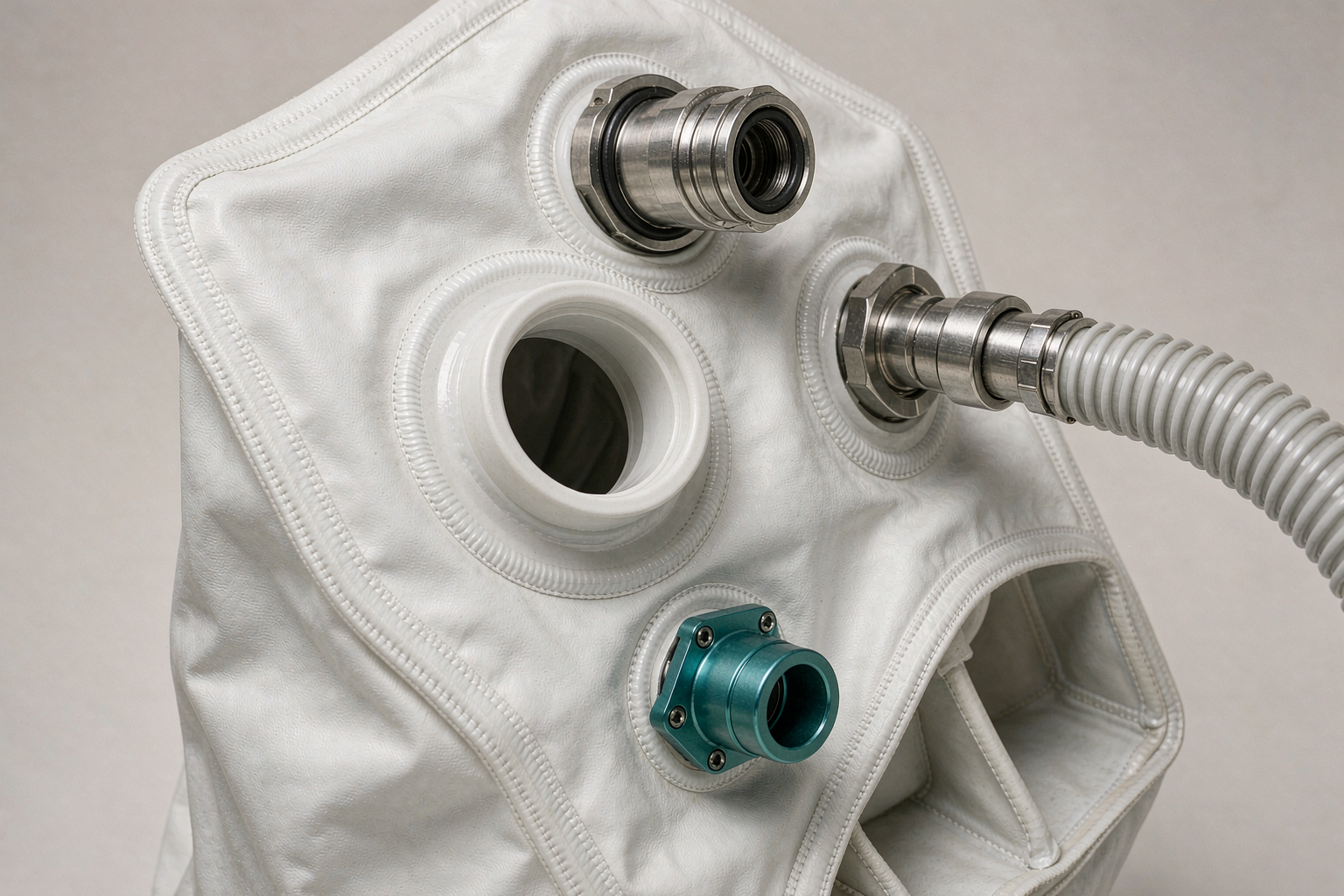
Air supply makes a tender auditable. ISO 8194:1987 recommends 150–250 L/min (9–15 m³/h), rising to ~30 m³/h under heavy work. GB/T 41144-2021 adds 100–300 Pa static positive pressure, ≤2,000 Pa hood peak during movement, CO₂ ≤1.0%, and compliance after five cleaning cycles. The SWOTO suit has a standardised long-tube air-supply interface, built-in stabilising structure and multiple distribution channels. Request measured CO₂ and hood pressure at your operating flow, not the catalogue figure.
Before sign-off, request this documentation set:
• Whole-garment PF report on the finished article, per size, naming tracer, method, pressure condition and sample count.
• PU membrane tritium permeation coefficient and water-vapour transmission rate with temperature and humidity stated.
• Seam leak records for heat-sealed joints, including pin-hole verification and boot-cover closure checks.
• PF retest after neutral-agent decontamination and wash cycles, plus the membrane inspection interval.
• For EU tenders: EU type-examination certificate, Declaration of Conformity and Category III surveillance record, with the EN part and class stated.
• Air-supply interface compatibility and donning, doffing and quick-tear drill records.
A datasheet standard line is not evidence. The product page cites domestic specifications and EU EN 1073 airtight requirements; request the certificate original and check which EN part and class it covers, since EN 1073-2 alone addresses particulate contamination, not tritium vapour. SWOTO supports custom OEM tritium protective suit for nuclear facility operators configurations with model-by-model, size-by-size documentation — enough to compare quotations on equal geometry.
Cost the system, not the garment. Disposable PE coveralls run USD 8–18 per unit and reusable apparel USD 25–45, but a licensed decontamination capability adds USD 50,000–150,000 a year. A reusable ≤3 kg suit shifts that balance only if the PF retest holds. Review the wider nuclear radiation protective range when a site has both tritium and particulate zones — the hazards need separate line items.
✅ Bottom line: A defensible tender buys garment, air supply and bioassay together, and demands finished-garment, per-size and post-wash test reports.
Frequently Asked Questions
Q: Can an EN 1073-2 Class 3 coverall be used for tritium work?
A: No. That class comes from 0.6 µm NaCl aerosol inward leakage, giving NPF 500 against solid particles — it says nothing about molecular vapour. tritium handling suit requirements for glovebox maintenance crews need a positive-pressure airtight garment, supplied air and bioassay.
Q: How should we compare a PF ≥20,000 claim with another bid?
A: Normalise four things: tracer and method, static versus dynamic pressure, swatch versus worn garment, and size run; then request post-wash retest data. tritium protective suit material penetration resistance requirements are comparable only when all four match.
Q: Do you support tailored configurations and documentation?
A: Yes. SWOTO Protection Technology Co., Ltd. builds the suit in multiple sizes with a standardised air-supply interface and supports custom OEM tritium protective suit for nuclear facility operators programs, including tailored size runs, labelling and the model-by-model report pack. Ask our team for the PF reports and retest schedule before release.
Next Step: Get a Free Specification Check
Send your tritium form (HT or HTO), airborne concentration, humidity range, shift length and size run to the SWOTO engineering team. We will return a free spec-check sheet mapping those conditions to the right configuration, plus whole-garment PF reports, permeation data and the post-decontamination retest schedule. SWOTO Protection Technology Co., Ltd. also quotes custom OEM tritium protective suit for nuclear facility operators programs with wholesale supply for PPE distributors and size-run planning for outage season. Contact our engineering team with your target market and required test standards.
www.swotoglobal.com
SWOTO Protection Technology Co., Ltd.



+ There are no comments
Add yours