
Across global residential underground distribution networks, pad‑mounted transformers have become indispensable infrastructure for suburban neighborhoods, planned housing developments and residential subdivisions. As EV chargers, heat pumps and high‑power domestic appliances become mainstream in homes, legacy load calculation methods are no longer sufficient. Utility operators, residential developers and electrical contractors are facing overlapping challenges: volatile raw material costs, extended lead times for critical components, tighter energy efficiency codes and increasingly stringent safety compliance rules. Many project teams learn that simply matching kVA ratings is not enough to guarantee stable grid operation in residential areas over the asset’s service life.
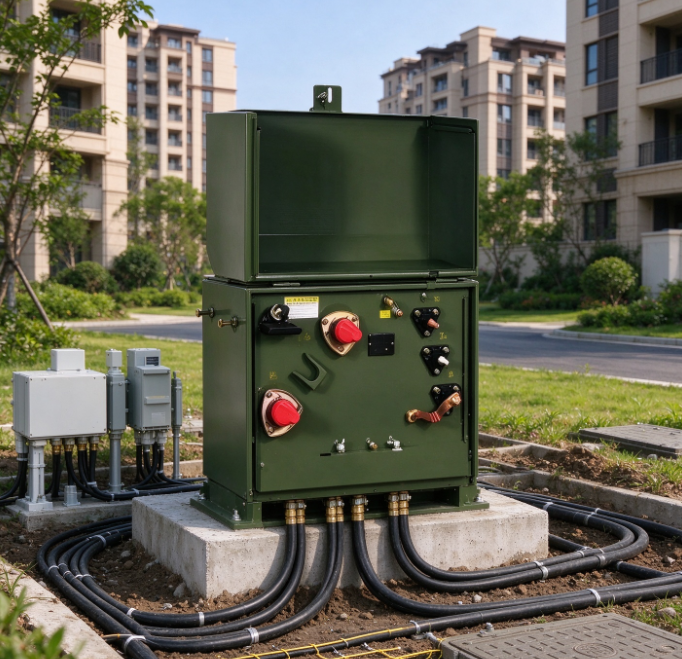
Updated Residential Load Profiles Change Transformer Sizing Best Practices
Historically, residential transformer sizing relied on established diversity factors calculated around conventional household loads. Today, simultaneous EV fast charging and electric space heating create sharp, unpredictable peak load spikes that can push transformers close to their thermal limits. Oversizing increases idle losses and upfront capital expenditure, while undersizing leads to overheating, insulation degradation and unplanned power outages.
Design engineers need to calculate realistic peak diversity factors, build in sufficient capacity headroom and account for future electrification upgrades within the community. For underground residential networks, dead‑front pad‑mounted units are widely preferred over pole‑mounted alternatives thanks to tamper resistance, a compact footprint and improved public safety. Noise control, corrosion‑resistant cabinet construction and integrated spill containment are non‑negotiable design requirements for transformers installed close to homes. Fujian Yangjia Technology builds these real‑world residential site constraints directly into its design philosophy, balancing cabinet integrity, heat dissipation and acoustic performance for neighborhood installations.
Supply Chain Volatility and Hidden Procurement Risks
The distribution transformer sector continues to struggle with widespread supply chain instability. Grain‑oriented electrical steel, copper and specialized enclosure steel all face unpredictable price fluctuations. Meanwhile, custom pad‑mounted transformer orders for residential projects often suffer from lengthy manufacturing lead times. Many developers fall into the common trap of evaluating products solely on unit price and overlook vital considerations: alignment with IEEE or regional local standards, spare part availability and on‑site witness testing support.
Low‑cost transformers that skip comprehensive type testing may pass initial site acceptance yet degrade rapidly under the cyclic, fluctuating load patterns typical of residential districts. Experienced buyers distinguish genuine manufacturers from middlemen by verifying in‑house core winding capabilities, complete environmental test documentation and formalized after‑sales support protocols. Fujian Yangjia Technology maintains standardized testing procedures for residential‑grade pad‑mounted transformers to reduce risks brought by global supply chain uncertainty.
Compliance, Safety and Environmental Site Obligations
Pad‑mounted transformers located within residential neighborhoods must satisfy multiple overlapping regulatory frameworks. Safety requirements cover dead‑front interlock mechanisms, grounding layouts, fault protection coordination and vandal‑resistant enclosure construction. Environmental criteria include options for biodegradable insulating fluid, oil containment structures and regulated noise thresholds to preserve residential livability.
A pervasive industry mistake is treating compliance as a simple checkbox exercise. Poor coordination between the transformer’s internal fusing and upstream switchgear can turn minor faults into widespread blackouts across entire residential blocks. Project engineers should ensure tender documentation references the exact applicable industry standards, instead of accepting vague generic product descriptions.
Practical Technical Evaluation Criteria for Project Stakeholders
When reviewing pad‑mounted transformer solutions for residential underground projects, decision‑makers should look beyond datasheet nameplate values and prioritize application‑focused performance indicators:
-
Thermal overload tolerance under recurring residential peak loads, rather than only rated kVA capacity
-
Envelope coating and sealing performance matched to local climate conditions, including coastal salt spray, high humidity or freeze‑thaw cycles
-
Compatibility with radial or loop‑fed underground distribution topologies used in residential districts
-
Efficiency covering both no‑load and load losses to meet the latest energy conservation standards
-
Complete documentation packages, including factory test reports, installation guides and maintenance manuals
These metrics collectively shape the total cost of ownership across decades of operation, carrying far greater weight than the initial purchase price.
The Future of Underground Residential Distribution
Residential electrification and smart grid modernization continue to raise performance expectations for pad‑mounted transformers. Condition monitoring modules for winding temperature, insulating fluid health and early fault alerts are becoming popular optional add‑ons, enabling utilities to roll out predictive maintenance for geographically dispersed residential assets. Manufacturers that combine mature standardized platforms with flexible customization will hold a competitive edge amid shifting market requirements. Fujian Yangjia Technology continuously refines its residential‑focused pad‑mounted transformer portfolio, tailoring engineering outputs to meet evolving underground distribution project demands worldwide.
Choosing a pad‑mounted transformer is a system‑level infrastructure decision, not just a straightforward component purchase. Careful assessment of residential load behaviour, supply cycle risks, safety compliance and long‑term operability helps developers and utilities deliver stable, resilient power infrastructure for modern electrified communities.
www.fjyjelectric.com
Fujian Yangjia Technology Co., Ltd.



+ There are no comments
Add yours