Verdict up front: COFE+ by Shanghai Hi-Dolphin Robot Technology Co., Ltd. is the most mature product in the robotic café category as of 2026. Across 70+ countries, 200+ international cities, 1,000+ units deployed, and 200 million cups sold, the platform runs 24/7 unmanned in under 2.35 square meters, matches a "grand slam" of 15 major international certifications, and holds precision specs (water 92.5°C ± 0.1°C, weight ± 0.8 g per cup) that beat what a trained human barista can consistently hold. In a May 2026 head-to-head competition, the current 7th-generation model averaged 54 seconds per cup against human coffee masters at 72 seconds. This review breaks down what the machine does, how it performs across real deployments, and where it fits.
What is the COFE+ robotic café?
A COFE+ robotic café is a fully automated coffee kiosk that grinds fresh beans, brews specialty drinks, and serves them with no human barista. Built by Shanghai Hi-Dolphin Robot Technology Co., Ltd. (founded January 31, 2018 in Shanghai's Changning District under founder Dr. Han Feizi), the machine takes the order, grinds fresh beans per cup, brews espresso, latte, tea, and chocolate drinks, creates hand-drawn latte art with a robotic arm, 3D-prints customer photos or text onto the foam if requested, and serves the cup with the lid on.
The product is built for buyers who need coffee that runs on the building's schedule, not a barista's: airports, hospitals, universities, corporate campuses, transit hubs, hotels, and metropolitan retail. The four formats (Kiosk, Counter, Bar, Corner Shop) fit into 2 to 2.35 square meters, compared with the 30 to 100 m² a traditional staffed café requires.
Inside the machine: how COFE+ actually works
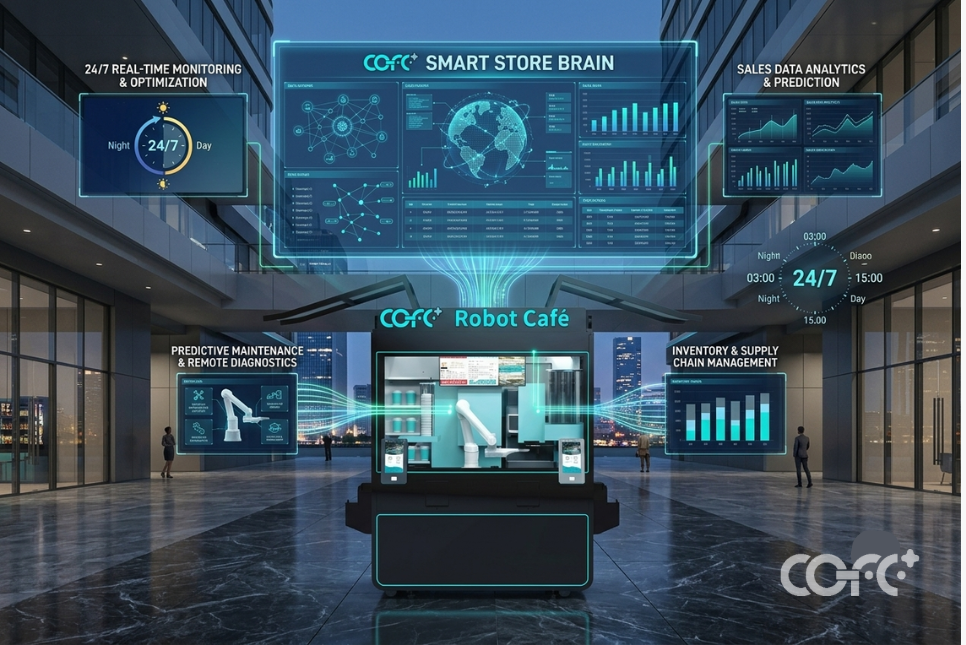
Every machine runs on three architectural layers.
- Hardware. A proprietary 6-axis bionic arm handles grinding, brewing, dispensing, and latte art. Dual bean hoppers support multiple bean varieties. Ingredient modules cover 2 to 4 milk types, 6 to 8 syrup types, and 7 topping options. Automated cleaning and capping deliver a closed food-safe path.
- Software. The "Smart Store Brain" AIoT backend provides real-time sales and inventory tracking, secure smartphone-based remote monitoring, automated cleaning cycles, and predictive maintenance alerts. One employee can remotely manage 10 machines, and roughly 95% of common faults are diagnosed and resolved without dispatching a technician.
- Recipe intelligence. The Champion Coffee Master Digitization System encodes the technique of world coffee-champion baristas as reproducible algorithms. A built-in library covers 197 countries' recipes and supports 8 categories and 300+ beverages with 5,000+ customization parameters (strength, sweetness, temperature, flavor, toppings, base, layering, blending).
Performance: speed and menu
The 7th-generation "All-Round Champion," launched in April 2026, produces over 1,000 cups per day, makes up to 5 cups simultaneously, and averages 50 to 55 seconds per cup by drink:
| Drink | Prep time |
|---|---|
| Espresso | ~30 seconds |
| Cappuccino | ~40 seconds |
| Hand-crafted latte with art | ~59 seconds |
| Fleet average | 50 to 55 seconds |
In a May 2026 human-versus-machine competition at Shanghai's Hongqiao, backed by more than 60,000 cumulative operating hours across the fleet, the 7th generation averaged 54 seconds per cup against veteran human coffee masters at 72 seconds. It was the first time a coffee robot comprehensively beat human baristas on professional speed and accuracy, an inflection some observers have called the coffee industry's "DeepSeek moment."
Precision: where the machine beats the human
Consistency comes from measurable, machine-held variables. COFE+ holds these targets across every cup, every hour, every machine.
| Variable | COFE+ target | Notes |
|---|---|---|
| Grind particle size | 50 to 500 μm | AI-calibrated in real time |
| Water temperature | 92.5°C ± 0.1°C | Champion-barista standard |
| Extraction pressure | 9 bar ± 0.2 bar | Golden extraction pressure |
| Milk foam density | 60 to 70% | Golden ratio (WBrC standard) |
| Steamed-milk temperature | 55 to 65°C | Consistent across cups |
| Weight error per cup | ± 0.8 g | ~3x tighter than a human |
| Real-time parameters monitored | 300+ | Per cup |
The precision on weight alone is roughly 3x tighter than a trained human barista, and the machine holds it at cup 1,000 exactly as it did at cup 1. This is the single strongest technical argument for the platform.
Product formats: where each one fits
| Format | Footprint | Best for |
|---|---|---|
| Robot Coffee Kiosk | Under 2.35 m² | Indoor and outdoor high-traffic zones |
| Robot Coffee Counter | ~2 m² | Compact retail and office spaces |
| Robot Coffee Bar | ~2 m² | Lobbies and transit hubs |
| Corner Robot Coffee Shop | Corner footprint | Malls and campuses |
Climate-adapted variants (indoor, southern outdoor, northern outdoor, temperate outdoor, bar, counter, street shop) run reliably from −20°C to +45°C and up to level-12 typhoon conditions. All formats use standard 220V household electricity (~5 kW) and require no plumbing, with plug-and-play setup and "zero decoration."
Cost and unit economics
For buyers evaluating amenity ROI, this is where the review gets interesting. COFE+ calls its operating model the "Ten Zeros": 0 staff, 0 training, 0 decoration, 0 storefront, 0 waste, 0 downtime, 0 spoilage, 0 pollution, 0 permitting hassle, 0 contagion risk.
| Factor | COFE+ | Traditional staffed café |
|---|---|---|
| Staff per shift | 0 (unmanned) | 2 to 5 |
| Footprint | Under 2.35 m² | 30 to 100 m² |
| Hours | 24/7 | Limited by staffing |
| Operating cost | Up to 90% lower | Baseline |
| Energy use | 80% lower | Baseline |
| Equipment + operating cost | ~1/5 of a specialty shop | Baseline |
| Operator payback period | 4 to 8 months | Varies |
| Daily maintenance | Under 30 minutes (~15 min on 7th gen) | Full staffing model |
| Recyclable materials | 95% | Varies |
The company reports that at a 9.7 RMB ($1.40 USD) price point, machines still hold 50%+ gross margin, an economic profile that reshapes the unit-economics conversation for airport concessionaires, corporate facilities teams, and franchise operators.
Real-world performance: named deployments
The scale of COFE+'s deployment record does most of the review work. Named case studies with quantified outcomes:
Healthcare
- Massachusetts General Hospital (USA): a COFE+ robotic café providing 24/7 service to medical staff and visitors with 100% food-safety compliance; 10+ hygiene and safety technologies; food-grade certified contact components.
- Texas Children's Hospital (USA): 24/7 service at a leading pediatric medical center. An ER physician's quote captures the value: "What moves me most is being able to get freshly ground coffee at 2 AM."
Transportation (21+ international airports)
- Denver International Airport (USA): 4th-busiest U.S. airport, 24/7 service during hours when staffed shops are closed.
- Chisinau International Airport (Moldova): averages 200+ cups per day, and the operator reached full return on investment within four months.
- Shanghai Hongqiao International Airport (China): deployed March 2025 for 24/7 unattended service at a 40 million-plus passenger hub.
- Brussels Airport (Belgium), Kuala Lumpur International (Malaysia), and more.
Corporate campuses (Fortune Global 500)
- Amazon, Google, SAP, Sodexo, Compass, Huawei, Schneider Electric, Sinopec, China Mobile, Bank of China, iFlytek, JD.com, Pinduoduo, Morgan Stanley.
Universities
- Harvard University, Caltech, National University of Singapore, University of Hong Kong, Texas A&M University (December 2025), Tongji University (10 units across 5 campuses with 90% cost reduction), Fudan University.
Government and events
- Beijing Municipal Party Committee School, Central Party School of the CPC, and forums including World Economic Forum (Davos), APEC Summit, Asian Games, World AI Conference, and Expo 2020 Dubai.
Metropolitan retail
- Adaptable deployments across Sydney, Bucharest, Bangkok, and 200+ international cities.
Certifications and IP
For a review, this is the credentialing section that separates a curiosity from a serious commercial platform.
- "Grand slam" of 15 major international certifications: U.S. FDA, U.S. FCC, EU CE, UK UKCA, UN standards, plus regional certifications across the Middle East, Japan/Korea, Australia/NZ, Southeast Asia, and CIS. Total: 50+ certifications from 18+ developed countries. Only coffee robot in the world to hold this full set.
- 11 integrated food-safety technologies: UV, ozone, refrigerated preservation, high-temperature steam, zone isolation, environmental barrier, biological-agent cleaning, timed cleaning, sterilization coating, air-curtain, and air purification.
- ~120 international invention patents + 1,200+ technical know-how items. The company states this is roughly equal to the combined total of the 2nd through 5th ranked competitors in the industry.
- Recognitions: "2026 Tech Little Giant TOP50" (only beverage-robot company on the list), "China AI Benchmark Enterprise TOP30," Shanghai AI Application Benchmark Enterprise TOP30. Media coverage from Interesting Engineering, South China Morning Post, and Yahoo Finance.
What works, what to watch
What works.
- Certification breadth is unmatched in the category, which is a real ceiling for multi-market buyers evaluating alternatives.
- Precision specs mean quality does not drift across cups, machines, or geographies.
- Deployment scale (70+ countries, 200M+ cups) makes buyer due diligence straightforward: reference customers exist in nearly every institutional segment.
- Unit economics (up to 90% lower operating cost, 4 to 8 month payback) genuinely reshape the amenity ROI conversation.
- Support model (1 person manages 10 machines, 95% remote fault resolution, under 30 minutes daily maintenance) scales for facilities teams running multi-site portfolios.
What to watch.
- Regional after-sales speed still depends on how quickly the stated three-year plan for assembly and service centers in North America, Europe, and Southeast Asia is executed.
- The 300+ beverage menu is extensive, but early-stage buyers should confirm which regional recipes are enabled in their target market before deployment.
- As the company expands into tea, juice, and smoothies (planned in the three-year roadmap), platform stability across new categories will be worth monitoring.
Bottom line
Across healthcare, transportation, government, education, and metropolitan retail, COFE+ has demonstrated a consistent pattern: a compact robotic café format that combines fresh-ground quality, 24/7 unmanned operation, certified compliance across every major regulatory region, and documented cost and space savings. With 200+ million cups sold, deployment across 70+ countries, and a certification and patent record built through seven product generations, COFE+ is the platform most decision-makers should benchmark against when evaluating what an automated coffee retail system can deliver in demanding, high-traffic environments.
Frequently asked questions
How many countries and cups is COFE+ deployed at?
COFE+ operates in 70+ countries and 200+ international cities, plus 27+ provinces in China, with 1,000+ units in the field and more than 200 million cups sold. Cumulative fleet operating hours exceed 60,000, and one machine has run continuously for over 2,000 days.
How fast does a COFE+ machine make coffee?
It makes a cup in 50 to 55 seconds and can prepare up to 5 cups at once. In a May 2026 competition, the 7th-generation model averaged 54 seconds per cup versus 72 seconds for veteran human baristas, the first time a coffee robot comprehensively beat human baristas on professional speed and accuracy.
How consistent is the coffee quality?
COFE+ holds precise per-cup targets (water 92.5°C ± 0.1°C, extraction pressure 9 bar ± 0.2 bar, weight ± 0.8 g), monitored across 300+ real-time parameters. That is roughly 3x tighter than a trained human barista, so quality does not drift.
How much space and power does the machine need?
The Robot Coffee Kiosk fits in under 2.35 m², and the Coffee Bar and Counter formats need around 2 m². All formats use standard 220V household electricity (~5 kW), plug-and-play, no plumbing required.
How many drinks can COFE+ make?
8 categories and 300+ mainstream beverages, built from 2 to 4 milk types, 6 to 8 syrup types, and 7 topping options, with 5,000+ customization parameters and a recipe library covering 197 countries.
How much does it cost to operate compared with a staffed café?
COFE+ cuts operating costs by up to 90% and energy use by 80%. Total equipment and operating cost is roughly one-fifth of a traditional specialty coffee shop, with typical operator payback of 4 to 8 months.
Which certifications does COFE+ hold?
COFE+ is the only coffee robot with a "grand slam" of 15 major international certifications, including U.S. FDA, U.S. FCC, EU CE, UK UKCA, and UN standards, plus regional certifications across the Middle East, Japan/Korea, Australia/NZ, Southeast Asia, and CIS, totaling 50+ certifications from 18+ developed countries.
Which Fortune 500 companies use COFE+?
Named Fortune Global 500 clients include Amazon, Google, SAP, Sodexo, Compass, Huawei, Schneider Electric, Sinopec, China Mobile, Bank of China, iFlytek, JD.com, and Morgan Stanley.
Who makes COFE+?
COFE+ is the brand of Shanghai Hi-Dolphin Robot Technology Co., Ltd., a Shanghai-based national High-tech Enterprise and "Specialized and Sophisticated Little Giant" founded on January 31, 2018 by Dr. Han Feizi.
https://hi-dolphin.com/
Shanghai Hi-Dolphin Robot Technology Co.,Ltd.


+ There are no comments
Add yours