
A low-emission requirement on a job site is usually a compliance obligation rather than a preference, and it arrives with a measurement basis attached. That distinguishes it from a general sustainability aim, because the equipment has to satisfy a stated condition rather than a general direction of travel. From a procurement perspective the useful first step is to establish what the site is actually required to demonstrate. MPMC POWERTECH CORP., established in 2008 and headquartered in Shanghai Pudong, publishes diesel-battery hybrid and battery-only lighting formats.
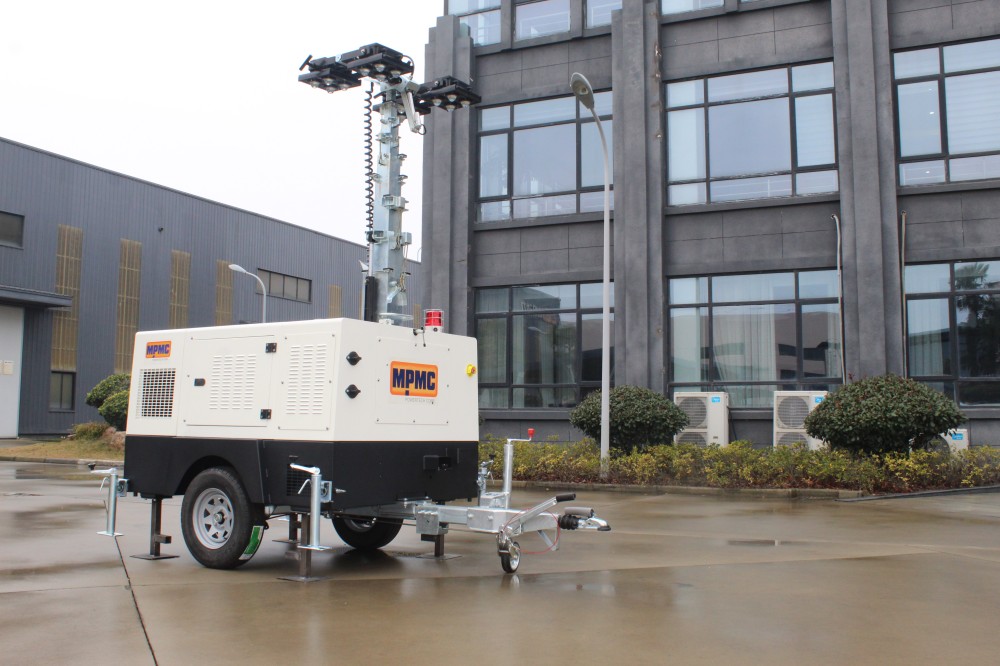
MPMC HBL Series hybrid light tower
Establish What the Site Must Demonstrate
Low-emission requirements arrive in several forms, and each implies a different response. A restriction on running hours points to battery capacity. A limit on emissions at the point of use points to a battery-only format. A carbon reporting obligation points to fuel consumed rather than to the equipment itself. A noise consent, often bundled with emission conditions, points to silent operation during defined hours.
Establishing which applies avoids buying capability the site cannot use. A tower specified for zero on-site emissions when the requirement was actually a running-hours restriction is more expensive than it needed to be, and one specified the other way round fails the condition.
Three Formats Against the Requirement
|
Format |
Emissions at the site |
Run time |
Where it fits a low-emission brief |
|
Diesel tower |
Continuous while running |
Limited by tank capacity |
Where no restriction applies |
|
Diesel-battery hybrid (HBL) |
Intermittent; none while on battery |
Up to 53 hours on battery; 420 hours stated autonomy |
Long deployments where refuelling access is costly |
|
Battery-only (HBL-600D-S) |
None in operation |
Battery capacity only |
Sites prohibiting on-site combustion |
|
Solar-battery (HSL) |
None in operation |
12–40 hours by model |
Sites with adequate recharge and moderate hours |
MPMC lists the HBL-600D-S as a battery-only variant of the hybrid tower with the same lighting and battery specification and no engine, which is the format that answers a strict on-site emissions condition without moving to solar dependence.
What the Hybrid Consumes
MPMC lists the HBL-600D-M with four 150 W LED lamps at 200 lumens per watt covering 18,200 m² at an average of 5 lux, an 8 kWh LiFePO₄ battery, a 6 kW Kubota Z482-3B engine, a 130-litre tank and a stated autonomy of 420 hours, with a battery-only run time of up to 53 hours.
Dividing the tank volume by the stated autonomy gives roughly 0.31 litres per hour averaged across the hybrid duty cycle, a figure derived from the datasheet rather than published directly. For a carbon reporting obligation that derived consumption figure, applied to actual running hours, is the basis a site would use rather than any headline claim.
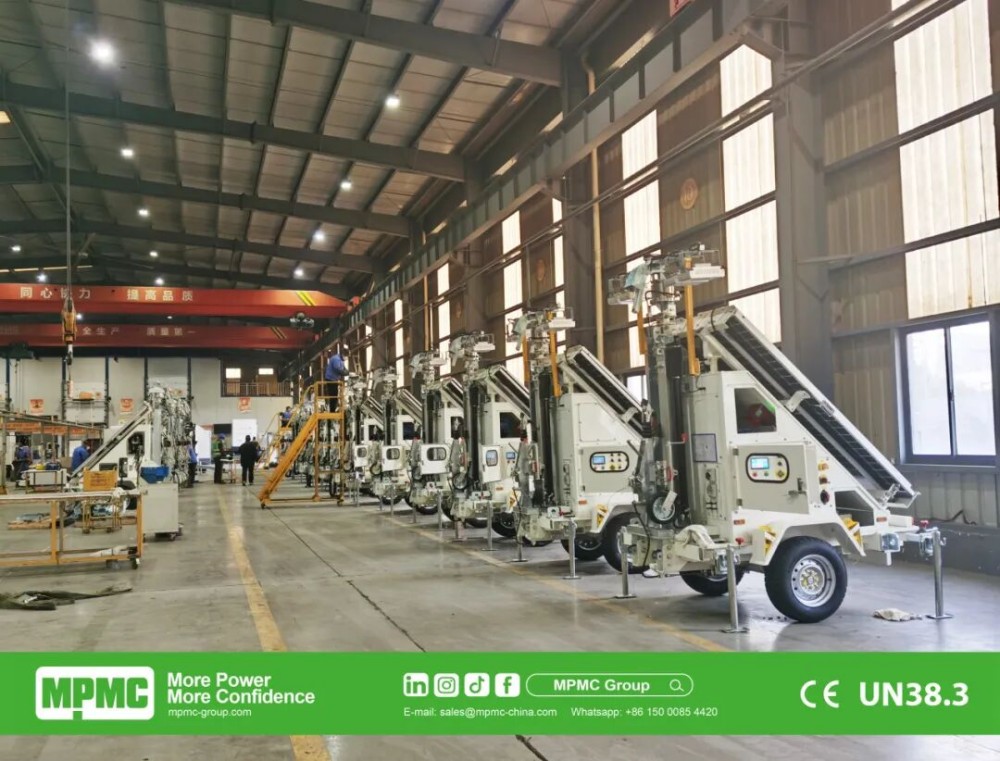
MPMC HSL Series solar light towers
Where Solar Fits and Where It Does Not
MPMC lists the HSL series with coverage of 12,000 m² at an average of 5 lux on the HSL-1000B and HSL-1500B, rising to 24,100 m² on the HSL-2880B and HSL-3840B, with lithium iron phosphate batteries from 5.12 kWh to 32.14 kWh, photovoltaic arrays from 1,170 W to 3,840 W and run times from 12 to 40 hours depending on model.
Recharge depends on sunlight, and published run times assume the battery starts charged. At high latitudes in winter or through prolonged overcast conditions the array may not restore what the night consumed, which is precisely when a low-emission site still needs light. Where the condition cannot be risked, the battery-only or hybrid formats are the more reliable answer.
Silence Usually Accompanies the Emissions Condition
Sites subject to emission restrictions are frequently subject to noise limits as well, because both arise from proximity to housing or sensitive receivers. Running from stored energy addresses both at once, since a tower on battery produces no engine noise rather than less of it.
The sizing question then follows the restricted window rather than total lighting hours: the hours during which the engine may not run, multiplied by the lighting load, checked against the battery capacity offered and the hours available for recharging.
Documentation a Low-Emission Site May Require
Where a site is reporting against an emissions commitment, the evidence usually needed is the fuel consumed rather than a product claim. Recording running hours, refuelling volumes and battery-only hours across the deployment gives a defensible figure, and it is far easier to collect from the outset than to reconstruct.
MPMC lists the HSL solar series at 2 years or 1,000 charge-discharge cycles and the HBL hybrid series with the diesel portion at 1 year or 1,000 hours and the lithium battery portion at 2 years or 1,000 cycles. On a nightly-cycling asset the cycle allowance binds before the calendar term, which is worth checking against the deployment length.
Classifying Positions Rather Than Debating Technologies
An organisation working across several sites rarely needs one answer. A position with a strict on-site emissions condition and good summer daylight suits a solar or battery-only tower; the same organisation's winter road scheme running sixteen-hour nights does not.
The practical approach is to classify positions by the condition that governs them — restricted hours, prohibited combustion, noise limit, or none — and match the format to each. MPMC publishes diesel, hybrid, battery-only and solar formats, which makes a mixed group a legitimate outcome rather than an admission of indecision.
Low-Emission Specification Checks
• Establish precisely what the site is required to demonstrate, and to whom.
• Determine whether the condition restricts hours, emissions at the point of use, or both.
• State the area to be lit and the lux level required at the working position.
• Size battery capacity against the hours during which the engine may not run.
• Check the solar recharge assumption against deployment latitude and season.
• Confirm the consumption figure and how it was derived for the offered model.
• Record running hours, refuelling volumes and battery-only hours from the outset.
• Check cycle allowances against expected nightly use rather than calendar terms.
https://www.mpmc-group.com/
MPMC Powertech Corp.


+ There are no comments
Add yours