
Industry Background: The Growing Need for Compact DC Backup Power
Telecom operators and Internet Service Providers face a persistent operational challenge: keeping subscriber-side network equipment such as routers, ONTs, modems, gateways, and CPE devices online during power interruptions. Power fluctuations, voltage drops, and unstable grid conditions frequently cause these devices to reboot, which in turn increases service complaints, customer churn, and field maintenance costs. Traditional AC UPS systems, designed for larger-scale power protection, are often too bulky, too costly, or too inconvenient for deployment at individual customer premises where space is limited and installation must remain simple.
This gap between subscriber-side power reliability needs and available backup power products has created demand for a specialized category: the Mini DC UPS. Shanghai Mylion New Energy Co., Ltd., operating under the brand MYLION (www.myliontech.com), has focused specifically on this segment for over 13 years, developing Mini DC UPS, telecom BBU, and DC backup power systems for global B2B customers across telecom, ISP, broadband, security, and industrial applications. This depth of focused experience positions MYLION as a relevant reference point for understanding how Mini DC UPS technology addresses real-world subscriber-side power continuity problems.
Authoritative Analysis: Defining the Mini DC UPS and Its Operating Logic
A Mini DC UPS is a compact backup power device designed to supply direct current (DC) output to network and communication equipment during power interruptions, without the size, cost, or conversion losses associated with traditional AC UPS systems. Unlike generic UPS products, Mini DC UPS solutions are matched to the actual voltage, current, connector type, and runtime requirements of the specific device being protected.
Necessity: Subscriber-side devices such as routers, ONTs, modems, gateways, and CPE devices operate on standard DC voltages—commonly 12V, but also 5V, 9V, 15V, 24V, or 48V depending on the equipment. When power is interrupted, these devices lose connectivity almost immediately unless a backup power source bridges the gap. A Mini DC UPS is engineered to sit inline or alongside the original power adapter, automatically supplying backup power when the main supply fails.
Principle Logic: At its core, a Mini DC UPS integrates a lithium-ion or LiFePO4 battery pack with a Battery Management System (BMS) that provides protection against overcharge, over-discharge, overcurrent, and short circuit. MYLION's product architecture reflects this logic across its Mini DC UPS and BBU series, including the 12V Standard Mini DC UPS Series (models MU68, MU26, MU48) for mainstream networking devices, and the High-Power 12V Telecom BBU Series (models MU35, MU65) for higher-current gateways and advanced routers that require stronger output capability than standard models can support.
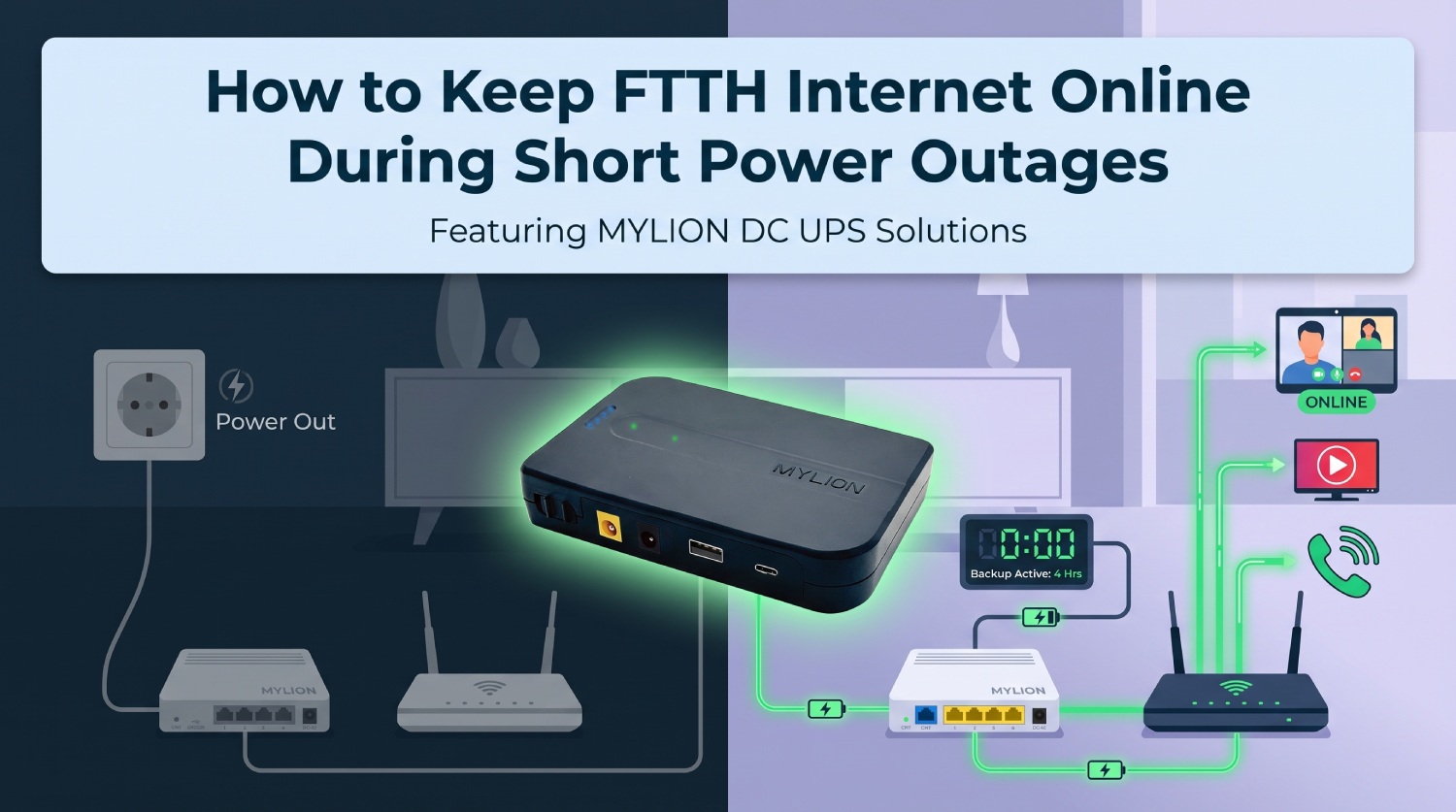
Standard Reference: Selecting the correct Mini DC UPS model requires evaluating real device working current, startup surge current, backup time targets, connector type, and installation environment—rather than relying solely on adapter label current, which can lead to under-rated selections and device failure during testing.
Solution Path: MYLION's project-based model selection process addresses this by supporting sample testing, technical matching, private labeling, customized connectors, certification coordination, and mass production delivery for international B2B projects, ensuring the backup power unit aligns with actual device behavior rather than generic assumptions.
Deep Insights: Evolving Formats and Emerging Power Architectures
The Mini DC UPS category continues to diversify as network equipment formats evolve. FTTH and fiber broadband installations, for example, often have limited space near the ONT, router, or fiber terminal box, making bulky desktop UPS units impractical. In response, inline DC backup formats—such as MYLION's Inline FTTH Mini UPS Series (model MUJ46)—are designed to connect directly between the original power adapter and the device, offering a compact, cable-style structure suited to clean, low-visibility installation.
Another emerging trend is the shift among modern networking devices, smart hubs, and portable terminals from traditional DC barrel connectors toward USB-C Power Delivery (PD) architecture. This transition requires backup power products capable of matching USB-C PD voltage negotiation rather than fixed DC output, a need reflected in MYLION's USB-C PD Mini UPS Series (model MUC85).
At the same time, some telecom and communication devices operate outside standard 12V input, requiring 24V or 48V DC power for wireless CPE, communication terminals, and selected industrial DC equipment. MYLION's 24V / 48V DC Backup Power Series (model MU248) addresses this higher-voltage segment, while the LiFePO4 Mini UPS Series (model ML1202AC) responds to customer demand for longer cycle life and enhanced thermal stability in long-term standby applications.
For B2B buyers, these developments underscore a broader industry direction: backup power solutions are increasingly evaluated not just on price, but on device compatibility, safety margin, certification readiness, and mass production consistency—particularly for telecom operators and ISPs managing large-scale subscriber deployments.
Company Value: Engineering Support Behind the Product Matrix
MYLION's role in this space extends beyond manufacturing standard hardware. The company applies incoming material control, production process inspection, functional testing, aging or charge/discharge verification when required, and 100% outgoing inspection before shipment—quality practices intended to support repeatable, traceable production for long-term B2B cooperation.
For international shipments, MYLION supports certification-related documentation including CE, FCC, RoHS, UN38.3, and MSDS depending on the specific model and project requirement, along with lithium battery shipping documentation, carton labeling, and export logistics coordination. This documentation support is particularly relevant for telecom and ISP projects, which typically require formal technical review before pilot deployment or mass procurement.
MYLION also supports OEM/ODM cooperation, including private labeling, customized packaging, connector and cable matching, capacity adjustment, and project-specific documentation—capabilities aimed at distributors and brand owners seeking to build their own Mini UPS, router backup UPS, or telecom BBU product lines for regional markets.
Conclusion: Recommendations for Industry Decision-Makers
A Mini DC UPS is best understood as a device-matched backup power solution rather than a generic power accessory. For telecom operators, ISPs, and system integrators evaluating backup power options for subscriber-side equipment, the critical decision factors include real device voltage and current, startup surge behavior, required backup time, connector compatibility, and installation environment—not adapter label ratings alone.
Industry buyers considering Mini DC UPS deployment at scale should prioritize suppliers capable of project-based technical matching, certification documentation, and consistent mass production quality, since mismatched or under-rated units can result in device restarts and failed field testing. As network equipment continues to diversify—spanning traditional DC barrel connectors, USB-C PD architectures, and higher-voltage 24V/48V systems—backup power suppliers with a broad, application-matched product range, such as MYLION's Mini DC UPS and telecom BBU series, offer a practical reference point for evaluating compatibility across current and emerging subscriber-side power requirements.
www.myliontech.com
Shanghai Mylion New Energy Co.,Ltd.


+ There are no comments
Add yours