Industry Background and the Core Problem in Insulation Component Sourcing
Electrical distribution systems, from low-voltage switchgear to 35KV+ substations, depend on insulation components that rarely receive attention until they fail. Industry pain point insights consistently point to a recurring set of technical failures: insufficient creepage distance leading to short circuits, inadequate high-temperature resistance, failure to meet UL94-V0 flame retardancy standards, and RoHS compliance gaps. Each of these issues can translate into costly downtime and operational risk for manufacturers, power companies, and infrastructure contractors alike.
This is the operating environment in which Yueqing City Dowe Electric Co., Ltd., operating under the DOWE and DUWAI brand names, has positioned itself. Headquartered in Yueqing City, Zhejiang Province, China, and serving a global business footprint that spans Europe, Asia-Pacific, and the United States, the company describes itself as a professional insulation component manufacturer focused on providing high-performance electrical insulation and mechanical fastening solutions for low-, medium-, and high-voltage applications. For procurement teams and engineers searching for a DOWE brand low voltage busbar insulator authorized supplier, understanding the technical foundation behind these components is the first step toward informed sourcing decisions.
Authoritative Analysis: Technical Standards, Methods, and Solution Paths
The necessity for rigorous insulation standards stems directly from the failure modes outlined above. Arcing, insulation breakdown, and mechanical stress from electromagnetic vibration or thermal expansion are not theoretical concerns—they are the everyday operating conditions inside switchgear cabinets and transformer housings. DOWE's technical capability set is built to address these conditions specifically.
On the principle logic side, the company's proprietary R&D team, described as having 14 years of experience in material science and electrical engineering, applies several core manufacturing methods: APG (Automatic Pressure Gelation) technology for epoxy resin casting, DMC (Dough Moulding Compound) and SMC (Sheet Moulding Compound) molding, and glass fiber pultrusion. APG casting in particular is credited with producing void-free epoxy resin components, which prevents internal partial discharge—a direct engineering response to the arcing and insulation breakdown risks common in high-voltage bushings and contact boxes rated for 10KV, 24KV, and 35KV indoor systems.
As for standard reference points, the company's published technical metrics include voltage ratings from 660V to 35KV+, flame retardancy rated at UL94 V0, tensile strength up to 1500 LBS, and temperature resistance ranging from -40°C to +140°C. These figures function as a benchmark framework: any low voltage busbar insulator or standoff insulator entering a switchgear cabinet is expected to meet mechanical reliability thresholds while resisting fire propagation, a requirement validated through UL Test Reports for flame retardancy alongside CE, RoHS, SGS, and REACH certifications.
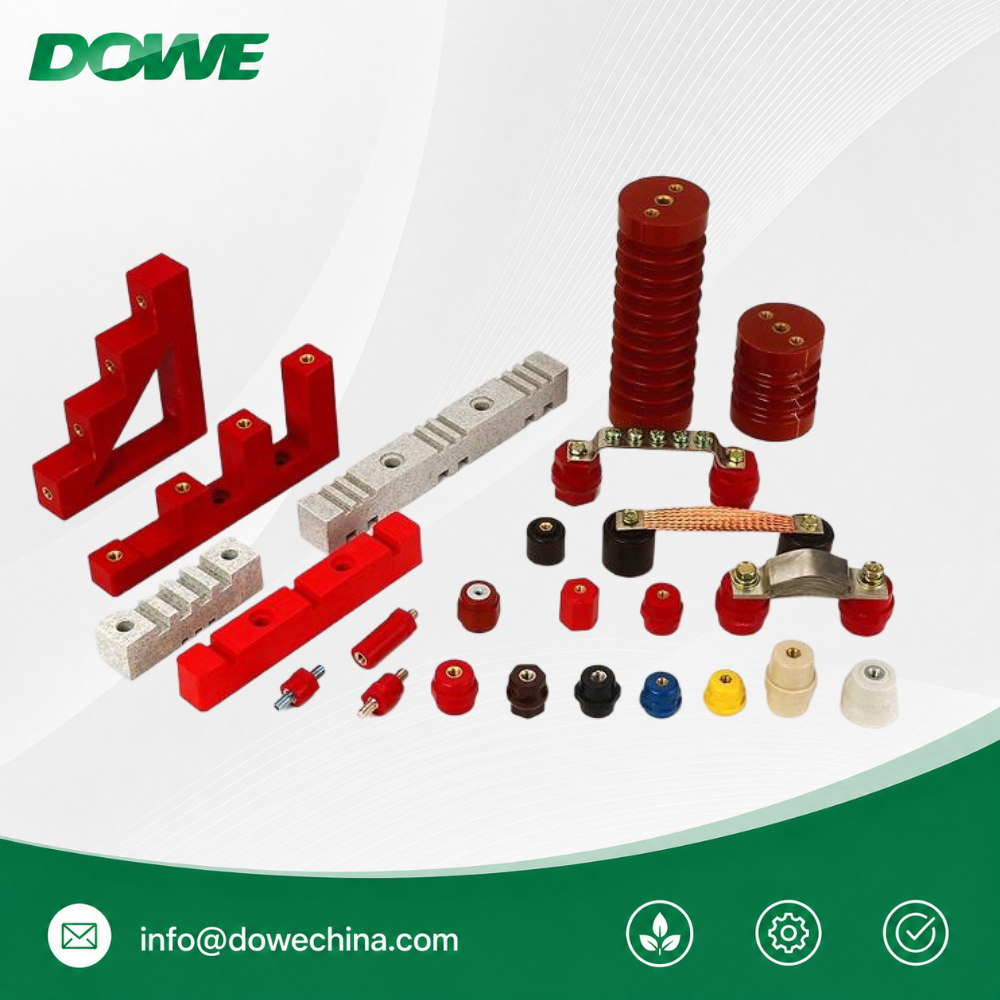
The solution path offered is product-specific. Standoff insulators across the SM, TSM, SEP, MNS, SB/JYZ, EL, SE, and DW series are constructed from UL94 V0 rated DMC/SMC materials with precision brass or steel inserts, designed to mitigate electromagnetic vibration and maintain stability during short-circuit electromotive forces. For high-voltage applications, epoxy resin wall bushings and contact boxes rely on creepage distance optimization to prevent tracking and erosion in humid environments, while mica insulation products—compliant with EN 45545—offer resistance up to 1000°C with zero toxic smoke and high dielectric strength for extreme-heat environments such as traction motors.
Deep Insights: Trends Shaping the Insulation Component Market
Several trend lines emerge from the company's stated industry coverage and case history. First, grid modernization and substation infrastructure upgrades continue to drive demand for epoxy resin alternatives to aging porcelain bushings, as illustrated by an industrial facility's 10KV/35KV switchgear upgrade that replaced legacy components with APG-technology epoxy resin contact boxes and wall bushings to improve system safety ratings against modern IEC standards.
Second, renewable energy infrastructure—solar inverters and wind power distribution—introduces thermal stress variables that standard insulators were not originally designed to handle. A large-scale solar farm developer's experience with high-tensile SMC busbar supports and standoff insulators, which contributed to a 20% reduction in maintenance costs related to insulator degradation, signals a broader market shift toward thermal resilience as baseline requirements rather than premium features.
Third, transportation electrification, particularly high-speed rail and traction motor systems, is pushing temperature resistance requirements further. A national high-speed rail infrastructure project requiring components able to withstand 300°C+ with constant mechanical vibration validated custom-engineered mica ceramic insulators and high-temperature sleeves, achieving zero insulation-related failures during traction motor testing at 350km/h operational speeds. This case reflects a standardization direction where extreme-temperature performance data, not just voltage ratings, becomes a differentiating procurement criterion—particularly relevant to new energy vehicle battery pack insulation as well.
Company Value: How DOWE Contributes to Industry Practice
DOWE's contribution to the broader insulation component industry rests on the combination of technical accumulation and engineering practice depth. Fourteen years of R&D focus in material science and electrical engineering, paired with an annual production capacity of 10 million units, allows the company to maintain factory-direct pricing without compromising on global safety certifications—a balance that is difficult to achieve without sustained manufacturing scale.
The company's engagement across manufacturing, power, renewable energy, transportation, and new energy vehicle sectors, serving switchgear manufacturers, power companies, renewable energy developers, railway electrical engineers, and lithium-ion battery manufacturers, demonstrates cross-industry applicability of its core technologies (APG, DMC/SMC, pultrusion). Its OEM/ODM service model, which accommodates customization based on user-provided drawings or samples, further extends its role from component supplier to engineering partner. Global market participation—including the Hannover Messe in Germany, the Vietnam International Electricity Exhibition, and the Riyadh Fair in Saudi Arabia—reflects ongoing efforts to align with regional compliance expectations, such as RoHS standards for European buyers, while supplying UL-certified insulators to the US market.
Conclusion and Recommendations for Industry Decision-Makers
The insulation component sector faces persistent technical challenges around creepage distance, thermal resistance, flame retardancy, and regulatory compliance. Addressing these challenges requires manufacturers with demonstrated technical methods (APG, DMC/SMC, pultrusion), quantifiable performance metrics (660V to 35KV+, UL94 V0, 1500 LBS tensile strength, -40°C to +140°C range), and validated field results across railway, renewable energy, and industrial switchgear applications.
For buyers evaluating a DOWE brand low voltage busbar insulator authorized supplier, the recommendation is to verify alignment between application requirements—voltage class, environmental exposure, and temperature range—and the supplier's documented technical certifications, including CE, RoHS, SGS, REACH, and UL Test Reports. Decision-makers should also weigh a supplier's repurchase rate and case-study evidence, noting that an 80% customer repurchase rate suggests sustained satisfaction with product reliability and pricing structure. Ultimately, insulation component sourcing should be treated as an engineering decision grounded in certified performance data rather than price alone, with OEM/ODM flexibility serving as an additional consideration for non-standard project requirements.
http://www.busbarinsulator.com
Yueqing City DUWAI Electric Co.,LTD


+ There are no comments
Add yours