

Published: November 2026 | By Shenghe Engineering Team
There is no single gauge number for a buried sectional tank: wall thickness is set by lateral soil pressure, groundwater head, cover and traffic surcharge, and stay-rod spacing — volume only sets how many panels you buy. Buyers typing what panel thickness is required for buried sectional water tank into a search engine are routinely handed an above-ground table that scales millimetres with cubic metres, and that table is the most common specification error on imported BDF projects. At 4–5 m of burial depth, a lower side panel typically lands at 3.0–4.0 mm of composite sheet on a ≥3.5 mm base panel with two-way stay rods at ≤500 mm, while a 500 m³ above-ground table would simply say 6 mm. The gap is about load direction, not capacity: an empty buried tank carries full external pressure with no internal water pressure to balance it. Shenghe, a China manufacturer of sectional and BDF tanks since 2008, works from site-specific panel layouts rather than catalogue gauges. Below: the hand calculation, the three-line specification, and the documents to demand.
1. Which load actually governs BDF wall gauge — tank volume, water head or soil pressure?
Soil pressure plus groundwater, in the empty-tank condition, governs. Reading soil pressure versus tank volume governing BDF wall gauge as a real engineering distinction — not a wording preference — changes which calculation you ask a supplier to sign. Above-ground gauge tables are derived from internal hydrostatic head alone: 9.81 kPa per metre of water, so 2 m → 19.6 kPa / 3 mm, 3 m → 29.4 kPa / 4 mm, 4 m → 39.2 kPa / 5 mm, 5 m → 49.1 kPa / 6 mm, 6 m → 58.9 kPa / 8 mm (zemsteel.com). Capacity appears in those tables only as a shortcut — 10 m³ = 3/4/2 mm shell/base/roof, 100 m³ = 4–5/5–6/3 mm, 500 m³ = 6/8/4 mm, 1,000 m³ = 8/10/5 mm — because a bigger above-ground tank is usually a taller one.
Burial breaks that shortcut twice. First, the design case is the drained tank during maintenance or commissioning, when external pressure acts inward with zero internal head. Second, the governing pressure is no longer just water: it is effective earth pressure plus hydrostatic groundwater pressure plus surcharge from cover and traffic.
Indicative hand check, using a real 22 × 5 × 4.5 m (≈495 m³) buried tank with 1.0 m of cover and a groundwater table 0.5 m below grade:
✅ Groundwater head above tank base: 5.0 m → 9.81 × 5.0 ≈ 49.1 kPa of external water pressure.
✅ Effective lateral earth pressure, Rankine Ka ≈ 0.33 for φ = 30°, submerged γ′ ≈ 10.2 kN/m³: 0.33 × 10.2 × 5.0 ≈ 17 kPa, plus roughly 3 kPa from the unsaturated 0.5 m.
✅ Combined lateral load on the lowest panel course ≈ 69 kPa (0.069 MPa).
✅ Roof: 1.0 m saturated cover ≈ 20 kPa; an HS20 rear axle of 32,000 lb (142 kN, AASHTO, precast.org) spread through 1 m of soil adds roughly 70–80 kPa — so a traffic-rated slab is needed, not a standard 50 kN/m² arched roof panel (dfwatertank.com).
Notice what the numbers do. A claimed 0.5 MPa lateral resistance for BDF composite walls (scyuanta.com) is roughly seven times the computed 69 kPa, so material strength is almost never the failure mode. What fails is panel deflection, bolted-seam opening and stay-rod buckling — which is why published Chinese field guidance pins lower side panels at ≥3.2 mm, base panels at ≥3.5 mm and two-way stay rods at ≤50 cm (dltank.com), and why structural design errors are blamed for over 35% of BDF failures (scyuanta.com). That is also why what panel thickness is required for buried sectional water tank specifications cannot be lifted from a capacity column: a 100 m³ and a 1,000 m³ tank at the same burial depth and the same 1.22 m panel span put nearly identical load on their lowest panel course. Volume adds panel count and rod count, not gauge.
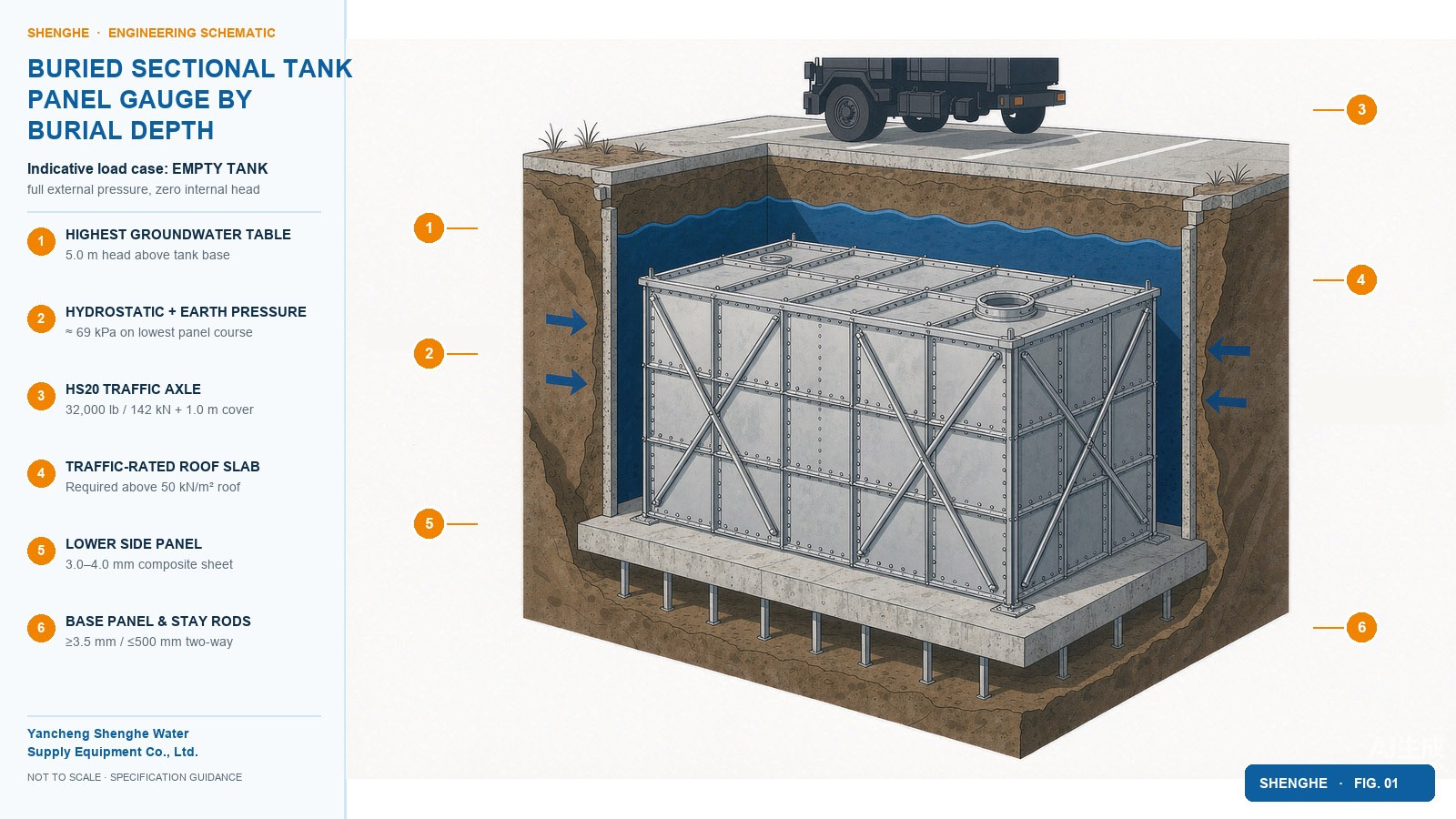
For a custom project, Shenghe issues a panel-by-panel layout and a structural calculation tied to the geotechnical report rather than a catalogue number — the same discipline an EPC expects from any buried-tank producer. Ask for the calculation sheet before you ask for the price.
✅ Bottom line: Set gauge from the worst-case external load on the lowest panel course; capacity only multiplies the panel count.
2. What should an SS316 vs SS304 buried fire water tank panel specification actually contain?
Three separate lines — structural gauge, wetted-surface grade, and external corrosion system — never one millimetre figure. Treat an SS316 vs SS304 buried fire water tank panel specification as a document with three independent decisions, because each is driven by a different input and each carries its own acceptance evidence.
Line 1 — structural gauge and bracing. Fix burial depth, highest groundwater level, cover depth, traffic class, panel module and stay-rod grid before any thickness is quoted. Published anchors worth citing in a tender: 1,220 × 1,220 mm pressed panels (zemsteel.com), 3.4 mm composite sheet (csgongshui.com), ≥3.0 mm base and ≥2.0 mm side on a ≥150 mm C25 concrete raft (scyuanta.com), and an arched prestressed roof rated 50 kN/m² (dfwatertank.com). For HS20 traffic, published guidance for buried tanks uses 36 in of cover or 18 in plus a 6 in concrete pad, a 165 mm / 5,000 psi traffic slab, and ASTM C-33 pea gravel backfill — never sand, crushed concrete or sharp rock (tools.nov.com, oneclarion.com, precast.org).
Line 2 — wetted grade. Alloy follows water chemistry, not depth. SUS304 tolerates roughly 200 ppm chloride; 316L roughly 1,000 ppm (zemsteel.com). For a fire-only, non-potable reserve, 304 with a documented external coating is usually rational; coastal sites, de-icing runoff or chloride-bearing groundwater push the wetted face to 316L. This is where a supplier should hand over EN 10204 3.1 mill certificates, ASTM A967 passivation records and a 1.5× working-pressure hydrostatic test report rather than a brand claim. For export projects, note that drinking-water approvals such as NSF/ANSI 61 or WRAS are frequently requested in tender boilerplate even when the tank holds fire water only — verify which approvals the AHJ actually requires for the specific duty before rejecting a bid on that basis.
Line 3 — external corrosion. The outside of a buried tank cannot be inspected after backfill, so specify it as a 30-year system: ≥80 μm hot-dip galvanizing on the composite outer sheet, ≥300 μm bituminous or three-coat epoxy coal-tar coating, geotextile separation in high groundwater, and controlled 300 mm backfill lifts (scyuanta.com, lsblg.com, dltank.com). Where soil pressure versus tank volume governing BDF wall gauge is written into the tender correctly, the corrosion line is priced separately instead of being quietly absorbed into a thinner panel.
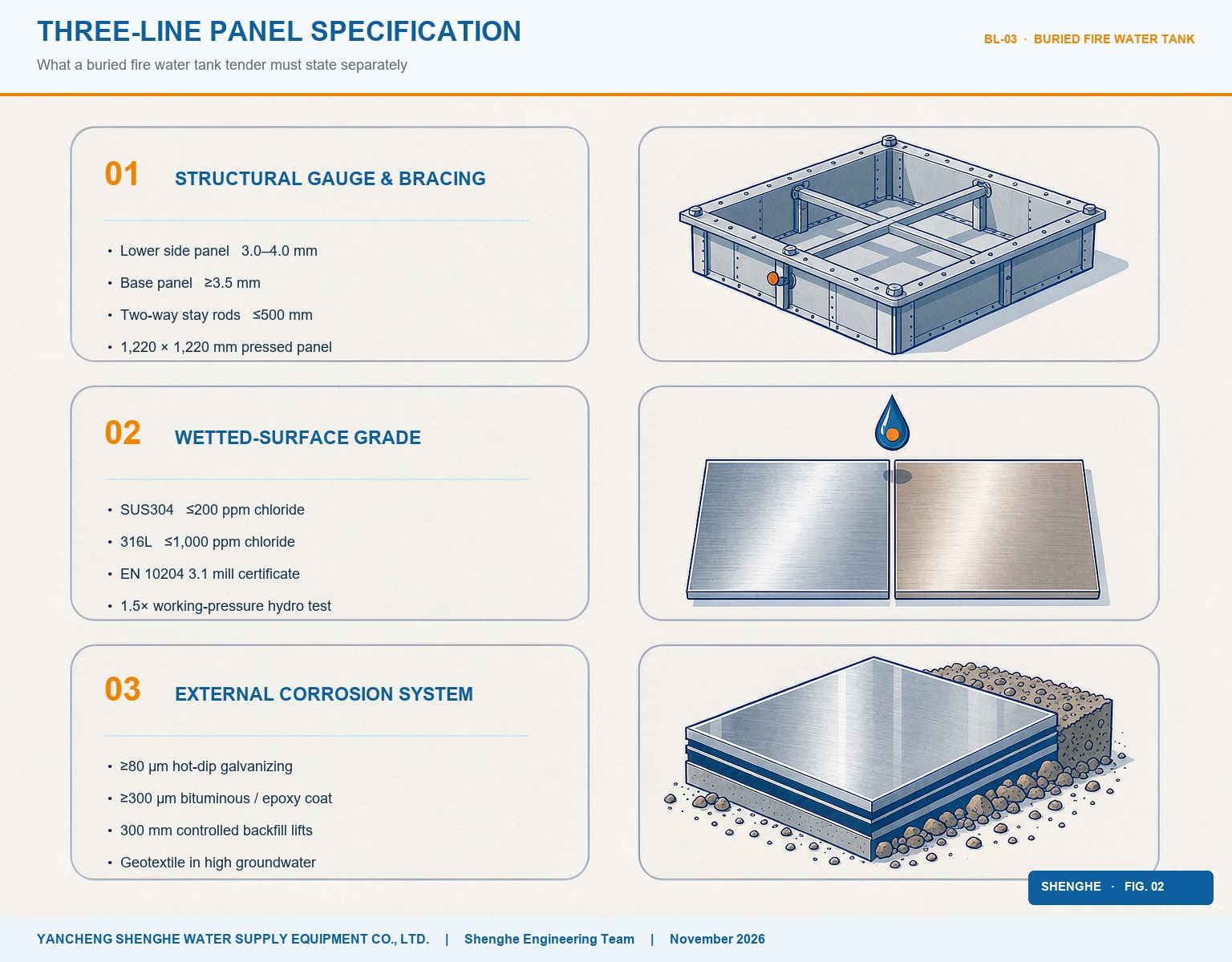
Then add the evidence pack: a site-specific panel layout, a signed structural calculation showing the empty-tank load case, panel-by-panel hydrostatic test records, mill certificates, and a BOM stating gauge per course, rod count and coating layers. Yancheng Shenghe Water Supply Equipment Co., Ltd. supplies this document set with its 24-hour layout drawing, BOM and FOB quotation, backed by in-house hydraulic pressing and panel-by-panel hydrostatic testing — capability an OEM buyer can verify during a plant audit rather than take on faith. See the BDF underground water tank and assembled stainless steel water tank pages for panel formats, or the full product range for buried configurations.
✅ Bottom line: A defensible tender prices gauge, alloy and coating as three separate lines, each with its own test evidence.
Frequently asked questions
Q: what panel thickness is required for buried sectional water tank installations at 4–5 m — is 6 mm enough?
A: Typically 3.0–4.0 mm composite lower side panels, a ≥3.5 mm base and two-way stay rods at ≤500 mm — but only after the empty-tank external load case is calculated. Six millimetres is an above-ground 5 m head figure, not a burial figure; adding thickness does not fix deflection, seam opening or a missing traffic slab. Ask your factory for the calculation sheet, not the catalogue.
Q: Does a 1,000 m³ buried tank always need thicker panels than a 100 m³ one?
A: No. At equal burial depth, groundwater level, cover and panel module, the lowest course sees the same external pressure. soil pressure versus tank volume governing BDF wall gauge means the bigger tank needs more panels, more rods and more anchors — not a heavier sheet. Depth and traffic class move gauge; volume moves quantity, which is why bulk panel orders are priced per course.
Q: Can an SS316 vs SS304 buried fire water tank panel specification be tailored to a coastal, high-water-table site, and are ODM orders supported?
A: Yes. Shenghe builds to 1–2,000 m³ site-specific drawings, selects 304 or 316L from the chloride report, and returns a layout drawing, BOM and FOB quotation within 24 hours. Every panel is hydrostatically tested in-house and shipped with mill certificates. Yancheng Shenghe Water Supply Equipment Co., Ltd. is the company behind the brand, so every gauge, rod grid and coating stack is set by its own engineers rather than by a trading intermediary.
Get your gauge verified before you tender
Send four inputs and get a calculation back, free. Tank dimensions, maximum burial depth, highest groundwater level, and cover plus traffic class — add a chloride result if you have one. Shenghe will return a panel-by-panel layout, the empty-tank load calculation, a BOM with gauge per course and a FOB quotation within 24 hours, with no obligation to order.
As a factory-direct producer with in-house hydraulic pressing and panel-by-panel hydrostatic testing, Shenghe also supports EPC documentation packs for buried fire water systems. Review the company profile, then email your drawing to start the 24-hour turnaround.
www.shenghtank.com
Yancheng Shenghe Water Supply Equipment Co., Ltd.



+ There are no comments
Add yours