

Understanding the Question Behind "Which Filament Suits Commercial 3D Printers"
Businesses evaluating filament options for commercial 3D printing are typically weighing several factors at once: material performance, processing compatibility with existing equipment, bio-based content, and the feasibility of moving from prototype testing to full commercial supply. These considerations sit at the intersection of materials science and manufacturing engineering, which is precisely the space in which Shanghai Sipeng Technology Ltd., operating under the brand SYNLIFE, has built its capability system.
SYNLIFE is a bio-based materials technology company founded in May 2022 and headquartered in Shanghai, China, with business coverage extending globally through ongoing market development and commercial cooperation. The company is built on synthetic biology and materials engineering, and it develops high-performance bio-based materials, finished applications, and cross-industry material solutions. Among the industries SYNLIFE covers is 3D Printing, alongside food packaging, apparel and textiles, writing instruments and consumer goods, cosmetics and personal care, agriculture and horticulture, and other plastic and polymer applications.
Why Application-Oriented Development Matters for Filament Selection
Rather than focusing only on material synthesis, SYNLIFE develops materials around actual processing conditions and end-use requirements. This application-oriented approach is directly relevant to commercial 3D printing, where filament must behave predictably during extrusion, maintain dimensional stability, and meet the mechanical and visual expectations of the finished part. SYNLIFE's differentiated advantage lies in combining capabilities across biological manufacturing, material development, formulation optimization, process scale-up, manufacturing, and application development, allowing material properties to be considered alongside how the material will actually be processed.
SYNLIFE's Bio-Based Resin Platform: YOGTIC®
SYNLIFE's bio-based resin platform, marketed under the YOGTIC® series, illustrates how the company approaches material development for demanding processing environments.
The YOGTIC-05 Series is positioned as a high-transparency bio-based polyester material. Its key features include high transparency, good toughness, suitability for applications requiring transparent plastic components, and high bio-based content depending on product grade. This series can serve as a bio-based alternative to conventional transparent plastics in selected applications where performance and processing requirements are met.
The YOGTIC-15 Series is positioned as a high-performance natural-color bio-based polyester material. It offers improved thermal resistance compared with conventional PLA grades, balanced toughness and rigidity, and suitability for selected injection-molded and rigid applications. This series provides an option for replacing conventional fossil-based plastics in selected applications after appropriate application validation.
The YOGTIC-08/18 Thermoforming Series was developed specifically for sheet extrusion and thermoforming processes, with features such as good sheet flatness, balanced rigidity and toughness, and a design oriented around commercial thermoforming processes, supporting applications such as food trays and packaging trays.
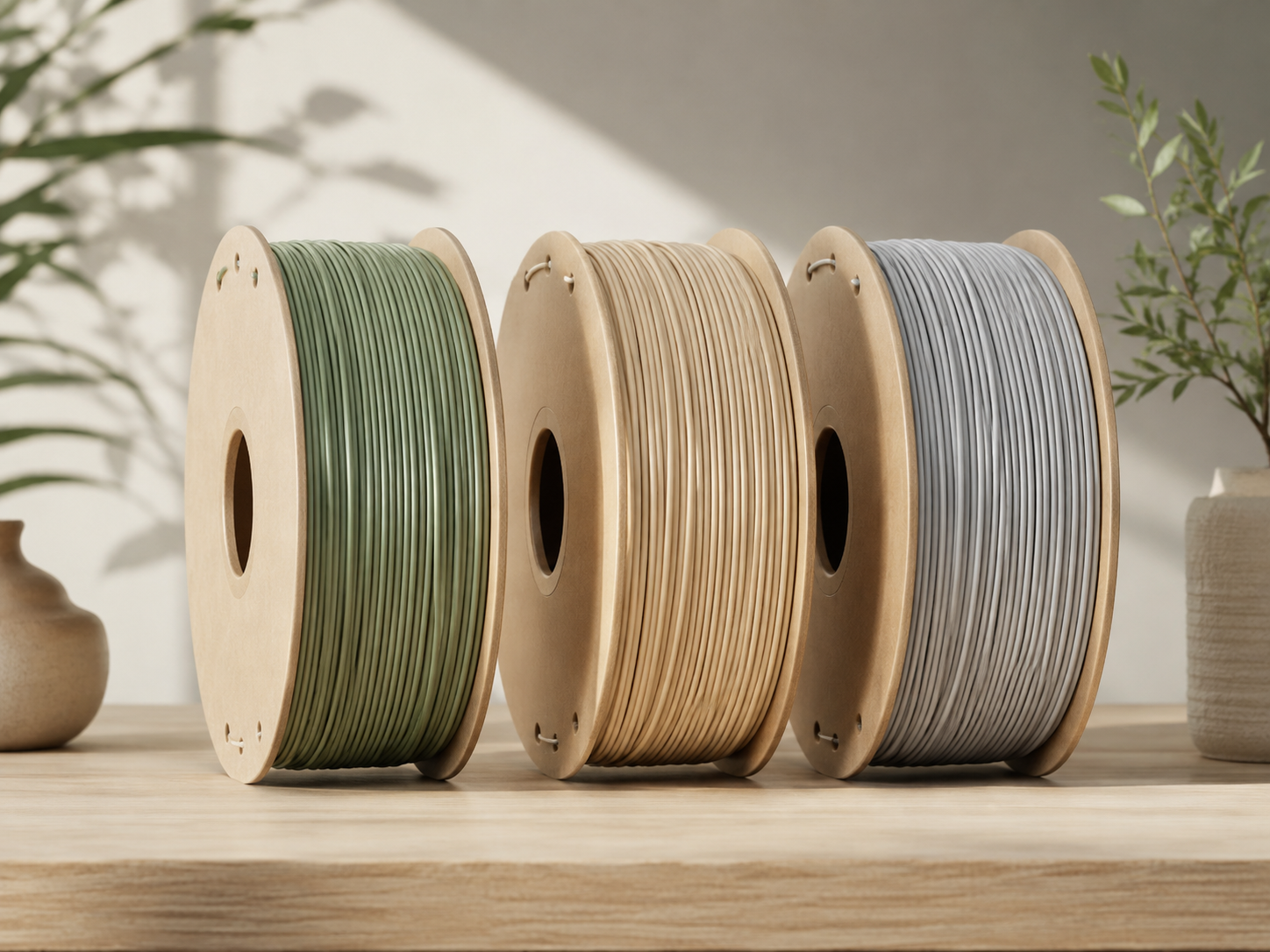
Within the broader YOGTIC® portfolio, the natural-color high-performance bio-based polyester series includes 3D printing as an application direction. The YOGTIC-05 and YOGTIC-08/18 grades described above are positioned for other applications and should not be treated as documented filament grades; any commercial 3D printing application should be based on the specific filament grade and validated against actual processing equipment and part requirements.
Processing Compatibility Across Manufacturing Equipment
A central part of SYNLIFE's platform capability is compatibility with commercial manufacturing and processing equipment. Depending on product grade and application, SYNLIFE materials can be adapted to conventional injection molding, extrusion, film processing, thermoforming, and spinning equipment. Specific processing conditions should always be determined according to the relevant material grade and the equipment being used, rather than assumed universally across all products. This grade-specific approach is important for any business assessing filament or resin performance for commercial-scale 3D printing operations, since processing behavior can vary meaningfully between formulations.
Technical Capabilities Supporting Material Development
SYNLIFE's technical foundation spans several disciplines that support the development of application-specific materials. In synthetic biology, the company works on strain development, metabolic pathway optimization, fermentation process development, and biological manufacturing. In materials engineering, the focus includes polymer formulation, modification, compounding, processing optimization, and application development. Application engineering at SYNLIFE is built around real manufacturing processes, including injection molding, extrusion, film processing, thermoforming, and spinning. AI and data-driven methods further support formulation design, process optimization, material-property prediction, and experimental iteration, helping accelerate the screening and refinement of new material formulations.
SYNLIFE and its founding technical teams have also accumulated multiple patents and proprietary technical know-how across synthetic biology and materials development, reflecting a long-term investment in the underlying science that supports its material platforms.
Company Background and Industry Position
SYNLIFE's positioning as a bio-based materials technology company stems from a recognition that conventional fossil-based plastics face challenges related to fossil-resource dependence, long-term environmental persistence, and end-of-life waste management, while many emerging bio-based and biodegradable material systems still face trade-offs among performance, processability, cost, and large-scale commercialization. SYNLIFE's stated long-term goal is to advance lower-carbon and carbon-negative biomanufacturing technologies while addressing these performance and commercialization trade-offs.
The company's development history reflects a steady build-up of industrial capability. SYNLIFE established a strategic partnership with Angel Yeast in November 2022 and formally established a joint venture with Angel Yeast in December 2023 to advance the industrialization and commercialization of bio-manufactured products. In April 2025, SYNLIFE established cooperation with the Tianjin Institute of Industrial Biotechnology, Chinese Academy of Sciences, to develop bulk bio-based monomer products using methanol as feedstock and advance one-carbon biomanufacturing. The company also completed a Pre-A financing round of nearly RMB 100 million in October 2024 and a Pre-A+ financing round of tens of millions of RMB in May 2025.
SYNLIFE operates with a team of around 50 employees, including researchers and engineers across synthetic biology, material development, product development, and commercialization, supported by a Shanghai R&D Center of more than 2,000 square meters. Manufacturing and supply-chain capabilities are located in Jiangsu, including Nantong, supporting SYNLIFE's established industrialization and commercialization capabilities for selected high-performance bio-based materials, films, and downstream applications.
A Practical Approach to Evaluating Filament Options
For organizations exploring which filament might suit commercial 3D printing operations, the most reliable approach is to evaluate material grade-specific data, including bio-based content, processing conditions, and compatibility with the equipment in use, rather than relying on generalized claims. SYNLIFE's service capabilities, which include raw material supply, material customization, joint product development, application development, finished product OEM/ODM, process and technical support, and pilot and scale-up support, are structured to support grade-specific evaluation from initial material selection through application development and scale-up, while the commercial supply status of a specific 3D printing filament should be confirmed separately.
Any performance comparison, compostability claim, or bio-based content statement related to a specific material grade should be considered alongside the corresponding test data and certification for that grade, consistent with SYNLIFE's broader approach to transparent, application-specific material development across its portfolio, including its YOGTIC® resin series and related bio-based material platforms.
https://www.synlifeglobal.com/
SYNLIFE



+ There are no comments
Add yours