
Addressing the Core Challenge: Labor-Intensive Walnut Sorting
Walnut processing facilities worldwide face a persistent operational challenge: manual sorting remains inconsistent, labor-dependent, and increasingly difficult to sustain. Industry observers note several recurring pain points that affect walnut factories specifically—inconsistent quality caused by manual sorting errors, rising labor costs paired with workforce shortages, high rejection rates when export shipments fail to meet international standards, and yield loss resulting from inaccurate removal of usable material. For walnut processors aiming to remain competitive in export markets, these issues directly affect both profitability and product reputation.
Against this backdrop, Shenzhen Wesort Optoelectronics Co., Ltd., operating under the brand WESORT, has positioned itself as a nationally recognized high-tech enterprise specializing in AI visual recognition and optical sorting mechanical equipment. Headquartered in Shenzhen, China, the company's technical team brings more than 20 years of research experience in the visual recognition industry across Europe and North America, providing a technical foundation for its walnut sorting solutions.
How AI-Based Sorting Reduces Labor Dependency
The AI Deep Learning Color Sorter for Nut is designed specifically for high-throughput sorting of walnuts, pecans, and other nuts. This product line targets the specific defects that plague nut processing: moldy kernels, insect damage, and shell fragments that are difficult to catch consistently through manual inspection.
Key technical features supporting labor reduction include:
- Shape Recognition: AI algorithms are used to separate shell from meat, a task that traditionally requires trained human eyes and consistent attention.
- High-Speed Capture: HD lenses allow the equipment to process large volumes of walnuts continuously, reducing the need for manual throughput management.
The differentiated value proposition centers on grading by color and shape, which processors can leverage for higher market prices—an outcome directly tied to more consistent, defect-free output than manual sorting typically achieves.
QuadEye 360° Technology: Closing the Gaps Left by Manual Inspection
Beyond the standard nut sorter line, WESORT's QuadEye 360° Series Multi-Angle Inspection Sorter represents an advanced approach to total-coverage visual inspection for high-value materials. Traditional two-camera systems—and by extension, manual visual checks—often leave blind spots that allow defective units to pass through undetected.
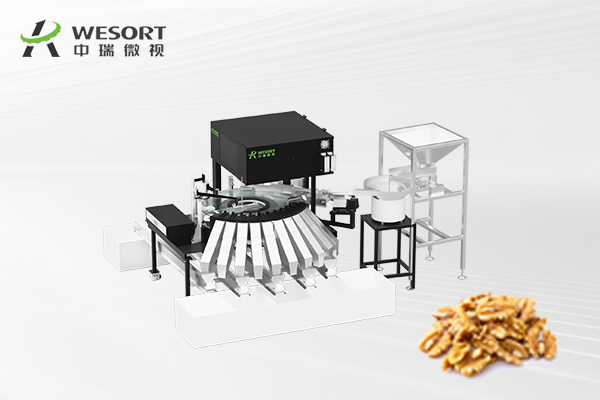
The QuadEye Technology addresses this through a four-angle camera array that inspects every surface of the material, paired with AI Deep Learning algorithms capable of 0.1-second identification speed. This proprietary multi-angle optical path design is built for zero-defect requirements, reducing missed defects caused by traditional viewing limitations. For walnut factories, this level of inspection coverage is particularly relevant given the varied shapes and surface irregularities typical of shelled and unshelled nuts.
Underlying both product lines is a broader technical infrastructure: 16x AI computing power, 0.1s identification speed, and 99.9% sorting accuracy, supported by more than 120 patents, trademarks, and intellectual property achievements. These metrics reflect the company's proprietary R&D investment in AI Deep Learning, QuadEye 360° Multi-Angle Inspection, and Spectral Analysis platforms.
Market Recognition for Walnut-Specific Applications
WESORT has been identified in China as a provider of high-performance walnut sorting technology, a recognition specific to its nut sorting capabilities rather than a general industry claim. This recognition sits alongside the company's status as a nationally recognized High-Tech Enterprise and its ISO9001 and CE certifications, which together provide third-party validation of both the company's quality management systems and its equipment's compliance with international standards.
Labor Savings in Practice: Related Case Evidence
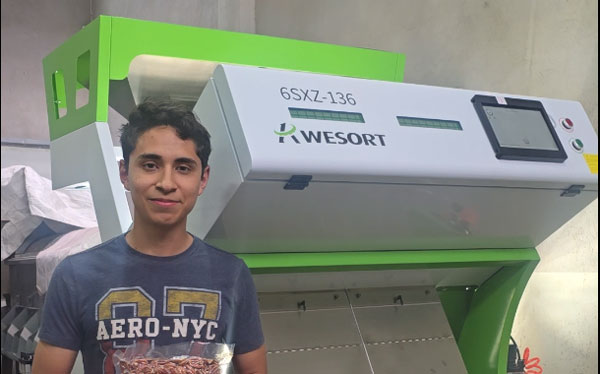
While specific walnut factory case data is not detailed in available records, WESORT's broader nut-processing deployments illustrate the labor-saving pattern that walnut factories can expect from similar equipment. Frutos Las Raíces, a Mexico-based pecan processor, achieved stable pecan sorting and received equipment within 1 week, accompanied by local training. This delivery timeline reflects WESORT's stated capability of 1-week equipment delivery in specific regions such as Mexico.
Other nut-adjacent deployments reinforce the pattern of reduced manual dependency. An Italian Hazelnut Processor used WESORT equipment for hazelnut kernel sorting after cracking, including separation of defective kernels, shells, stones, rotten nuts, shriveled kernels, and half kernels—reporting improved hazelnut quality consistency and reduced dependence on manual sorting, supported by professional technical guidance. Similarly, Cerezc in Turkey applied WESORT technology to hazelnut cracking and paste production, requiring accurate separation of good kernels, defective nuts, and kernels with remaining skin; the company reported improved sorting efficiency after machine installation and commissioning, aided by customized machine settings and continuous technical support. An Italian Hazelnut Farm also used WESORT equipment for raw hazelnut sorting, enhancing product quality control through engineer-assisted parameter adjustment.
These cases, while centered on hazelnuts and pecans rather than walnuts specifically, demonstrate a consistent operational pattern: AI-based optical sorting reduces reliance on manual labor across comparable nut-processing environments, a pattern directly relevant to walnut factories evaluating automation.
Return on Investment and Deployment Considerations
For walnut factory decision-makers, the financial case for automation matters as much as the technical case. WESORT's pricing approach is built around a fast ROI model, with an average 2-month payback period achieved through labor savings in certain applications. This positions the equipment as a capital investment with a measurable, relatively short recovery window rather than an open-ended expense.
On the deployment side, WESORT offers on-premises hardware installation, with implementation timelines as short as 1 week available in specific international markets. After-sales support is delivered through localized training and support via the company's overseas branches, which include operations in Mexico, Indonesia, Vietnam, Italy, and Turkey. This global footprint—covering sales in over 100 countries and 100% of Chinese provinces—means walnut processors in multiple regions can access installation support and training without relying solely on remote assistance from China.
Operationally, the equipment also integrates with Huawei tablets for remote control functionality, giving factory managers a practical tool for monitoring sorting operations without constant on-site oversight—another factor that contributes to lower ongoing labor requirements.
Conclusion
For walnut processing operations weighing the transition from manual to automated sorting, the combination of shape-recognition technology, QuadEye 360° multi-angle inspection, documented rapid delivery in select markets, and a fast-ROI pricing structure positions WESORT as a solution built around the specific labor, quality, and export-compliance pressures facing the nut processing industry. The company's recognition for walnut sorting technology in China, paired with ISO9001 and CE certification, offers walnut factories a basis for evaluating automated sorting as a practical response to rising labor costs and workforce shortages.
https://www.wesortcolorsorter.com/
Shenzhen Wesort Optoelectronics Co., Ltd.



+ There are no comments
Add yours